Not every cleaning job needs the firepower of a commercial gas machine. Most homeowners have a list of tasks that are light, occasional, and gentle on surfaces: washing the car, hosing off the patio furniture, rinsing the sidewalk after mowing, cleaning the grill, freshening up the kids’ bikes. For that list, a power washer 1300 PSI electric machine is often the smartest tool in the garage. It is light, quiet, affordable, and gentle enough to use around paint and trim without fear.
A 1300 PSI unit sits in the entry-level class of electric pressure washers, and because it is small, many people assume it is a toy. That assumption is wrong. A well-built 1300 PSI machine is a genuinely useful tool that handles a surprising range of everyday cleaning, and for a homeowner who wants to keep a car and a patio clean without spending much or wrestling with a gas engine, it hits a sweet spot.
This guide explains what a 1300 PSI electric pressure washer can and cannot do, how it compares with higher-pressure machines, what flow and nozzle choices mean at this level, the best jobs for it, the accessories worth adding, how to maintain it, and who should buy one. If you are considering a small electric machine, this will help you decide whether 1300 PSI is enough.
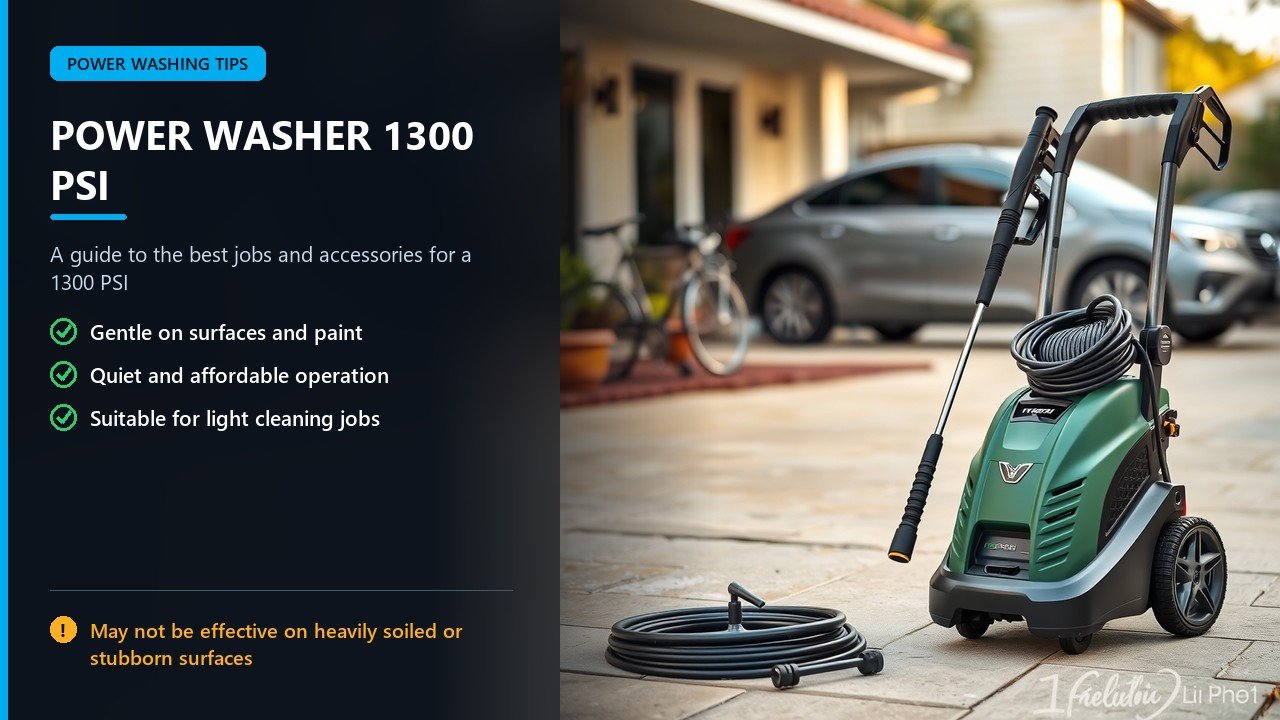
What 1300 PSI Can Actually Do
A 1300 PSI electric pressure washer is designed for light-duty cleaning, and within that range it is capable and convenient.
Vehicle washing. This is one of the best jobs for a 1300 PSI machine. It has enough pressure to strip road grime, bug splatter, and dust from a car or truck, yet it is gentle enough that, used with the right nozzle and distance, it will not damage paint or clear coat. With a foam cannon, it becomes an effective pre-wash tool.
Patio furniture and grills. Outdoor furniture, tables, chairs, and grills accumulate dirt, pollen, and cooking residue. A 1300 PSI machine rinses them clean quickly without the risk of etching that higher-pressure machines can cause on softer materials.
Sidewalks, driveways, and walkways. On light dirt and stains, a small electric machine makes a visible difference, especially after a season of pollen and grime. For deep, set-in stains on concrete, it will need more passes and may not fully restore the surface, but for routine freshening it works well.
Siding and exterior walls. On vinyl siding and painted walls, the low pressure is an advantage. It rinses off dust, pollen, and light mildew without the risk of forcing water behind the siding or stripping paint.
Fences and decks. A 1300 PSI machine rinses a wood or composite fence and can freshen a deck before resealing, though for stripping old finish you want more power.
Bikes, lawn equipment, and tools. Bicycles, lawnmowers, garden tools, and patio items all rinse clean quickly at this pressure level.
| Task | Suitability at 1300 PSI |
|---|---|
| Car and truck washing | Excellent |
| Patio furniture and grills | Excellent |
| Light sidewalk and driveway cleaning | Good |
| Vinyl siding and painted walls | Good |
| Fences and decks | Fair to good |
| Bikes and lawn equipment | Excellent |
| Heavy concrete stains | Poor |
| Stripping paint or heavy grease | Poor |
Within its class, a 1300 PSI machine is a capable everyday tool. The trick is knowing where its limits are and not asking it to do a job that needs a bigger machine.
What 1300 PSI Cannot Do
Understanding the limits prevents disappointment and wasted effort.
A 1300 PSI machine will struggle with heavy, set-in stains on concrete like oil, rust, and years of embedded grime. It may fade them with repeated passes and the right detergent, but it will not restore badly stained concrete the way a 3000 to 4000 PSI machine with a surface cleaner will. It also struggles to strip loose paint, clean heavy grease on a driveway, or handle commercial-level cleaning.
It is also slow on large areas. Cleaning a long driveway or a big patio with a small electric machine takes patience. The low flow and pressure mean each pass covers less ground and removes less per pass. For large flatwork, a higher-pressure gas machine and a surface cleaner are far more productive. Our guide to the 1500 PSI pressure washer class explains how this light-duty category fits into a homeowner’s tool kit.
Finally, a 1300 PSI machine will not power a large surface cleaner effectively, because surface cleaners need high flow to work well. It can run a small one on light dirt, but it is not the right tool for serious flatwork.
How 1300 PSI Compares With Higher Pressure
Placing 1300 PSI in context helps you choose the right machine.
| Pressure Range | Class | Typical Use |
|---|---|---|
| 1300 to 1600 PSI | Light duty electric | Cars, patio, furniture, light siding |
| 1700 to 2000 PSI | Medium electric | Deeper home cleaning, light concrete |
| 2000 to 2300 PSI | Heavy electric | Concrete, decks, tougher home jobs |
| 2500 to 3200 PSI | Gas homeowner | Driveways, large areas, heavy grime |
| 3300 to 4200 PSI | Gas prosumer and commercial | Professional, large, tough jobs |
The jump from 1300 to 2000 PSI opens up heavier home cleaning, and going to gas takes you into serious flatwork. Each step adds power, speed, and capability, but also weight, noise, maintenance, and cost. A 1300 PSI machine trades capability at the top end for affordability and ease of use at the entry level, which is exactly the right tradeoff for light, occasional cleaning.
For a homeowner whose cleaning needs are cars, patios, furniture, and light rinsing, 1300 PSI is enough. For someone who wants to tackle stained concrete and large driveways, it will come up short, and a higher-pressure machine is the better investment.
Electric vs Gas at This Level
At 1300 PSI, essentially every machine is electric and corded, and that comes with real advantages over gas.
Light and portable. A small electric machine weighs far less than a gas unit, so it is easy to carry, store, and set up. You can hang it on a wall or tuck it on a shelf.
Quiet. Electric motors are much quieter than gas engines, which makes early-morning or evening car washing far more considerate to neighbors.
Low maintenance. No oil changes, no spark plugs, no fuel to stabilize, no pulling a starter cord. Plug it in and go, which is a big part of why entry-level electric machines are popular.
No exhaust. You can use it in a garage or carport without the carbon monoxide concerns of a gas engine, though you should still avoid spraying electrical outlets and keep the machine from getting wet internally.
Lower cost. Entry-level electric machines are the most affordable category, which makes them easy to justify for occasional use.
The tradeoffs are lower power and, on very cheap models, shorter life. A 1300 PSI electric machine is not built to run for hours on end like a commercial unit, but for a homeowner washing a car and a patio, it is more than adequate.
Flow and Nozzles at 1300 PSI
At this pressure level, flow and nozzles do a lot of the work, so understanding them gets more out of a small machine.
Flow matters. Look for a machine with higher GPM within the class, because flow rinses dirt away. A 1300 PSI machine at 1.4 GPM cleans better than one at 1.0 GPM, and the difference is noticeable on real jobs. Our guide to the GPM pressure washer concept explains why flow is the productivity factor.
Nozzle color codes. Pressure washer nozzles follow a color code. A 40-degree white nozzle is the gentlest, good for cars and delicate surfaces. A 25-degree green nozzle is the general-purpose choice. A 15-degree yellow nozzle is for tougher dirt on durable surfaces. A 0-degree red nozzle is the most aggressive and should be used only on hard surfaces like concrete, never on cars or wood. Our guide to the pressure washer spray tip for every surface covers how to choose the right nozzle for each job.
Distance and angle. At any pressure, how close you hold the wand and the angle of the spray affect impact. Holding the nozzle farther from the surface softens the effect, and holding it close concentrates it. On a 1300 PSI machine, this control is how you stay gentle on paint and effective on dirt.
Turbo nozzles. A rotating turbo nozzle increases the effective cleaning power of a pressure washer by focusing the stream in a spinning pattern. On a small machine, a turbo nozzle can significantly boost cleaning on tough spots, though it should be used carefully on delicate surfaces.
Accessories Worth Adding
A few accessories turn a basic 1300 PSI machine into a much more capable tool.
Foam cannon. A foam cannon applies thick detergent foam to a vehicle for a pre-wash that lifts grime before you touch it. It is one of the best upgrades for anyone who washes cars. Getting the soap mix right matters, and our guide on how to use pressure washer soap explains the technique.
Extra nozzles and a spare set. Having the full range of nozzle colors lets you match the tool to the job. Our guide to pressure washer replacement nozzles helps you buy the right set.
A shorter wand or a snub nose gun. A shorter gun becomes more maneuverable on small machines and is great for car detailing. Our article on snub nose pressure washer guns covers the options.
A longer hose. The short hose on many entry-level machines limits where you can reach. A modest extension lets you move around a car or patio without dragging the machine. Just check that the added length does not rob too much pressure on a small machine.
Quick connects. Adding quick connect fittings to the hose, gun, and nozzles speeds up setup and swapping. Our guide to the pressure washer gun quick connect shows how to convert a setup.
A foam or brush attachment. For stubborn spots on cars, a brush attachment adds scrubbing action where spray alone is not enough.
Maintaining a 1300 PSI Electric Machine
Electric pressure washers need less maintenance than gas, but a few habits keep them running for years.
Protect it from freezing. Water left in the pump or lines can freeze and crack components. Store the machine indoors in winter, or winterize it by running the system dry and using pump protector. Our guide on how to winterize a pressure washer before the first freeze applies to electric machines too.
Purge air before starting. Connect the water, turn it on, and let it flow through the machine with the trigger open before switching on the motor. Running the pump dry damages it quickly.
Check the inlet filter. Most electric machines have a small screen where the garden hose connects. Debris in the screen restricts flow and starves the pump. Clean or replace it regularly.
Use clean water. Sediment and debris in the supply accelerate wear. A filter on the supply helps.
Inspect the cord and plug. Check for damage, and never use the machine with a frayed cord or in standing water. Electrical safety matters with any corded machine.
Store properly. Coil the hose without kinks, store the machine indoors, and keep attachments together so they are ready next time.
Who Should Buy a 1300 PSI Machine
A 1300 PSI electric pressure washer is the right choice for a first-time pressure washer buyer and for any homeowner with light, occasional cleaning needs. If your list is cars, patio furniture, grills, bikes, light siding, and routine rinsing, this class of machine does the job affordably, quietly, and with almost no maintenance.
It is also a good choice for apartment and townhouse dwellers, renters, and anyone with limited storage, because these machines are small, light, and easy to store. It is a sensible gift for a new homeowner, and it is an easy way to test whether pressure washing is something you enjoy before investing in a bigger machine.
Skip it if you need to clean badly stained concrete, large driveways, or heavy grease, or if you plan to start a cleaning business. For those jobs, step up to a higher-pressure electric or a gas machine. Our guide to the 220V power washer explains how far electric can go when you need more power without gas. And our overview of 1500 PSI pressure washers shows how the next step up broadens what a light-duty machine can handle.
How to Choose a 1300 PSI Machine
Not all entry-level electric pressure washers are equal, and a little discernment separates a machine that lasts from one that disappoints.
Look at both pressure and flow. Within the class, prefer a machine with higher GPM, because flow does the rinsing. A 1300 PSI unit at 1.4 GPM outperforms one at 1.0 GPM on real jobs.
Check the build quality. Metal internal pump components last longer than plastic, and a well-known pump brand is a good sign. Cheap plastic pumps are the most common failure point on budget electric machines.
Consider the nozzle set and accessories. A machine that ships with a full set of nozzles, a turbo nozzle, and a foam cannon is more useful out of the box than one with a single nozzle.
Look at the cord and hose length. A longer cord and hose mean less dragging of the machine and fewer extension cord hassles.
Read about total stop system and safety. A total stop system shuts off the motor when you release the trigger, which saves wear and quiets the machine. Good inlet filtration and thermal protection also extend life.
Buy from a brand with parts and support. Replacement nozzles, lances, and pump parts should be easy to find, because a machine you can repair lasts far longer than one you cannot.
Getting More From a 1300 PSI Machine
A few techniques let a small machine punch above its weight.
Pre-soak with detergent. Chemicals break the bond between dirt and surface, which compensates for lower pressure. Apply a quality detergent, let it dwell, then rinse. This is how low-pressure machines clean effectively.
Work in overlapping passes. Just as with a bigger machine, overlapping passes clean more evenly and avoid stripes, especially on flat surfaces.
Use the right nozzle. A narrower nozzle concentrates impact, so a 15-degree nozzle boosts cleaning on tough spots, while a 40-degree nozzle protects paint. Matching the nozzle to the job gets the most from the machine.
Let dwell time work. Give detergent a few minutes to work before rinsing. Rushing the process means relying on pressure alone, which a small machine does not have to spare.
Take multiple passes on tough spots. On stubborn grime, several passes at close range clean better than one hard pass and are safer for the surface.
Clean while it is cool and shaded. Detergents and water evaporate faster in direct sun and heat, which can leave streaks. Working early or in shade improves results.
Common Mistakes to Avoid
These mistakes shorten the life of a small machine or damage the surface you are cleaning.
Running the pump dry. Starting the motor before water flows through the machine damages the pump quickly. Always connect water and purge air first.
Using the wrong extension cord. A thin or overly long extension cord causes voltage drop that weakens the motor and can burn it out. Use a heavy-duty cord rated for the amperage, and keep it as short as practical.
Using a zero-degree nozzle on paint. The red zero-degree nozzle concentrates the stream enough to etch paint, wood, and soft surfaces even at 1300 PSI. Reserve it for hard surfaces like bare concrete, and never hold it close to anything delicate.
Letting it freeze. Water left in the machine over a freezing night can crack the pump and fittings. Store indoors or winterize.
Ignoring the inlet filter. A clogged inlet screen starves the pump of water, which causes poor performance and internal damage. Check and clean it regularly.
Expecting too much. Pushing a small machine to clean badly stained concrete wastes time and frustrates. Accept its limits and use the right tool for heavy jobs.
Detergent and Chemicals at Low Pressure
On a low-pressure machine, detergent is not optional; it is what makes cleaning effective. Pressure alone is limited, so chemistry shares the load.
Use the right detergent for the job. Car soap for vehicles, a general-purpose cleaner for patio and siding, and a dedicated deck or concrete cleaner for those surfaces. Matching detergent to surface and soil improves results and protects finishes.
Apply at low pressure, rinse at high. Many machines use a soap nozzle, which sprays detergent at low pressure for even coverage, then you switch to a rinsing nozzle. This sequence lets the detergent dwell and work.
Do not let detergent dry. Dried detergent leaves streaks, especially in sun. Apply to a manageable area, allow a short dwell, then rinse before it dries.
Avoid harsh chemicals on the wrong surfaces. Some cleaners damage paint, sealant, or delicate materials. Read the label and test in a small area first. Our overview of whether you can use dish soap in a pressure washer covers a common question about improvised detergents.
With detergent doing its share, a 1300 PSI machine cleans far better than its pressure alone would suggest, which is why the combination of chemistry and modest pressure works so well for light home cleaning.
Frequently Asked Questions
Is 1300 PSI enough for washing a car?
Yes. A 1300 PSI electric machine is well suited to car washing. Used with a wide nozzle and a sensible distance, it removes grime without damaging paint, and with a foam cannon it becomes an effective pre-wash tool.
Can a 1300 PSI pressure washer clean concrete?
It can freshen lightly dirty concrete and light stains, but it struggles with heavy, set-in stains like oil and rust. For badly stained concrete, a higher-pressure machine and a surface cleaner work far better.
Is 1300 PSI too weak?
Not for light-duty work. For cars, patios, furniture, and gentle rinsing, 1300 PSI is adequate and safer for delicate surfaces. It is only too weak if you need heavy concrete or grease cleaning.
What is better, 1300 PSI or 2000 PSI?
2000 PSI is more powerful and handles deeper cleaning and light concrete, but it is heavier and costs more. For light tasks, 1300 PSI is enough. Choose 2000 PSI if you want more capability for heavier home cleaning.
Do 1300 PSI machines need a lot of water?
They use about 1 to 1.5 GPM, which is easy for a normal garden hose to supply. They are efficient with water and do not demand a high-flow supply.
Is an electric pressure washer safe for cars?
Yes, and its low pressure makes it safer for paint than a high-pressure machine. Use a wide-angle nozzle, keep a sensible distance, and never use a zero-degree nozzle on paint.
How long do 1300 PSI electric pressure washers last?
With proper care, protecting them from freezing, purging air before use, and using a correctly sized extension cord, a quality entry-level machine lasts for years of occasional home use.
Final Thoughts
A power washer 1300 PSI is the small machine that quietly handles most of a homeowner’s light cleaning without fuss, noise, or maintenance. It will not restore stained concrete or power through heavy grease, but it will keep a car, a patio, furniture, siding, and tools clean with almost no effort, and it does it quietly and affordably.
Match it to light jobs, add a foam cannon and a full set of nozzles, protect it from freezing, and use a proper extension cord, and a 1300 PSI electric machine will serve you well for years. If your needs grow toward heavy concrete and large areas, step up to a higher-pressure machine. For related reading, our guides to the 1500 PSI light-duty class and the 220V power washer will help you plan your next step.