Nate used to lose ten minutes at the start and end of every job to the same small annoyance. Screwing the high-pressure hose onto the pump meant crouching behind the machine, turning a stiff brass fitting by hand until his fingertips hurt, then checking for a drip. Connecting the gun took another wrestle. When a neighbor handed him a pressure washer hose with quick connect fittings already on the ends, he was skeptical that something so simple could matter. The first time he clicked the hose into place, heard the snap, and felt the fitting lock, he understood. No wrench, no crouch, no drip, no ten minutes gone. The job had not changed, but the friction around it had disappeared, and over a season that friction added up to hours he could actually spend working.
Quick connect is one of those features that is easy to dismiss as a convenience until you have lived with the alternative. A pressure washer hose with quick connect ends turns setup into a two-second click instead of a threaded wrestling match, protects the threads and seals from wear, and lets you swap hoses, guns, wands, and nozzles without a single tool. But the term hides a lot of variation, and a hose with the wrong fitting is useless no matter how nice it looks. This guide explains what quick connect really means on a pressure washer hose, the different sizes and types you will meet, how to match a hose to your machine, and the small maintenance habits that keep the fitting sealing season after season.
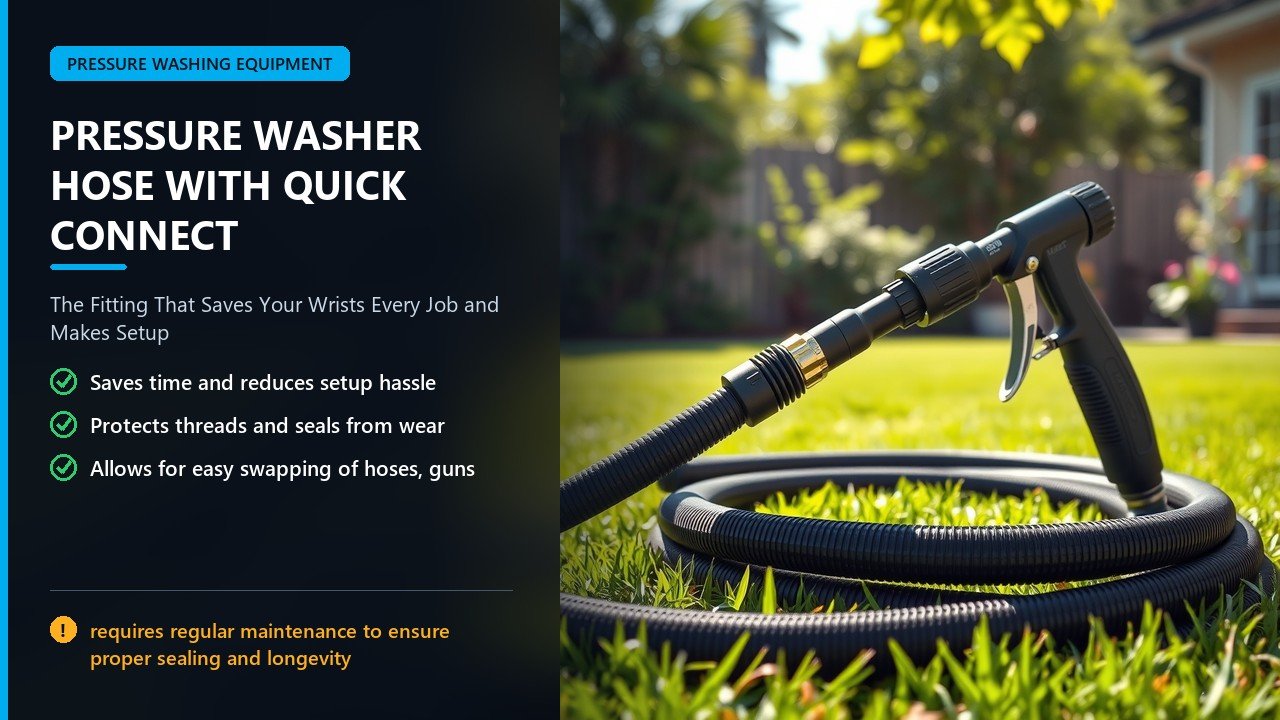
What “Quick Connect” Means on a Pressure Washer Hose
Quick connect, often shortened to QC, is a push-to-lock coupling. A male plug with a groove or collar slides into a female socket and locks in place, usually with a spring-loaded sleeve that you pull back to release. Water passes through the mated fitting without leaking when it is properly sealed. On a pressure washer hose, that means the hose terminates in a quick-connect plug or socket instead of a threaded male or female end.
Why it exists. Threaded fittings work, but they demand a wrench, they cross-thread, and they wear every time you connect and disconnect. Quick connect replaces that with a motion you can do one-handed and blind. The result is faster setup, fewer leaks from damaged threads, and the ability to move attachments between machines without hunting for a tool. Our overview of quick-connect fittings that owners rely on covers the whole family of these couplings.
What it is not. Quick connect does not eliminate pressure loss, and it does not make a cheap hose good. It is a connection standard, not a performance feature. A poor-quality quick connect with a weak spring and a worn o-ring will leak and pop loose, no matter how well the rest of the hose is made. Quality lives in the fit, the material, and the seal.
The Sizes and Types You Will Meet
Quick connect is a family of standards rather than a single fitting, and mismatching them is the most common reason a hose does not work.
1/4-inch quick connect. The residential standard. It is used at the gun, wand, nozzle, and often the pump outlet on homeowner and mid-range machines. If your wand has a socket that the nozzle plugs into, you have 1/4-inch quick connect somewhere in the chain. It is common and easy to shop for.
3/8-inch quick connect. Found on higher-flow and commercial equipment where full water flow matters. The larger bore moves more volume with less restriction, which is why big machines use it. A 3/8-inch system will not accept 1/4-inch plugs without an adapter, and the adapters must be the right direction. Our guide to 3/8 quick connect fittings and wide flow explains why size follows flow.
M22 threaded ends. Many pumps and guns use M22 threads rather than quick connect. If your machine has M22 ports, you keep the threaded connection there and use an M22-to-quick-connect adapter so the working end of the system is quick connect. That hybrid is extremely common and is why adapters sell so well.
Plug versus socket. Every quick-connect connection needs one male plug and one female socket. A hose with a plug on each end connects two sockets; a hose with a socket on each end accepts two plugs. Know which you need before ordering, and if you are ever unsure, our complete guide to 1/4 quick connect fittings spells out every combination.
| Fitting | Typical Size | Where It Shows Up | Tip |
|---|---|---|---|
| 1/4-inch quick connect | Residential standard | Gun, wand, nozzle, many pumps | The most common by far |
| 3/8-inch quick connect | High-flow / commercial | Big machines, long hose runs | Moves more water, less restriction |
| M22 thread | Pump and gun ports | Machine inlet/outlet | Pair with M22-to-QC adapters |
| Plug / socket | Male / female | Every QC joint | Match the direction you need |
Why Quick Connect Is Worth It on a Hose
The benefits are small individually and large together, especially for anyone who cleans regularly.
Speed. Setup and teardown drop from minutes to seconds. When you move between jobs, connect and disconnect multiple attachments, or store the machine daily, that saved time compounds fast.
No tools, no threads to strip. Threaded fittings cross-thread when you are in a hurry and wear out over hundreds of connections. Quick connect removes the wrench and protects the threads that remain in the system.
Sealed against leaks. A good quick connect seals with an internal o-ring, giving a leak-free joint that does not depend on how hard you can tighten a nut. This matters because a leaky connection wastes pressure and soaks your workspace.
Modularity. With quick connect at the working end, the hose becomes one piece of a system. You can swap a wand for a surface cleaner, a nozzle for a foam cannon, or one hose for a longer one without disturbing the rest of the setup. Our article on how quick connect ends the wrench fight walks through the modular workflows it unlocks.
Choosing the Right Hose With Quick Connect
The quick-connect fitting is only one property of a hose. Get these other specs right and the hose will serve you for years.
Inner diameter. Hoses are sized by inner diameter, most often 1/4 inch or 3/8 inch. The 3/8-inch hose moves more water and is standard on higher-flow machines, while 1/4-inch hose is lighter and suits smaller machines. Do not run a small-diameter hose on a big, high-flow pump, because it will strangle the flow. Our guide to 3/8 pressure washer hose ratings and construction explains the trade-offs.
Length. Match length to the job. A 50-foot hose is the residential sweet spot, long enough to circle a car or reach across a driveway without dragging. For bigger property, a 100-foot hose adds reach at the cost of some pressure and weight. Our piece on the 50 ft pressure washer hose explains why that length is the default for most homes.
Pressure rating. The hose must be rated for at least your machine’s working pressure, ideally with a safety margin. A hose rated to 4,000 PSI covers most gas machines. Never run a low-rated hose on a high-pressure machine, because failure means a burst line and a hazard.
Material. Rubber hoses are flexible in cold weather and resist kinking; PVC and hybrid hoses are lighter and cheaper but stiffer in the cold. Non-marking hose matters on light driveways. A kink-resistant, non-marking rubber hose is the most pleasant to live with for regular work.
| Hose Spec | Why It Matters | Common Choice |
|---|---|---|
| 1/4-inch inner diameter | Lighter, fits small machines | Electric and compact washers |
| 3/8-inch inner diameter | Moves more water, less restriction | Higher-flow gas machines |
| 50-foot length | Reach without extra weight | Most residential work |
| 4,000 PSI rating | Safety margin over working pressure | Most gas machines |
| Rubber, non-marking | Flexible, kink-resistant, no streaks | Regular use |
Matching the Hose to Gun, Pump, and Reel
A quick-connect hose is only useful if both ends fit the rest of the system. Think of the chain: pump outlet, hose, gun, wand, nozzle, and possibly a reel in between.
At the pump. Many machines have a threaded M22 outlet. Route it through an M22-to-quick-connect adapter so everything downstream is quick connect.
At the gun. Most guns accept a 1/4-inch quick-connect plug. Confirm the size, because a 3/8-inch system will not fit a 1/4-inch gun without adapting.
At the reel. If you run a hose reel, the reel inlet and outlet have their own fittings. A short jumper hose connects the machine to the reel inlet, and the long working hose connects to the reel outlet. Our guide to the jumper hose between pump and reel covers that short but important line. Our overview of hose couplers helps you bridge mismatches cleanly.
At the wand and nozzle. The wand usually ends in a 1/4-inch quick-connect socket for the nozzle. Keep enough spare plugs and sockets on hand so you can adapt on the fly. Our article on building a leak-free connection covers the whole loop.
The O-Ring: Small Part, Big Job
Inside every quick-connect joint sits an o-ring. That tiny rubber ring is what stops the joint from leaking, and it is the part that fails first.
Signs of a worn o-ring. Drips at the joint, a spray of fine mist, a drop in pressure at the tip, or a fitting that feels loose even when locked. These usually mean the o-ring is hardened, cut, or missing, not that the fitting itself is bad.
The fix is easy. Pop out the old o-ring, replace it with a fresh one of the correct size and material, and the joint seals again. Keep a small bag of spares; they cost almost nothing and save a job. A little silicone grease on the o-ring helps it seat and last.
Do not overtighten or force. Quick connect should click, not need force. A gritty or corroded fitting, or the wrong size, requires pressure to seat and will never seal reliably. Clean the fitting and check the size before blaming the hose. Our guide to pressure washer hose fitting types and replacement shows how to identify and swap the parts.
Using a Quick Connect Hose Properly
A few habits keep quick connect reliable.
Connect before pressurizing. Click everything together before you turn on the water. Connecting or disconnecting under pressure stresses the seals and can spray you.
Listen for the click. A proper quick connect locks with a positive snap and feels solid when you tug it. If it does not click, it is not seated, and it will pop apart under load. Give a light tug to confirm before you start.
Pull the sleeve to release. To disconnect, pull back the outer sleeve to unlock the plug, then pull the plug out. Do not yank the hose, which wears the locking mechanism.
Keep the fittings clean. Sand and grit inside a quick connect grind the o-ring and jam the sleeve. A quick wipe before you connect protects the seal, especially when you work around dirt and concrete dust.
Maintenance and Storage
Grease the o-rings occasionally. A touch of silicone grease keeps them supple and helps them seal.
Replacement is cheap, so replace early. O-rings, plugs, and sockets are inexpensive. Keeping spares on the truck means a small failure never ends your day.
Drain and coil the hose well. Store the hose without kinks and out of the sun, and drain it before freezing weather so water does not expand and damage the fittings. Protect the fittings the same way you protect the pump and any water tank on the rig from winter damage.
Cap exposed ends. Dust caps on idle quick connects keep grit out of the seal faces and extend their life.
Quick Connect Versus Threaded Fittings: The Honest Comparison
It helps to know exactly what you gain, and give up, when you choose quick connect over threads. The two systems each have a place.
Threaded fittings. M22 and NPT threads are simple, cheap, and extremely reliable as long as they are seated and sealed. They are the right choice at the pump, where the connection is made once and left alone for long stretches. Their weakness is the day-to-day connections at the working end, where repeated on and off wears threads, invites cross-threading, and demands tooling or brute finger strength.
Quick connect. The working end is where quick connect wins. Frequent swaps, one-handed changes, and tool-free access make it the natural choice for anything you touch often. Its weakness is that it depends on a small o-ring and a spring, which is why quality and basic maintenance matter more than with threads.
The smart system uses both. Keep the threaded connection at the pump and the permanent reel joints, and run quick connect everywhere you routinely attach and detach. That hybrid is exactly how most working setups are built, and it is why M22-to-quick-connect adapters exist in the first place. If you are designing a system from scratch, our guide to matching hoses and fittings as a system walks through the plan.
| Connection | Best For | Weakness | Recommended Use |
|---|---|---|---|
| Threaded (M22 / NPT) | Permanent joints | Wear and cross-threading | Pump inlet and outlet |
| Quick connect | Frequent attachment | O-ring and spring wear | Gun, wand, nozzle, hose ends |
Buying a Factory QC Hose or Adding Fittings Yourself
You have two ways to end up with a quick-connect hose, and each suits a different situation.
Factory quick-connect hoses. Many manufacturers sell hoses with the fittings already on the ends, which is convenient, consistent, and tested. The drawbacks are fewer: you are limited to the combinations offered, and factory fittings sometimes use unusual thread styles that are harder to match. If the hose you want comes with the right QC ends, buying it that way is the fastest, simplest path.
Add-on quick-connect ends. If you already own a good hose, you can screw a quick-connect plug or socket onto the threaded end, using the correct thread and a little thread sealant. This lets you keep your favorite hose and standardize the ends. The risk is buying the wrong thread size, which is why knowing your hose’s end connection matters. Our guide to pressure washer hose fitting types shows how to identify the threads before you order.
Which is better? Neither, universally. Buy the factory hose when the specs and ends match. Add ends when they do not. Either way, the goal is a consistent quick-connect standard across the working end of your system, so every hose, gun, and wand clicks together no matter what you grab.
Jobs a Quick Connect Hose Makes Noticeably Easier
The benefit of quick connect shows up most on jobs that involve changeovers, and there are several classics.
Washing multiple machine types. If you own more than one pressure washer or share hoses between a machine and a rental, standardizing on quick connect lets one hose serve both.
Detailing cars. Detailing is nothing but swaps: foam cannon, rinse tip, soft brush, spot-free rinse. Tool-free changes keep the workflow smooth and the finish safe, and a quick connect hose is the backbone of that routine.
Swapping from wand to surface cleaner. On flatwork, you want a surface cleaner for the main slab and a wand for edges and corners. Quick connect makes each switch take seconds instead of a trip for a wrench.
Managing hose length. With QC ends and a coupling, you can join two hoses for a longer run and uncouple them for storage. That is far easier than maintaining two separately threaded setups. Just remember every extra joint adds a little restriction, so keep the chain short where possible.
Common Quick Connect Mistakes
Buying the wrong size. A 1/4-inch plug will not fit a 3/8-inch socket. Confirm sizes at both ends before ordering.
Ignoring the o-ring. Most leaks blamed on the hose are really a worn o-ring. Replace it and the leak usually stops.
Mixing budget and quality fittings. A flimsy quick connect with a weak spring pops loose under pressure. Brass or stainless fittings cost a little more and cause far fewer problems.
Forcing a gritty fitting. If it will not click, something is wrong: wrong size, debris, or corrosion. Clean it and check the size instead of forcing it.
Running the wrong hose rating. A quick-connect end does not change the hose’s pressure rating. Do not put a cheap hose behind a powerful machine.
Frequently Asked Questions
Are quick connect fittings universal? No. The most common residential size is 1/4-inch, but 3/8-inch exists, and plugs and sockets come in both. Match the size and the direction (plug versus socket).
What is the difference between a pressure washer quick connect and M22? M22 is a threaded connection used at pumps and guns that you tighten by hand or with a wrench. Quick connect is a push-to-lock coupling that needs no tools. Many machines use M22 at the pump and quick connect at the working end.
Why does my quick connect leak? Almost always a worn or missing o-ring, or the wrong size fitting. Replace the o-ring and confirm the size. Grease the new o-ring for a better seal.
Can I add quick connect to an existing hose? Usually yes, if the hose has threaded ends. Screw on a quick-connect plug or socket with the correct thread, using thread sealant where appropriate.
Do quick connect fittings reduce pressure? A quality full-flow fitting adds very little restriction. A cheap or partially clogged fitting can cost you pressure, so buy quality and keep it clean.
How long do quick connect fittings last? Good brass or stainless fittings last years with basic care. The o-rings wear faster than the metal, so keeping spares and replacing them is the key to a long life.
Final Thoughts on Pressure Washer Hoses With Quick Connect
A pressure washer hose with quick connect is a small upgrade with an outsized effect. It removes the wrench, the crouch, and the drip from every setup, protects the threads you still have, and turns the hose into one interchangeable piece of a system you can rearrange in seconds. For anyone who cleans more than once in a while, that convenience is not a luxury. It is the difference between dreading the setup and just getting to work.
Match the quick connect size to your gun, wand, and pump, choosing 1/4-inch for most residential machines and 3/8-inch for high-flow setups. Pick a hose with the right inner diameter, length, and pressure rating, and prefer rubber and non-marking construction for easy living. Buy brass or stainless fittings, keep a bag of spare o-rings, and grease them now and then. Do that, and every connection clicks, seals, and holds, so the only thing you fight is the dirt, and even that gives up faster than it used to.