Surface pressure washing is the job that keeps exterior cleaning companies busy year-round: cleaning driveways, patios, walkways, sidewalks, pool decks, and parking lots with a pressure washer fitted with a rotary surface cleaner. It is distinct from house washing and roof washing because it works on flat hard surfaces, and it is the service most homeowners think of first when they hear “pressure washing.” It is also one of the highest-margin services in exterior cleaning when done right.
If you are a homeowner, surface pressure washing is how you get a driveway that looks fresh-poured again instead of striped and uneven. If you are a contractor, surface pressure washing is the entry point into a business where even a modest setup can produce professional results and healthy margins almost from the first job. Either way, the fundamentals — equipment, water, technique, and pricing — are the same, and getting them right is what separates a clean result from a damaged one.
Quick Note: Surface pressure washing means cleaning flat hard surfaces — concrete, pavers, asphalt, stone — with a rotary surface cleaner rather than a wand. The surface cleaner spins two or more high-pressure jets under a shroud, giving even coverage with no striping.
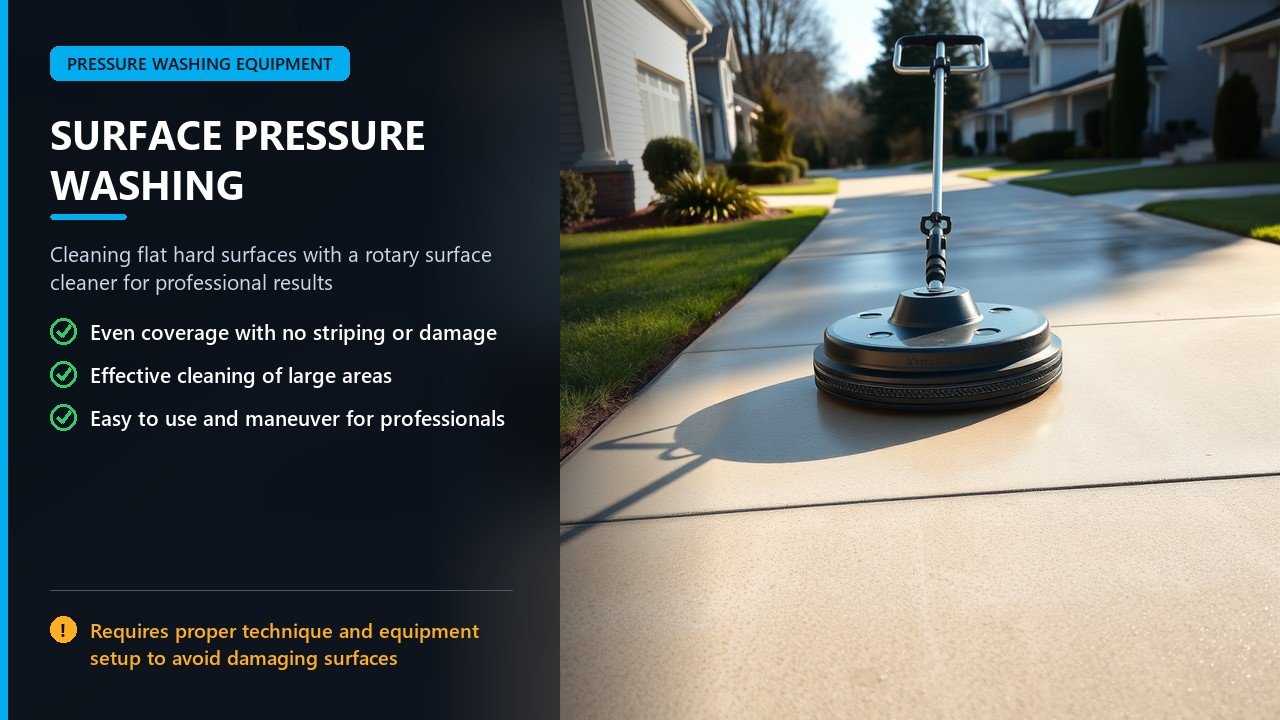
What Makes It Different From a Hand Wand
Anyone can point a spray wand at a driveway. The difference with proper surface pressure washing is the tool: a rotary surface cleaner that spins high-pressure nozzles in a circle beneath a protective skirt while you walk the handle slowly over the surface. By the time the tool has passed, the concrete looks consistent and clean — no tiger stripes, no etched lines, no missed slivers.
- Even coverage. A hand nozzle concentrates pressure; a surface cleaner distributes it evenly over its diameter, so results are uniform.
- Speed. A 16-inch surface cleaner covers a width of about 16 inches per pass. A driveway that takes hours with a wand becomes a 45-minute job with a surface cleaner.
- No etching. Because the jets work under a shroud that rides above the surface, you do not leave start-stop pressure marks or “fisheyes” where you squeezed the trigger.
- Less rebound. The shroud catches most of the rebound mist, which means less spray on the operator and the surrounding property.
The exact tool you need depends on your machine’s flow. Our surface cleaner guide covers the pairing in detail, but the sizing rule is roughly four inches of cleaner diameter per gallon per minute of flow from your washer.
| Machine Flow | Surface Cleaner | Typical Use |
|---|---|---|
| 2.5 to 3 GPM | 12 to 14 inch | Homeowner driveways and patios |
| 4 GPM | 16 to 18 inch | Starting a residential business |
| 5.5 to 8 GPM | 20 to 30 inch | Commercial flatwork and lots |
Why Property Owners Pay For It
Driveways and patios accumulate years of dirt, oil, moss, and biological growth, and the results are visible from the street. Surface pressure washing delivers immediate curb appeal, and that is what owners are paying for. Professionally cleaned flatwork:
- Restores appearance — a sealed-looking driveway that frames the house.
- Protects the surface — removing moss and algae reduces slip hazards and lets concrete drain and breathe.
- Adds value — clean concrete and pavers are among the cheapest, highest-impact improvements before selling.
- Prepares surfaces — for resealing, repainting garage floors, or repairs where a clean base is essential.
It is also a seasonal, repeatable business: most customers want their walkways cleaned at least once a year, and many book a spring flatwork clean every single year without fail. The service sells itself with before-and-after photos — there is no product on earth that needs less marketing than a transformation nobody can argue with.
The Right Setup For Surface Work
A professional surface pressure washing setup does not need to be expensive, but it needs to be correct. The minimum is a 4 GPM gas pressure washer, a 16-inch surface cleaner, 200 feet of non-marking high-pressure hose, a downstream injector for chemicals, and safety gear. That is the package the plans on StartCosts and most contractor guides size at roughly $3,000 to $8,000 for a serious entry into the trade.
- Pressure washer. 4 GPM at 4,000 PSI is the sweet spot for a growing business — enough flow to drive a 16-inch cleaner. Our 4,000 PSI 4 GPM shopping guide walks through the choice.
- Surface cleaner. Sizing is the whole game; the table above is the starting point.
- Non-marking hose and reels. Protect customer property and save setup time. A manual reel keeps feet and hands clear.
- Downstream chemical injection. Degreasers for oil stains and surfactants for biological growth multiply results. Our hose fittings guide helps you build a leak-free system, and the tank setup guide covers supplying water when the site faucet is weak.
- Safety gear. Eye protection, ear protection, gloves, and footwear rated for the job are non-negotiable on a 4,000 PSI machine.
Equipment buyers debate belt drive versus direct drive on the machine. For regular commercial use, a belt-drive triplex pump wears far better; the cold versus hot and direct versus belt comparison explains why professionals favor belt drive on the machines that run every day.
Quick Note: The core flatwork rig: a 4 GPM pressure washer, a properly sized surface cleaner, non-marking hose, downstream chemical injection, and safety gear. A rotary surface cleaner is essential — wand washing a driveway is slow and leaves stripes.
How Much Surface Pressure Washing Costs
Surface pressure washing is priced per square foot, with rates that vary by surface, condition, region, and access. In 2026 the general market bands are:
| Surface | Typical Rate | Typical Job |
|---|---|---|
| Concrete driveway | $0.20 to $0.35 per sq ft | $150 to $450 |
| Sidewalk / walkway | $0.18 to $0.40 per sq ft | $50 to $150 |
| Paver / stone patio | $0.20 to $0.45 per sq ft | $150 to $500 |
| Commercial flatwork / lot | $0.08 to $0.25 per sq ft | $500 to $3,000+ |
Light condition (washed within the last year) prices at the low end; heavy buildup, black algae, red clay, and years of neglect add 25 percent or more, and oil or rust stain removal is a separate line item. Most contractors set a minimum charge of around $100 to $200 so small jobs still cover travel and setup, and they price add-ons like sealant application, paver re-sanding, and gutter brightening as high-margin extras. The 2026 cost guide at Power Wash Maps and the rate guide at WashPricing are good references for local quoting.
The Simple Job Method That Gets Clean Results
Whatever you charge, results come from a repeatable process. The method used by commercial crews — the same six-step sequence taught in every professional pressure washing course — follows this shape.
- Inspect and protect. Walk the job, note oil stains and fragile areas, move furniture and planters, wet the surrounding plants, and plan the runoff so dirty water does not pour into a neighbor’s flower bed.
- Pre-treat. Apply a degreaser to oil spots and a surfactant-based cleaner to biological growth, and let it dwell while you prepare the machine.
- Test the surface. Spot-check a small area to confirm pressure and distance are safe for the concrete, paver, or stone before you commit to full passes.
- Work the surface cleaner in overlapped lanes. Keep the tool moving and overlap each pass by a few inches to avoid fine lines; match the machine’s flow so the cleaner spins smoothly.
- Edge with a wand. The surface cleaner cannot reach tight edges, so finish borders with a 25 degree nozzle in a deliberate pattern, keeping the gun at a consistent angle.
- Rinse and review. Give the surface a final rinse, check for missed spots from a low angle, and photograph the result for the customer and your portfolio.
Tackle concrete at a lower, deliberate speed to let the cleaner lift the dirt rather than blasting it. On soft or porous surfaces, add water or widen the pattern to reduce pressure at the surface. On pavers, watch for loose sand — and if re-sanding is needed, tell the customer; it is a separate service you can quote.
Turning It Into a Business
For anyone ready to sell surface pressure washing, the business case is straightforward. Material costs are a small fraction of the price; the startup breakdown at Mike Vidan’s site shows chemical costs running under 10 percent of what you charge, with healthy margins across the service list. Start with a 4 GPM machine and a 16-inch cleaner, learn on your own driveway, then use before-and-after photos to book neighbors’ driveways and patios.
- Bundling pays. House washing plus driveway cleaning mutually reinforces both — customers who book a package save 15 to 20 percent and you sell more hours per stop.
- Recurring contracts. Commercial lots and strip malls that need quarterly or annual maintenance give you predictable revenue between residential peaks.
- Condition surcharges are normal. Heavily soiled jobs take 25 percent longer; charge for them honestly and tell the customer why.
- Insurance and licensing. General liability coverage and any local water-runoff permits are part of staying professional and winning commercial work.
The full picture of the flatwork craft — from machine flow to cleaning technique — is covered on this site in the flat surface cleaning guide, and the detailed breakdown of a surface cleaner for a pressure washer explains how to choose and use the star attachment correctly when you are ready to build your rig.
Preparing the Site Properly
The difference between an amateur flatwork job and a professional one is visible before the machine ever starts — in how the site is prepared.
- Clear the surface. Move vehicles, planters, furniture, toys, and doormats out of the work area so you are not cleaning around objects and leaving a crescent of dirt behind them.
- Close windows and doors near the work and cover nearby electrical outlets, light fixtures, and garage electronics; a 4,000 PSI stream sends mist sideways.
- Wet plants and gardens along the paths where runoff will flow, and use plant-safe chemicals where vegetation is unavoidable.
- Contain runoff. On commercial lots, sweep and pre-clean so the wash water carries soil out of the way rather than spreading it, and know your local rules about wastewater flowing to storm drains.
- Test the water supply early. Weak faucets starve the pump and ruin the whole job; hook up and check flow before you quote timing. The tank setup guide covers how to buffer a marginal supply.
Preparation also means protecting the operator. Set the machine down the slope from the job when you can, keep the hose clear of vehicle traffic, and never run hoses across places where people will walk without flagging them.
Common Mistakes and How to Avoid Them
Most complaints about pressure washing damage and disappointment trace to a handful of repeatable mistakes, all of them avoidable.
- Standing still. Holding a surface cleaner in one spot spins the jets in place and presses a swirl pattern into the concrete. Keep the tool moving at a steady, overlapping pace.
- Too much pressure, too much wand. Bumping up pressure to make up for a slow machine etches softened concrete and blows out paver joints. Use the correct nozzle and pressure for the surface instead.
- Skipping pre-treatment. Biological growth and oil need chemical dwell time; blasting without it pushes stains around and takes twice as long.
- Bad edge work. Edges done hastily with a tight nozzle leave the telltale stripes a surface cleaner was supposed to prevent. Edge with the same nozzle at a consistent angle, or use an edging attachment.
- Cleaning in direct sun on hot concrete. Chemicals dry and streak in minutes; schedule for morning or shade, or do small sections and rinse and follow behind.
- Skipping the before photos. For contractors, the “before” is half the portfolio; for owners, it documents exactly what you paid to fix.
Respect the machine too: never let the pump run dry, keep the inlet strainer clean, flush detergent through the injector after use, and winterize before the first freeze. The pump saver guide has the storage routine that keeps the rig dependable for years.
Upsells and Add-Ons That Multiply the Job
Once the machine is on site and the flatwork is clean, the most profitable forms of surface pressure washing include the five-minute conversations that turn one ticket into three.
| Add-On | What It Is | Why It Pairs Surfaces |
|---|---|---|
| Sealing | Applying a concrete or paver sealer after cleaning | Only works on clean concrete — a natural next step |
| Paver re-sanding | Refreshing joint sand washed out by cleaning | Restores stability after the wash |
| Gutter brightening | Removing tiger striping on gutter faces | Adds the full exterior curb appeal |
| House wash | Soft-washing siding at low pressure | Frames the driveway work and doubles the ticket |
| Trash bin / dumpster area | Cleaning the pad behind the house | Practical, low-skill, high-margin add-on |
The numbers tell the story: material cost on these add-ons is a few dollars against a $50 to $300 ticket, and commercial lot customers often take a quarterly package that smooths your schedule. A surface cleaner that already cost you $400 to $800 pays for itself in a few driveways, so every add-on after that is margin.
Concrete, Pavers, and Stone: Adjusting the Method
Not all flat surfaces respond to the same treatment. Material is the variable that decides pressure, chemical, and speed.
- Standard concrete. Tough and forgiving: a full-pressure surface cleaner pass with occasional pre-treatment for biological growth works well most of the time.
- Soft or aging concrete. Weathered, new, or hand-troweled concrete can be softer than it looks. Drop one nozzle size wider and slow down; testing a corner first tells you whether the surface holds up.
- Pavers. The joint sand erodes easily. Clean at lower pressure, follow the joints, and warn the owner that re-sanding is the natural finishing step. Never let standing water sit while the sand is loose.
- Stamped and colored concrete. The color layer is thin; use a wider nozzle and lighter pressure or you will see ghosts of the pattern disappear.
- Stone and tile. Porosity varies a lot: dense granite cleans tight and fast, while softer travertine needs a gentle, lower-pressure pass, often combined with a mild cleaner.
- Asphalt. Deliberate and low-pressure; concentrated jets chew grooves in softened asphalt on hot days, so wash in cooler weather and avoid prolonged contact.
Testing in an inconspicuous corner is not wasted time — it is the single most reliable way to avoid the damage complaints that end careers. The results that earn repeat customers come from matching the machine to the material instead of running one setting for everything.
Commercial Flatwork: A Different Rhythm
Commercial surface pressure washing — parking lots, loading docks, drive-thru pads, and plaza walkways — runs on volume pricing and recurring contracts, and it changes the job in three honest ways.
- Speed rules. At $0.08 to $0.25 per square foot, the margin lives in how much footage you cover per hour. That is why commercial crews run 5.5 GPM and larger machines with 20 to 30-inch surface cleaners — the setup covered in our 5 GPM guide.
- Water and runoff are the real cost. Lots produce serious volume, and local rules about wastewater to storm drains make reclaim and berms a line item. Operators either price it in or wash only onto surfaces where it soaks away.
- Contracts beat ads. The best commercial business is a recurring quarter or annual agreement with a property manager, because it fills the calendar without the chase.
Commercial work also demands insurance, a professional appearance, and often night or early shifts when lots are empty — which is exactly why high margins survive: reliable commercial operators are rewarded for showing up at 4 a.m. with the machine running.
What to Expect If You Hire a Professional
For homeowners comparing surface pressure washing quotes, a few signs separate a professional from a guy with a truck.
- They inspect first. A pro walks the property, notes oil spots and fragile pavers, and tells you up front what will affect the price.
- They use a surface cleaner. If the quote is for a hand wand on the whole driveway, expect stripes — ask why.
- They mention protection. Plants, runoff, and pre-treatment details show experience.
- They take photos. Before-and-after documentation is the professional’s proof of work and portfolio.
- They are insured and honest about add-ons. Oil stain treatment and sealing are separate asks, pursued transparently rather than discovered afterward.
And their answer to how long the job takes should sound like “a couple of hours,” because that is what a modern surface cleaner delivers on a normal two-car driveway — not “all day.”
Timing the Season and Scheduling Smart
Flatwork cleaning has a natural rhythm, and using it well helps both homeowners and operators get better results.
- Spring is the busy season. After winter, driveways and patios are at their worst — grime, salt residue, and biological growth are all visible. Most operators book their residential flatwork early and treat April through June as the anchor of the year.
- Fall is the second wave. Leaves and moisture leave mold and algae that owners want gone before holidays and winter; fall flatwork keeps the season from being a dead zone.
- Midday sun is the enemy of chemicals. Clean in morning or shade, or work in sections and rinse quickly, so detergent and biological treatments do not dry on the surface.
- Bundling evens out the calendar. Pair a spring driveway wash with a hull wash and gutter work so one visit produces a full afternoon of labor and one drive.
- Book before you advertise. Happy neighbors photograph better than ads; a street with three cleaned driveways sells itself before the weather warms up.
For contractors, the shift that protects flat margins is simple: quote by the square foot with a minimum, protect weekend and holiday slots with a small surcharge, and prefer recurring commercial contracts that fill midweek hours no one else wants.
Frequently Asked Questions
What is surface pressure washing? It is the service of cleaning flat hard surfaces — driveways, patios, walkways, sidewalks, pool decks, and parking lots — with a pressure washer and a rotary surface cleaner, which provides even coverage without the stripes a hand wand leaves.
How long does it take a professional crew? A standard two-car driveway takes roughly one to two hours with a 16-inch surface cleaner on a 4 GPM machine; larger lots and commercial flatwork scale up by square footage.
Can pressure washing damage concrete? Yes, if misused — an undersized tight nozzle, too much pressure, or too-slow passes can etch concrete and blow out joints. Professional crews use wide coverage and the right nozzle and keep the tool moving.
Is surface pressure washing worth it for homeowners? Usually yes for appearance and before selling: clean concrete transforms curb appeal for a modest price, and moss or algae removal reduces slip risk.
What is the best tool for a 3,000 to 4,000 PSI machine? A 16 to 18-inch surface cleaner on 4 GPM, or 12 to 14-inch on a smaller 2.5 to 3 GPM machine. Match the cleaner diameter to your flow so the tool spins with authority.
Do I need hot water? No. Cold water plus the right chemicals handles almost all flatwork. Hot water helps on the heaviest oil and grease, but it is a luxury, not a requirement, for surface pressure washing.
Will surface pressure washing remove oil stains? Not completely on its own. Oil needs a degreaser and dwell time before the wash; surface cleaning then shows the stain was treated. Full removal on old, deep stains sometimes takes a second pass or a poultice.
How often should a driveway be pressure washed? Once a year is the sweet spot for most homes, with a spring or fall visit catching the worst of grime before it sets. Commercial lots and strip malls often move on a quarterly rhythm.
Will the machine damage my lawn or plants? Runoff can, if it is heavy with chemicals. Professionals wet down the plants before starting, use appropriate chemistry at label rates, route the wash water away from garden beds, and a good surface cleaner keeps most of the spray down on the slab where it belongs.
Final Thoughts
Surface pressure washing is the backbone of the exterior cleaning trade: simple equipment, high margins, visible results, and endless repeat customers. For owners it is the quickest curb-appeal improvement a property gets. For operators it is the entry point that builds the machine hours, the technique, and the portfolio of before-and-after photos that every other service — house washing, roof washing, gutter work — then rides on.
Start with a properly sized surface cleaner on a 4 GPM machine, respect the technique — overlapped passes, pre-treatment, decided edges — and price honestly by the square foot with a sensible minimum charge. Follow that recipe and the driveway will look brand new, the customer will book the annual cleaning again, and the photograph will sell your next job for you.