Maya started her mobile detailing business with a pressure washer that was wrong in almost every way. It was too powerful for paint, it needed a garden spigot that most office parks did not have, and it was heavy enough that lifting it in and out of her hatchback wore her out by the third car. Her first month was a lesson in everything a mobile car wash machine should not be. By the second month she had rebuilt her setup around the right pressure washer, a portable tank, and a small power source, and her average time per car dropped by half. The machine was not the most powerful one she could have bought. It was the one that fit the way a mobile detailer actually works, and that made all the difference.
Choosing a pressure washer for a mobile car wash is a different exercise from buying one for a driveway. On a car, pressure is a hazard more than a tool, water is scarce because you carry it with you, power may not exist at the curb, and the whole business depends on working fast, cleanly, and repeatably. This guide explains what a mobile car wash pressure washer needs to do, how to choose the machine, how to size the water and power that travel with you, and the mistakes that sink new mobile detailers before they get off the ground.
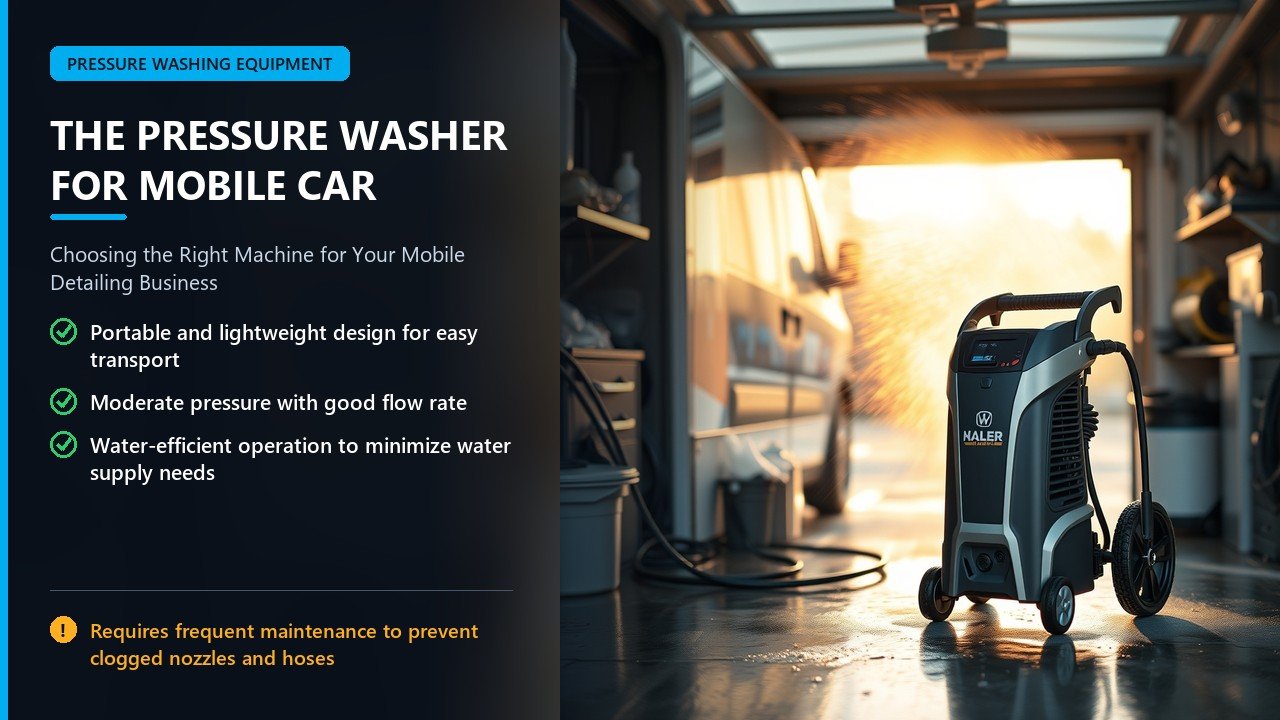
What a Mobile Car Wash Actually Requires
A mobile car wash is a complete system, not just a machine. Four things travel with you, and each one has to work with the others.
The pressure washer. The core tool that delivers water for rinsing and blasting. On a car, it is used at moderate pressure with wide tips, because concentrated pressure damages paint, clear coat, and trim.
The water supply. Most mobile setups carry a tank because there is rarely a spigot at the driveway. Tank size determines how many cars you can wash before you have to refill, so it is a direct limit on your daily capacity. Our guide to a pressure washer tank setup explains how to size and use one.
The power source. An electric pressure washer needs a power source, and at a curb that often means a generator or the vehicle’s electrical system. A gas pressure washer carries its own power but adds noise, exhaust, and weight.
The vehicle and layout. Everything has to fit, be organized, and be easy to set up and tear down. A tidy rig saves minutes on every job, and minutes are money for a mobile detailer. Our overview of a trailer-based mobile cleaning rig shows how professionals lay out a mobile operation.
Choosing the Pressure Washer Itself
The machine at the center of a mobile car wash has different priorities than a machine built for concrete. Match the machine to car washing, and the whole business runs smoother.
Prioritize flow over pressure. Cars need water volume to rinse clean, not brute force. A machine with strong gallons per minute and moderate pressure rinses soap and grime efficiently without risking the finish. Chasing 4000 PSI for car washing is not only unnecessary, it is dangerous to paint. Our article on why GPM matters as much as PSI explains the balance.
Electric versus gas. Electric machines are quieter, produce no exhaust, and are easier to start, which suits residential neighborhoods and parking lots where noise and fumes draw complaints. Gas machines are more powerful and independent of wall power but noisier and heavier, and they need fuel. For most mobile car wash work, a quality electric unit with strong flow is the better fit. Our guide to the electric pressure washer that melts grease without fumes covers the electric advantage.
Hot or cold water? Hot water helps with stubborn road film and grease, and it speeds drying, but it adds cost, weight, and fuel needs. Many successful mobile detailers start with cold water and good chemistry, then add heat later if their market rewards it. Heat is a premium upgrade, not a starting requirement.
Portability and footprint. A mobile machine must be easy to move and to load. Compact, light machines on wheels save your back and speed up setup. If your rig is a van or trailer, size the machine to the space you have and the way you work.
| Machine Type | Pros | Cons | Best For |
|---|---|---|---|
| Electric, moderate pressure | Quiet, no exhaust, easy start | Needs a power source | Most mobile car wash work |
| Gas, high flow | Powerful, self-powered | Noisy, heavy, needs fuel | Large fleets, off-grid jobs |
| Hot water unit | Better on road film and grease | Costly, heavy, needs fuel or power | Premium and commercial work |
| Battery or 12V unit | Truly portable, light | Lower pressure and flow | Light rinsing, spot work |
Water Supply: The Real Limit on Your Day
In a fixed car wash, water comes from a pipe and never runs out. In a mobile car wash, every drop is carried in a tank, so water becomes a resource you plan around. Get this part right and you control your daily capacity.
Size the tank to your day. Tank size determines how many cars you can wash per fill. A small car uses a certain amount of water for the foam stage, the rinse, and the final spot-free rinse, and the total per car includes some waste. Choosing a tank that carries enough for a full day of work reduces mid-day refills and keeps you productive.
Use a pump, not gravity, for pressure. A tank needs a transfer pump to feed the pressure washer with enough flow and pressure. An undersized supply pump starves the washer and damages it, so match the supply pump to the machine’s demand. Our guide to a water pump for a pressure washer tank explains the pairing.
Plan for refills and water sources. Know where you can refill between jobs, and consider whether you can tap a customer’s spigot with permission. Many mobile detailers carry enough water to avoid depending on the customer, which keeps the business self-contained and professional.
Wastewater and runoff. Mobile washing creates runoff that carries soap, dirt, and sometimes oil. Some areas restrict what can flow into storm drains, so know the local rules and consider containment or waterless methods where required. The U.S. Environmental Protection Agency publishes guidance on runoff and water quality that is relevant to wash water.
| Tank Size | Rough Cars per Fill | Best For |
|---|---|---|
| About 25 gallons | A few vehicles | Light, spot-focused work |
| About 50 gallons | Several vehicles | Part-time mobile detailing |
| About 100 gallons | A full day for a small operation | Serious mobile car wash |
| 200 gallons and up | Large daily volume | Trailer rigs and fleets |
Power on the Road
If you choose an electric pressure washer, you need electricity wherever you park, and that shapes your rig as much as the machine does.
Generator power. A quiet inverter generator lets you run an electric washer anywhere, which is the most common solution for mobile detailers. Size the generator to the machine’s starting and running demand, with margin to spare. An undersized generator trips or bogs down, and an oversized one wastes fuel and space.
Vehicle power and batteries. Smaller electric washers may run from an inverter tied to the vehicle’s electrical system or from a battery bank. This suits light-duty setups and truly portable work, such as a 12-volt pressure washer, but it cannot feed a high-flow machine for long.
Gas engine independence. A gas pressure washer carries its own power source, which removes the generator entirely. The trade-off is noise, exhaust, weight, and fuel, which is why many car-wash markets prefer quieter electric rigs.
Safety with power and water. Combining electricity and water demands care. Use ground-fault protection, keep cords and connections dry and elevated, and never run an electric machine in standing water. A mobile car wash deals with wet ground constantly, so treat every electrical connection as a potential hazard. The Occupational Safety and Health Administration treats water and electricity together as a serious hazard, and the same discipline that protects a jobsite protects your rig.
Water Quality and Spot-Free Rinsing
Cars are judged by how they dry, and the final rinse decides whether you leave spots behind. Water quality is a quiet but important part of a mobile car wash setup.
Hard water leaves spots. Minerals in hard water dry into visible spots on glass and paint. Filtering or softening the rinse water, or using a spot-free rinse system, prevents the most common customer complaint. For a professional finish, this step is worth the investment.
Deionized or softened rinse. A final pass with softened or deionized water lets the car air-dry without spotting, which saves the labor of towel-drying every panel and reduces the risk of towel-induced scratches.
Chemistry matters as much as water. A good foaming soap, a wheel cleaner, and a bug-and-tar remover do a lot of the work before the pressure washer ever touches the car. The pressure washer rinses; the chemistry cleans. Relying on pressure alone is slower and riskier for the finish. Our article on adding soap to a pressure washer covers the foam stage.
Nozzles and Technique for Vehicle Work
The nozzle and the technique decide whether the machine protects the paint or harms it. For cars, err toward safety.
Use wide tips. A 40-degree tip is the workhorse for vehicle work because its soft, wide fan cleans without concentrating force. A 25-degree tip can handle wheels, tires, and lower panels, but keep it off painted body panels. Never use a 0-degree tip on a car.
Avoid turbo nozzles on paint. A turbo or rotating nozzle concentrates a spinning jet that can strip paint and damage trim. They belong on concrete, not on vehicles. Our guide to turbo nozzles and what to buy explains where they are safe.
Keep the wand moving and at a distance. Hold the wand at a consistent distance and keep it moving, working top to bottom. A stationary jet on a car is a fast way to damage a panel. Distance is your pressure control; step back rather than reaching for a narrower tip.
Work in stages. Pre-rinse, foam, agitate with a soft mitt or brush, then rinse, then apply a spot-free final rinse. This sequence is what separates a professional result from a quick spray-down, and it protects the finish throughout.
Building the Business Around the Machine
The machine is the tool, but the operation around it decides whether the business succeeds. A few business realities shape the equipment choices.
Time per car drives pricing. Faster work means more cars per day and better hourly earnings. A machine with strong flow and a streamlined setup shortens each wash, which is why efficiency matters more than maximum power.
Reliability is everything. A breakdown in a customer’s driveway costs you the job, the customer, and your reputation. Choose a machine known for reliability, carry spare parts and consumables, and keep a backup plan. Our guide to the equipment a pressure washing business needs covers the full kit.
Presentation sells. A clean, organized rig signals professionalism and justifies premium pricing. A tangled hose, a dirty machine, and a scattered setup do the opposite. A hose reel, a tidy tank, and a well-organized van are sales tools as much as conveniences. Our guide to choosing a pressure washer hose reel shows how organization pays off.
Match the machine to the market. A high-end detailing market rewards investment in soft water, heat, and premium chemistry. A volume-focused mobile wash rewards speed and reliability. Know which business you are building before you choose the machine. Our article on matching a pressure washer to the job helps map machine to market.
Soft Washing and Waterless Options for Mobile Work
Pressure is not the only way to clean a car, and for mobile detailers the alternatives can be just as important as the pressure washer. Water scarcity, runoff rules, and delicate finishes all push toward lower-pressure methods that lean on chemistry and technique.
Foam and agitation. A foam cannon applied through the pressure washer coats the car in thick soap that lifts dirt before any pressure touches the paint. After a short dwell, a soft mitt or brush loosens the rest. The pressure washer then rinses. This method cleans thoroughly at low pressure and is the backbone of safe mobile detailing.
Touchless washing. Touchless methods rely on stronger chemistry and a rinse rather than contact, which reduces the risk of swirl marks from dirty mitts and towels. They demand a good soap and a reliable rinse, but they are fast and safe for the finish. Many mobile operations combine a touchless presoak with a light contact wash for the best of both.
Waterless and rinseless washing. Some jobs, or some locations, cannot tolerate runoff. Waterless sprays and rinseless washes use very little water and are ideal for light soil on lightly dirty cars, indoors, or where drainage rules are strict. They are not a replacement for a full pressure wash on a filthy vehicle, but they are a valuable tool for a mobile operator who needs to work in a tight space or a restricted area.
When lower pressure wins. On a show car, a freshly wrapped vehicle, or a delicate finish, soft washing is not just safer; it produces a better result than blasting with pressure. Understanding when to reach for chemistry instead of force is a mark of a professional, and it often produces a higher-quality finish than the pressure washer alone. Our article on a cleaning attachments for a pressure washer shows how to adapt one machine to these gentler methods.
Assembling the Ideal Mobile Setup
An efficient mobile car wash rig is more than a machine and a tank. It is a system arranged so that setup takes minutes and every tool is within reach. The most effective rigs share the same basic layout.
Water and supply on one side. The tank, the transfer pump, and the supply line sit together so the pressure washer is always fed. A quick-connect on the supply line speeds up setup and teardown.
The pressure washer and reel together. Mount the machine and a hose reel close to each other so the hose pulls straight off the reel to the gun. A reel prevents tangles and protects the hose, which extends its life and speeds every job. Our guide to a pressure washer reel that ends hose chaos explains the benefit.
Power source secured and safe. The generator or power supply sits on the opposite side from the water tank, with cords routed away from wet ground and protected with ground-fault protection. Keeping power and water separated is both an efficiency and a safety choice.
Chemicals, tools, and towels organized. Soap, wheel cleaner, brushes, mitts, and towels belong in marked containers so you never hunt for anything mid-job. Organization is what turns a slow wash into a fast one, and it makes the rig look professional to customers.
| Rig Component | Priority | Why It Matters |
|---|---|---|
| Pressure washer with strong flow | Essential | Rinses fast without damaging paint |
| Water tank and transfer pump | Essential | Frees you from the customer’s spigot |
| Power source (generator) | Essential for electric | Lets you work anywhere |
| Hose reel | High | Prevents tangles, speeds setup |
| Water filtration or softener | High | Prevents spots on paint and glass |
| Foam cannon | High | Cleans at low pressure, saves time |
| Wide nozzles | Essential | Protects paint while rinsing |
Common Mistakes in Mobile Car Wash Setups
Buying too much pressure. A high-PSI machine on cars is a liability. Moderate pressure with strong flow and good chemistry is faster and safer.
Undersizing the water tank. Running out of water mid-job is unprofessional and costly. Size the tank to your daily workload.
Ignoring the supply pump. A weak transfer pump starves the pressure washer and damages it. Match the supply to the machine’s demand.
Forgetting water quality. Hard water leaves spots that undo the wash. Filtering or softening the rinse prevents the most common complaint.
Neglecting power safety. Water and electricity demand ground-fault protection and dry connections. A mobile setup is wet all day, so this is a daily discipline.
Overlooking waste rules. Runoff can be regulated. Know the local rules and handle wash water responsibly.
Frequently Asked Questions
What pressure washer is best for a mobile car wash? A machine with strong flow and moderate pressure, typically electric for quieter operation, paired with a water tank and a generator or power source. Raw pressure is less important than flow, water efficiency, and reliability.
How much water does a mobile car wash use per car? It varies with technique and vehicle size, but a thorough wash consumes a meaningful amount for the foam, rinse, and final rinse stages. Size your tank so a full day’s work fits in one fill, and track your real usage once you start.
Do I need a generator for a mobile car wash? If you use an electric pressure washer and no outlet is available, yes. A quiet inverter generator sized to the machine’s demand lets you work anywhere. A gas machine carries its own power and removes the generator.
Can I use a normal pressure washer for cars? You can, but choose the machine with car washing in mind. Use wide nozzles and moderate pressure, avoid turbo and 0-degree tips on paint, and rely on chemistry and flow rather than force.
Is hot water necessary for mobile car washing? Not to start. Cold water with good chemistry handles most jobs. Hot water helps with road film and grease and can be a premium upgrade later, but it adds cost, weight, and fuel needs.
How do I stop water spots on cars? Use filtered or softened rinse water, or a spot-free rinse system, and dry or air-dry promptly. Hard water minerals cause the spots, so addressing water quality is the real fix.
What size pressure washer do mobile detailers use? Most use a machine with strong flow and moderate pressure, often an electric unit in the 1,800 to 3,000 PSI range paired with high gallons per minute. The flow does the rinsing work; the pressure stays gentle enough to protect paint.
How many cars can I wash with one tank? That depends on your tank size and your water use per car. Track your actual consumption on your first few jobs, then size your tank so a full day’s bookings fit in one fill. Plan refills between clusters of jobs for safety.
Final Thoughts on the Pressure Washer for Mobile Car Wash Work
The right pressure washer for a mobile car wash is the one that fits the way you work, not the one with the biggest number on the box. Cars need flow and water efficiency, not brute force. A mobile operation needs a water tank, a matching supply pump, a safe power source, and a setup that sets up and tears down fast. Water quality and good chemistry make the final rinse spot-free, and the machine’s reliability keeps your business running when a breakdown would cost you a customer.
Start with a machine that delivers strong flow at moderate pressure, add a tank sized to your daily capacity, and power it safely. Use wide nozzles, work in stages, and protect the finish at every step. Organize the rig so it looks and works professionally, keep spare parts on hand, and match the machine to the market you are chasing. Handle runoff responsibly and follow local rules.
Do those things and the equipment stops being the thing that slows you down. It becomes the engine of the business, letting you finish clean, consistent work fast enough to book more cars, earn more per day, and build a mobile car wash that customers come back to again and again.