4 GPM Power Washer: What It Cleans, What It Drinks, and How to Run It
A 4 GPM power washer sits at the door of commercial cleaning. It is the flow rate where a machine stops being a homeowner tool and starts keeping up with real work, yet it is still small enough to move, feed, and afford. The number 4 GPM, or four gallons per minute, tells you how much water the machine moves, and that single figure shapes everything about how the washer performs, what it can clean, and what you have to do to run it properly. This guide explains what a 4 GPM washer really delivers, why it drinks so much water, and how to match nozzles, hose, and supply so it runs at full strength.
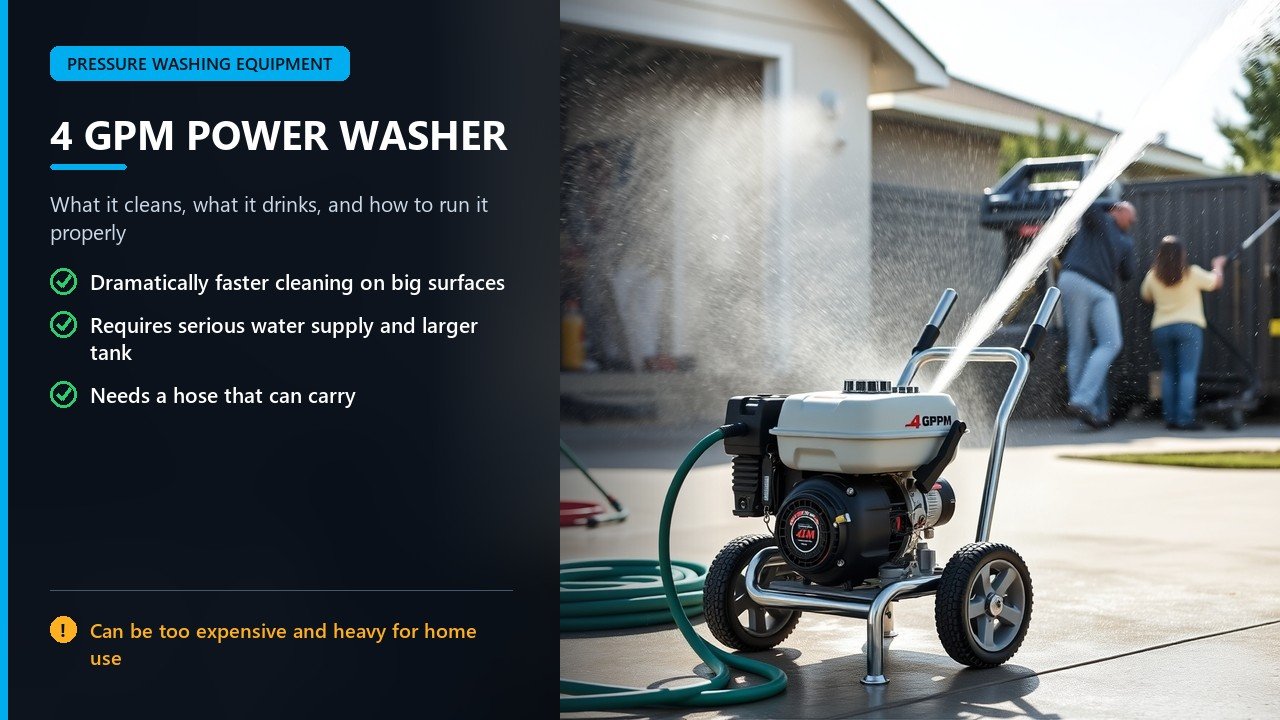
What 4 GPM Actually Means
GPM stands for gallons per minute, the volume of water the pump pushes through the nozzle. It is the flow half of the cleaning equation, and it is the half most buyers underrate. Pressure, measured in PSI, decides how hard the water hits the surface. Flow decides how much water hits it per second, and therefore how fast dirt is carried away. A high-pressure trickle cleans a narrow stripe slowly; a high-flow stream covers ground.
Four gallons per minute is roughly double the flow of a typical 2 GPM electric washer and well above the 2.5 to 3 GPM many gas machines deliver. That extra volume is why a 4 GPM unit feels dramatically faster on big surfaces, and also why it demands a serious water supply, a larger tank, and a hose that can carry the load without choking it. Our overview of why flow rate decides how fast you clean explains the reasoning behind the number.
Cleaning Power: PSI Times GPM
The industry shorthand for overall cleaning ability is cleaning units, calculated by multiplying pressure by flow. A machine running 4,000 PSI at 4 GPM produces 16,000 cleaning units, which is a professional-grade figure. The same pressure at 2.5 GPM produces only 10,000 units, a third less work done per hour despite identical pressure.
This is why a 4 GPM washer at a moderate pressure often out-cleans a higher-pressure machine with lower flow. Rising pressure adds impact, but rising flow adds coverage, and coverage is what finishes jobs. A good example of a high-flow machine is the Generac XC Series, which pairs 4.0 GPM with 4,200 PSI on a three-wheel frame with a five-gallon bucket holder. The 4,000 PSI and 4 GPM combination is the classic benchmark for a reason, and you can read more in our guide to the 4,000 PSI, 4 GPM combo.
Formula: Cleaning units = PSI x GPM. A 4,000 PSI, 4 GPM machine scores 16,000. Compare machines this way rather than by pressure alone.
How Fast a 4 GPM Washer Cleans
Speed is where the extra flow pays off. Because a 4 GPM machine delivers nearly twice the water of a 2 GPM unit, it clears the same surface in roughly half the time, and often better, because the extra volume flushes debris instead of merely blasting it. On a large driveway or a commercial flatwork job, that difference turns an all-day task into a few hours.
The gain is not just physical but economic. For anyone charging by the job, cleaning twice as fast means twice the jobs per day, which is why professional cleaners reach for flow rates in this range. The trade is that the machine needs more water, more powerful support equipment, and a bigger budget, all of which we will cover. If you are weighing flow classes, our shopping guide for a 4,000 PSI, 4 GPM machine walks through the decision.
The Water Supply Problem
Here is the catch that trips up new 4 GPM owners: the machine can only push out what it is fed. A 4 GPM pump pulling from a weak supply will starve, cavitate, and lose pressure, and over time that starvation damages the pump. Your water source has to deliver at least 4 GPM at pressure, ideally with some margin, for the washer to run as rated.
Most household taps can supply around 4 to 8 GPM, which is enough on paper, but the figure drops sharply once you add a long garden hose. A narrow or lengthy supply hose adds friction and restricts flow, so a tap that tests fine at the spigot may deliver far less at the pump inlet. This is the single most common reason a 4 GPM washer underperforms, and it is a supply problem, not a machine problem.
Feeding 4 GPM from a Garden Hose
To keep a 4 GPM machine fed from a tap, maximize the supply line. Use a short, wide hose, ideally five-eighths or three-quarters of an inch, and avoid long runs or multiple coupled hoses. A half-inch hose over a long distance will strangle the flow, while a three-quarter-inch hose of modest length keeps the inlet pressure up.
Check for other demands on the same line, because a washing machine or sprinkler running at the same time steals flow. If the machine surges or the engine labours, the supply is almost certainly the cause. Some operators fit a pressure gauge at the pump inlet to confirm the machine is getting what it needs. Our guide to water pipe and supply lines covers sizing the feed correctly.
Using a Tank and Float
When a tap cannot keep up, a buffer tank solves the problem. A tank with a float valve fills from the tap while the washer draws from the tank, so the machine always has a reservoir to pull from even if the incoming flow is uneven. This smooths out the supply and lets a 4 GPM washer run continuously where a direct hookup would starve.
For true mobility, a tank lets you work with no tap at all, which is why mobile rigs carry one. Size the tank to run for the minutes you need between refills, remembering that four gallons per minute adds up fast: twenty minutes of cleaning uses eighty gallons. Our guide to water tank sizes and buffer setups helps you choose.
Nozzle Sizing for 4 GPM
Nozzles are matched to flow, and this is where many owners accidentally throttle their own machine. A nozzle that is too small for 4 GPM raises pressure but restricts flow, starving the pump and overheating it. A nozzle that is too large drops pressure and washes weakly. The right nozzle flows four gallons per minute at your working pressure.
Nozzles are sold with a size number that corresponds to flow at a reference pressure, so a 4 GPM machine wants a nozzle rated for 4 GPM at its operating pressure. Using the nozzle from a smaller machine will choke the pump, while using one for a larger machine wastes pressure. When in doubt, check the nozzle chart for your flow and pressure, and never run a 4 GPM pump through a tip meant for 2 GPM. Our nozzle guide and the color code explainer cover the matching rules.
The Nozzle Color Chart
The colour of a quick-connect nozzle tells you the spray angle, and thus the pressure and coverage. Choosing the angle is the everyday decision for a 4 GPM operator.
| Colour | Angle | Best for |
|---|---|---|
| Red | 0 degrees | Tough stains on concrete, spot blasting |
| Yellow | 15 degrees | Heavy-duty stripping and paint removal |
| Green | 25 degrees | General-purpose cleaning, the everyday tip |
| White | 40 degrees | Gentle work on cars, windows, and siding |
| Black | 65 degrees | Low-pressure soap application |
On a 4 GPM machine, the green 25-degree tip is the workhorse for concrete and general cleaning, while the white 40-degree tip protects delicate surfaces. The larger flow means even the gentle tips clean well, because volume compensates for the wider spray.
Hose Size for 4 GPM
A 4 GPM pump needs a hose that does not restrict it, which points toward a three-eighths inch high-pressure hose rather than a quarter inch. The narrower hose adds friction loss that drops pressure at the nozzle, and at four gallons per minute the penalty is noticeable. Three-eighths inch is the standard choice for this flow class for exactly that reason.
Length matters as well, because every extra foot of hose costs a little pressure. Keep the working hose as short as the job allows, and choose a hose rated well above your machine’s pressure and temperature. Our guide to why high-flow machines use a 3/8 inch hose explains the relationship between bore and flow.
Engine and Pump Requirements
Producing four gallons per minute at high pressure takes real power. As a rough rule, a pressure washer needs on the order of one and a half horsepower per gallon per minute per thousand PSI, so a 4 GPM, 4,000 PSI machine demands a substantial engine. That is why 4 GPM units typically use fifteen-horsepower-class gasoline engines or large electric motors, not the small engines found on budget machines.
The pump should be an industrial triplex plunger design rather than an axial cam, because triplex pumps are built for continuous commercial duty and hold up to the flow and heat. A commercial example is the Canpump 15 hp gas washer, which uses a hollow-shaft triplex pump with a detachable unloader and extended bypass. Look for an external unloader with a bypass, a thermal relief valve, and a feed that returns water to the tank when the trigger is released. Those features protect the pump during the pauses that are part of every job. A belt-drive pump runs slower and cooler than a direct-drive unit, which adds life at this power level. See our comparison of triplex and axial cam pumps.
Electric vs Gas at 4 GPM
Both power sources can reach 4 GPM, but they suit different situations. Gasoline engines deliver this flow from a compact, portable, fuel-independent machine, which is why most 4 GPM washers are gas powered. They start anywhere, need no electrical supply, and put big power in a package you can wheel to a job.
Electric 4 GPM machines run cleanly and quietly with no exhaust, but they draw serious current, often on a 230-volt circuit, so they need a suitable power supply and are usually stationary or skid mounted. An industrial electric unit can be a base-mount or a cart, wired into a dedicated circuit. A representative example is the Cam Spray 4000GEAR, a 10 hp, 230-volt base-mount machine delivering 4,000 PSI at 4 GPM with ceramic plungers and stainless steel valves. Choose electric when you have fixed power and want no fumes, and gas when you need to work anywhere. Both need the same attention to water supply and hose sizing.
Hot Water at 4 GPM
Four gallons per minute is also a productive flow for hot water cleaning, where heat breaks down grease that cold water cannot touch. A hot water machine at this flow pairs the cleaning speed of high volume with the dissolving power of heat, making it ideal for fleet washing, engine degreasing, and commercial kitchens. Such a machine often pairs a gasoline engine with a diesel or oil burner.
Hot water adds cost, weight, and maintenance, and the heating coil needs protection in winter, but for grease-heavy work the combination is hard to beat. If most of your jobs involve oil and grime, the hot water version of a 4 GPM machine pays back quickly. Our guide to how a hot water machine heats explains the heating side.
Detergent and Downstream Injection
At 4 GPM, downstream injection becomes genuinely effective. A downstream injector draws detergent into the flow after the pump and delivers it through the nozzle at low pressure, which is the standard way to apply cleaning chemicals. The higher flow of a 4 GPM machine carries the detergent across the surface faster and more evenly than a lower-flow unit, so the chemical works harder and you rinse less.
Pair the injector with a detergent tank sized to the job, and remember that the soap tip or a low-pressure nozzle is what activates drawing. Because a 4 GPM washer covers ground quickly, staying ahead of it with detergent can be the limiting factor on a big job, so plan your chemical use. Getting the mix and the nozzle right turns the machine into a fast, thorough cleaning system rather than just a pressure hose.
Time and Productivity Math
It is worth doing the numbers before you buy. Take the area you clean, estimate how many square feet per minute the machine covers, and compare flow classes. Doubling flow does not quite double coverage, because overlap and technique cap the gain, but it comes close on flatwork and large surfaces. On small or delicate jobs, the advantage shrinks, and a smaller machine may be easier to handle.
The practical takeaway is that 4 GPM is the flow where speed becomes a business advantage. Consider a modest driveway of eight hundred square feet: a 4 GPM machine may clear it in under an hour, while a 2 GPM unit could take twice as long and still leave more rinse passes. Scale that up to a commercial lot and the gap becomes hours per job. If you clean large areas regularly, the time saved dwarfs the extra cost of the machine and its support gear. If your work is light and occasional, a 2 to 3 GPM machine will do the same jobs more cheaply, just more slowly. Match the flow to the workload, not to the biggest number available.
Common Mistakes to Avoid
Most 4 GPM disappointments trace back to the same avoidable errors. Watch for these.
- Feeding the machine from a long, narrow garden hose that starves the pump.
- Using a nozzle sized for a smaller machine, which chokes flow and overheats the pump.
- Running a quarter-inch hose, which robs pressure at this flow rate.
- Ignoring other water demands on the same supply line.
- Choosing a machine with an axial cam pump when a triplex is needed for continuous duty.
- Forgetting the pump needs a bypass and thermal relief for trigger-off pauses.
Each of these is easy to fix at the planning stage and expensive to discover mid-job. A 4 GPM washer rewards correct support equipment, and punishes shortcuts with lost performance and shortened pump life.
Example 4 GPM Machines
The table below shows how real machines in this class differ, from a commercial gas unit to an industrial electric base mount. Use it to see how the same flow can wear very different clothes.
| Machine | Pressure and flow | Power and pump | Notable spec |
|---|---|---|---|
| Generac XC gas | 4,200 PSI, 4.0 GPM | Gas, direct drive | 3-wheel frame, 5 gal bucket holder, 35 ft hose |
| Canpump commercial gas | 4,000 PSI, 4.0 GPM | 15 hp engine, triplex pump | Detachable unloader with extended bypass |
| Cam Spray electric | 4,000 PSI, 4.0 GPM | 10 hp, 230 V, base mount | Ceramic plungers, stainless valves, 50 ft hose |
Notice how the gas machines trade power for portability while the electric unit trades mobility for clean, quiet, high-current operation. All three move the same four gallons per minute, so the choice comes down to where and how you work.
Maintenance for a 4 GPM Machine
A machine working this hard deserves a maintenance routine. Check the pump oil regularly and change it at the interval in your manual, using the correct grade, because a starved or dirty pump fails faster than almost any other part. Inspect the inlet filter and clear debris that could restrict the feed, and keep the supply hose in good condition so the pump never goes short.
Watch for leaks at the unloader and connections, and check the nozzle for wear that changes the spray pattern. A worn nozzle lets more water through and drops pressure, which hurts performance and can also starve the pump if the tip grows too large. Replace worn tips promptly, and keep a spare set on hand so a damaged nozzle never stops a job. Store the machine properly through winter, draining the pump and hose and protecting the pump with antifreeze, because a frozen 4 GPM pump is an expensive repair. Our guide to the 4 GPM washer with a Honda engine covers engine-specific care.
How 4 GPM Compares to Other Flow Classes
Placing 4 GPM against its neighbours helps you judge whether the step up is worth it. A 2 GPM electric washer is fine for cars, patio furniture, and small decks, but it takes patience on a driveway. A 2.5 to 3 GPM gas machine is the common homeowner upgrade, faster and more capable but still modest. At 4 GPM you enter commercial territory, and above it flows of 5, 5.5, or even 8 GPM serve serious contract work and fleet washing.
The jump from 3 GPM to 4 GPM is a third more water, which is a noticeable gain on flatwork but a smaller leap than doubling. The real question is what you clean and how often. For a professional doing large surfaces daily, the difference between 3 and 4 GPM is several jobs a week. For a homeowner washing one driveway twice a year, it is a convenience you may not need. Match the flow to the frequency and size of the work, not to the appeal of a bigger number.
When 4 GPM Is the Wrong Choice
Despite its strengths, a 4 GPM washer is not right for everyone. If your water supply is weak and you cannot add a tank, the machine will starve and underperform, no matter how capable it is. If your work is delicate, such as cleaning vehicles or painted surfaces at close range, the extra flow and pressure demand more skill, because the same setting that speeds up concrete can strip paint if you are careless.
A 4 GPM unit is also heavier and thirstier than a smaller machine, which means more fuel, more water, and more effort to move around a tight site. For occasional home use, the cost and the supply requirements rarely pay off. The honest answer is that a 4 GPM washer earns its place when you have the water, the space, and the workload to justify it. Buy the flow that fits the work; overshooting brings as many problems as undershooting, and a machine you cannot feed is no faster than a smaller one that runs properly.
Frequently Asked Questions
Is 4 GPM good for a pressure washer?
Yes, 4 GPM is a strong commercial flow rate. It is about double a typical electric washer and delivers the volume that speeds up large-surface cleaning, which is why it is common on professional machines. It does require a matching water supply and hose.
What size nozzle does a 4 GPM pressure washer need?
A nozzle rated to flow 4 GPM at your working pressure. Using a smaller tip chokes the pump and builds heat, while a larger tip drops pressure. Check the nozzle chart and never run a 4 GPM pump through a tip meant for a smaller machine.
Can a garden hose feed a 4 GPM pressure washer?
Sometimes, if the tap delivers enough and the hose is short and wide, ideally five-eighths or three-quarters of an inch. Long or narrow hoses restrict flow and starve the pump, which is the most common cause of lost performance on a 4 GPM machine.
How much horsepower does a 4 GPM washer need?
Producing 4 GPM at high pressure takes substantial power, on the order of fifteen horsepower for a 4,000 PSI unit. That is why these machines use large gas engines or big electric motors rather than the small engines found on budget washers.
What hose size for a 4 GPM pressure washer?
Three-eighths inch is the standard for this flow class, because a quarter-inch hose adds friction loss that costs pressure at the nozzle. Keep the hose as short as the job allows and rate it above your machine’s pressure and temperature.
Is 4 GPM too much for home use?
For light, occasional cleaning, a 2 to 3 GPM machine is usually enough and easier to feed and handle. A 4 GPM washer suits larger or frequent jobs, or anyone who wants to clean big surfaces quickly. Match the flow to your workload.
The Bottom Line
A 4 GPM power washer is the flow class where cleaning speed becomes a real advantage. The extra volume roughly halves the time on large surfaces and pushes cleaning units into professional territory when paired with high pressure. But the machine only performs as well as the system around it, which means a supply that can actually deliver four gallons per minute, a nozzle sized to that flow, a three-eighths inch hose, and a triplex pump built for the duty. Get the support gear right and it will outwork smaller machines all day, finishing large surfaces in a fraction of the time. Starve it on water or choke it with the wrong nozzle, and you will blame the machine for a problem that was never its fault.