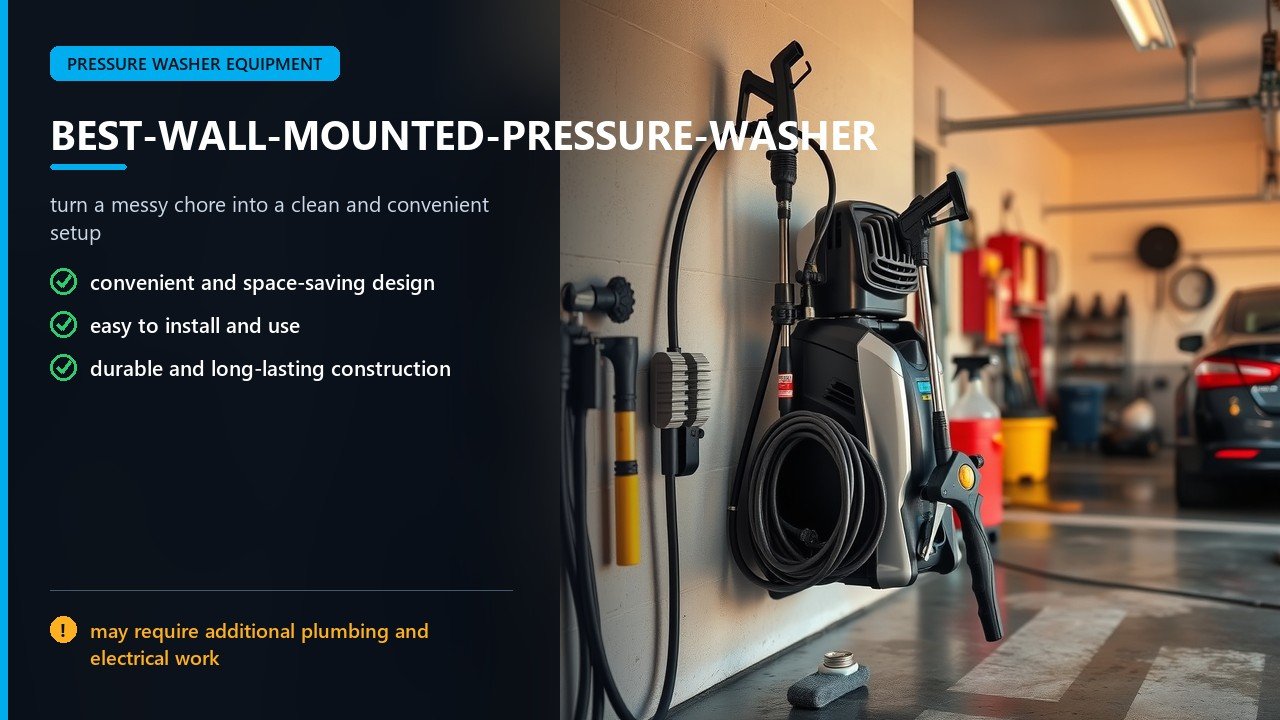
The best wall mounted pressure washer turns a messy, haul-it-out chore into a clean setup that is always ready. Mounted on a garage or wash-bay wall, these machines keep the pump, hose, and gun off the floor and within reach, so cleaning a car, a driveway, or a shop floor takes seconds to start instead of minutes of unpacking. For anyone who cleans often, that convenience changes how much they actually use the machine.
When Erin fitted a wall-mounted washer in her detailing bay, the change was immediate. No more dragging a cart across the driveway, no more tangled hose on the floor, no more leaving the unit out because it was too much hassle to put away. Everything hung on the wall, coiled and ready, and she cleaned her own vehicles far more often because starting took almost no effort. That is the real promise of a wall-mounted pressure washer.
This guide covers the best wall mounted pressure washers by category: all-in-one retractable units for home and detailing, compact electric washers that adapt to wall brackets, premium quiet machines, and commercial wash-bay systems. It explains what to look for, how to match the machine to your power supply, how to install it safely, and how to keep it running.
Quick Note: Wall-mounted pressure washers fall into three groups: all-in-one retractable units such as the Giraffe Tools Grandfalls Pro, compact electric washers that accept a wall bracket, and commercial wash-bay systems from brands like Canpump, BE, and Tomahawk. Match the machine to your power supply, your cleaning volume, and how much wall you have.
Why Mount a Pressure Washer on the Wall?
A wall mount solves the two biggest frustrations of pressure washing: storage and setup. A machine on the floor is always in the way, and getting it out, uncoiling the hose, and connecting everything is enough friction that many owners skip cleaning altogether. Mounting fixes both problems.
The benefits are practical:
- Space saved. The machine and, in all-in-one units, the hose reel live on the wall, off the floor, where they are out of the way of vehicles and foot traffic.
- Instant readiness. With the hose coiled and the gun holstered, a wall-mounted washer is seconds from running.
- Protection. Off the floor, the machine is safe from being run into, stepped on, or soaked by standing water.
- Tidy hose handling. A built-in reel or a wall-mounted boom keeps the high-pressure hose coiled and away from tangles and traffic.
- Indoor-friendly power. Wall-mounted electric washers avoid exhaust and the noise of a gas engine, which is ideal for garages and enclosed bays.
The concept is the same as any fixed tool station: put the tool where you use it, and you will use it more. Our broader guide to the pressure washer mount covers skid, trailer, and truck options if your work travels instead of staying in one place.
The Best Wall Mounted Pressure Washers by Category
There is no single “best” machine because the right choice depends on whether you are a homeowner, a detailer, or a commercial wash-bay operator. The table below maps the main categories to representative examples.
| Category | Example | Best For |
|---|---|---|
| All-in-one retractable | Giraffe Tools Grandfalls Pro | Home garages, driveway and car cleaning |
| All-in-one compact | Comet 1700 wall-mount | Tidy garage detailing setups |
| Premium quiet | Kranzle-class units | Detailers who value low noise and long life |
| Compact mountable electric | Ryobi, Sun Joe, Karcher | Budget-conscious light-duty use |
| Commercial wash bay | Canpump, BE, Tomahawk | Shops, fleets, professional wash bays |
All-in-one retractable units are the most convenient choice for home use. The Giraffe Tools Grandfalls Pro, tested by Bob Vila, earned a 4.5/5 rating for its wall-mounted, always-ready design and retractable hose, delivering a genuinely tidy installation that changed how often the tester cleaned. For a homeowner who wants one machine on the wall with everything integrated, this class is the answer.
Compact wall-mountable electrics from Ryobi, Sun Joe, and Karcher are affordable and light, and with a bracket they can live on a garage wall. They deliver modest pressure and flow — enough for cars, patio furniture, and light concrete — and they suit occasional use and tight budgets. They are noisy relative to premium units, so consider a lower-noise machine if the washer shares a wall with living space.
Premium quiet machines such as Kranzle-class units appeal to detailers who clean daily and value durability, low noise, and repairability. They cost more but last for years and sound far more civilized than budget electrics. If your wall-mounted washer will run every day, a premium unit is often the better long-term buy.
Commercial wash-bay systems are a different league. The Canpump wall-mounted range spans 2 to 5 HP motors with Total Stop System control and integrated hose reels, delivering 1,500 to 2,500 PSI at 2.0 to 3.1 GPM on 120V or 240V. The BE Power 2000 PSI wall-mounted unit and Tomahawk wall-mount systems with a ceiling boom serve professional bays where uptime and floor-space savings matter most.
What to Look For in a Wall Mounted Pressure Washer
Whatever the category, a handful of specifications separate a good wall-mounted machine from a poor one.
- Pressure and flow. Match these to your work. Cars and light cleaning need 1,500–2,000 PSI and modest flow; concrete and heavier jobs want more. Cleaning power is the product of pressure and flow.
- Motor type. Induction (brushless) motors run cooler, quieter, and longer than universal motors — a key advantage in a fixed installation.
- Total Stop System (TSS). This stops the motor when the trigger is released, saving power and reducing noise and wear. It is a must on commercial wall mounts.
- Hose and reel. A built-in reel or a wall-mounted boom keeps the hose tidy. Check the hose length and diameter for your reach and flow needs, and see our hose reel guide.
- Mounting hardware and weight. Confirm the bracket, the machine weight, and the fasteners are suited to your wall material.
- Power requirement. Confirm the motor’s voltage and amperage against your circuit; a dedicated circuit is usually required. Our electric machine hose guide covers related electric-machine fittings.
- Noise level. A fixed machine shares your space, so a quieter unit is worth the premium.
Matching the Machine to Your Power Supply
Because wall-mounted washers are usually electric, the power supply is the constraint that decides what you can install. Confirm these numbers before you buy.
| Motor Size | Typical Voltage / Amps | Circuit Needed |
|---|---|---|
| ~2 HP | 120V / ~16 A | Dedicated 20 A circuit |
| ~4–5 HP | 240V / ~17–22 A | Dedicated 30 A circuit |
| ~6–10 HP | 208–575V / varies | Dedicated circuit, possibly 3-phase |
A fixed wall-mounted machine should almost always have its own circuit. Sharing a circuit invites tripped breakers under load, and a pressure washer’s motor draws heavily at startup. Where required, install a disconnect near the machine and provide proper grounding and GFCI protection for wet environments. If you are unsure, have a licensed electrician assess your service — the cost of doing it right once is less than the cost of electrical problems later.
Note: Match the machine’s voltage and amperage to a dedicated circuit. A wall-mounted pressure washer draws high current at startup, especially with an induction motor. Use a qualified electrician and provide proper grounding and GFCI protection for a permanent, safe installation.
How to Install a Wall Mounted Pressure Washer
Installation is straightforward but should be done carefully, because a heavy machine on a wall is a safety matter.
- Choose the location. Mount it where the hose reaches your cleaning area, the water supply is close, and the power connection is convenient, ideally out of direct weather.
- Find solid structure. Fasten into studs, masonry, or a reinforced backing board. Drywall anchors alone are not adequate for the machine’s weight and vibration.
- Use the right hardware. Rated lag bolts or masonry anchors with washers, spaced per the manufacturer’s bracket.
- Mount the bracket or frame level, then hang or bolt the machine as designed.
- Connect the water supply with a proper feed hose, and confirm adequate flow for the machine.
- Connect power to the dedicated circuit, with grounding and GFCI where required.
- Install the hose reel or boom and route the hose to avoid sharp bends and hot or sharp surfaces.
- Test under load, checking for leaks, vibration, and secure fasteners before regular use.
Once installed, check fasteners periodically, since a fixed machine still vibrates. A wall mount that works loose is both a hazard and a source of leaks.
Cold Water or Hot Water on the Wall?
Most wall-mounted machines are cold water. That covers cars, concrete, siding, and general exterior cleaning, which is what the vast majority of home, garage, and light-commercial walls serve. Cold water is simpler, cheaper, and needs no fuel or venting.
Hot-water wall-mounted systems exist for professional bays where grease and oil demand heat, but they are typically stationary commercial units with a gas or electric burner. The trade-off mirrors the rest of the category: hot water cleans grease far better but costs more, needs fuel and proper ventilation, and requires more maintenance. For a home garage or a detailing bay, cold water is almost always the right choice.
If you do clean grease or oil regularly, weigh whether a hot-water machine or a smaller propane or diesel unit better fits your work. Our guide to the propane powered pressure washer covers clean-burning hot water for mobile and fixed use.
Maintenance of a Wall Mounted Pressure Washer
A fixed machine rewards a simple, regular routine.
- Winterize thoroughly. A garage wall machine can freeze. Drain and protect the pump, hose, and gun before cold weather — our pump saver guide covers the routine.
- Check fasteners and mounts periodically for loosening from vibration.
- Inspect the hose, O-rings, and couplers and replace worn parts; our coupler guide explains the connections.
- Clean the inlet filter to protect the pump from debris.
- Keep the gun and nozzles in good order, and store spares of both; see our nozzle guide.
- Service induction motors rarely, but keep them clean and dry and free of dust that blocks cooling.
Because the machine lives in one place, maintenance is easier to remember than with a machine that disappears into a shed. A short seasonal check keeps a wall-mounted washer reliable for years.
Wall Mount vs. Cart vs. Skid: Which Fits You?
A wall mount is not the only way to organize a pressure washer, and knowing when it beats the alternatives keeps you from buying the wrong format.
A cart machine rolls to the work. It is the most familiar format and the cheapest, but it lives on the floor, takes up space, and must be dragged out and packed away each time. For occasional homeowners who also clean far corners of a large property, a cart’s mobility is a real advantage that a fixed wall mount cannot match.
A skid or truck mount carries the machine between properties. It suits professional operators who travel and need water, fuel, and reels onboard. If your work moves, a wall mount is the wrong tool entirely, and our guide to the pressure washer mount explains skid and trailer options.
A wall mount wins when you clean in one place, often, and want zero setup friction, a tidy footprint, and protection from floor hazards. It is the ideal format for a home garage, a detailing bay, or a commercial wash bay where the same location hosts every job. The decision is simple: if the work stays put, mount it; if the work travels, cart or skid it.
| Format | Best When | Weakness |
|---|---|---|
| Wall mount | You clean in one place, often | Not portable |
| Cart | Occasional use across a property | Floorspace, setup hassle |
| Skid / truck | Professional mobile work | Cost, vehicle needed |
Comparing Wall-Mounted Options Head to Head
Once you have decided a wall mount fits your work, compare machines on the factors that actually differ between them: power and flow, motor type, hose handling, control system, and power requirement. A homeowner, a detailer, and a commercial operator will weight these differently.
For a homeowner, the priorities are convenience and a tidy result. An all-in-one retractable unit scores highest because the hose, gun, and nozzle storage are integrated, so nothing is left loose. For a detailer, motor durability, noise, and repairability rise in importance, which favors a premium unit even at a higher price. For a commercial bay, uptime, Total Stop control, hose reel capacity, and duty cycle dominate, which points to a purpose-built system rather than a repurposed consumer machine.
A useful exercise is to ask three questions: How often will I use it? How hard will I run it? And how much can I spend? Occasional, light use across a home garage is a different machine from daily, sustained use in a business. Buy for the middle of those answers, not the extremes, and you will land on the right unit. If you decide you need more output than a typical wall mount delivers, our articles on the 4,000 PSI, 4 GPM benchmark and the 5 GPM class explain where higher-performance machines fit.
Accessories That Complete a Wall Setup
A wall-mounted machine is only as good as the accessories around it. A small set of additions turns a mounted washer into a complete station.
- A hose reel or boom. The single most important accessory. A reel keeps the high-pressure hose coiled, protected, and organized, and it eliminates the tangle that ruins the convenience of a wall mount.
- A gun and nozzle holder. Giving the gun and tips a dedicated home keeps them off the floor and within reach.
- A foam cannon for vehicle cleaning, popular with detailers and home users alike.
- Quick-connect couplers and a spare O-ring set, so changing accessories is fast and leak-free — see our coupler guide.
- A surface cleaner for flatwork, and a turbo nozzle for stubborn spots — our surface cleaner guide covers matching one to your machine.
- A water filter and inlet screen to protect the pump from debris, especially on a plumbed supply.
- Spare nozzles in case of loss or wear; our nozzle guide explains selection.
Buy these with the machine where possible — bundled kits usually cost less than buying piecemeal, and they ensure the station is complete from the first use. The reel in particular transforms a wall mount from “a machine on the wall” into a genuinely tidy setup.
Quick Note: A hose reel is the accessory that makes a wall mount worthwhile. Without organized hose storage, a wall-mounted washer is just a machine bolted to the wall; with a reel or boom, it becomes an always-ready station that is a pleasure to use.
What Wall-Mounted Pressure Washers Cost
Prices track the category closely, so knowing the bands helps you budget realistically.
- Budget mountable electrics: roughly $100 to $250. Light-duty, often universal motors, suitable for cars and small jobs. You usually add a bracket or shelf separately.
- All-in-one retractable home units: roughly $300 to $600. Integrated hose reel, tidy installation, and enough power for driveways, patios, and cars.
- Premium quiet machines: $700 to $1,500 and up. Induction motors, low noise, longevity, and repairability for daily detailers.
- Commercial wash-bay systems: $1,300 to $3,500 and up. TSS control, hose reels, 240V motors, and duty cycles built for business use.
Weigh the sticker price against the whole cost: a $150 machine replaced every other year costs more than a $500 all-in-one that lasts a decade, and a commercial machine that stays running protects far more revenue than it costs. For a fixed installation you intend to keep, buy the durability and features you will want a few years from now, not just what gets you started today.
A Complete Detailing Bay Setup
To make these choices concrete, imagine a two-car garage converted into a detailing bay. The wall holds an all-in-one retractable washer or a premium quiet machine on a reinforced backing board, with a dedicated 120V or 240V circuit. A wall-mounted hose reel pays out the high-pressure hose to reach both sides of a vehicle and the driveway beyond. A holder keeps the gun and nozzles organized, and a foam cannon hangs beside it. The water supply is plumbed with a filter and a short, large-diameter feed hose, and the floor drains so standing water never reaches the machine.
In this setup, cleaning a car takes seconds to start: pull the hose, grab the gun, and squeeze the trigger. No dragging, no untangling, no packing up. That reduction in friction is the entire point of a wall mount, and it is what separates a machine you use weekly from one you avoid. Whether your bay houses a compact electric or a commercial system, the principle is the same: keep everything on the wall, ready to go.
Common Mistakes to Avoid
- Mounting into drywall alone. Always fasten into solid structure capable of holding the machine’s weight and vibration.
- Sharing a circuit. A wall-mounted washer needs a dedicated circuit, especially with an induction motor.
- Ignoring noise. A fixed machine shares your space; an unnecessarily loud one becomes a regret.
- Choosing hot water unnecessarily. Cold water covers most home and light-commercial needs for far less money.
- Skipping winterization. Freezing water is the leading destroyer of fixed electric machines.
- Undersizing the hose and reel. A small hose on a capable machine throttles performance; match them.
- Neglecting fasteners. Vibration loosens mounts; check them regularly.
- Forgetting water flow. Confirm the supply delivers enough GPM, or the pump will starve.
Frequently Asked Questions
What is the best wall mounted pressure washer? For home and garage use, all-in-one retractable units such as the Giraffe Tools Grandfalls Pro are the most convenient. For professional wash bays, commercial systems from Canpump, BE, and Tomahawk are the standard. For quiet daily use, premium machines like Kranzle-class units excel.
Can I mount any pressure washer on a wall? Many compact electric washers can be mounted with a bracket, but they must be light enough and have mounting provisions. Heavy commercial units need a purpose-built wall bracket and solid structure.
How much power does a wall mounted pressure washer need? Small units can run on a dedicated 120V circuit, while larger 4–5 HP machines typically need a dedicated 240V circuit. Commercial machines may need 208–575V, sometimes three-phase.
Are wall mounted pressure washers powerful enough? For cars, patios, and light concrete, yes. For heavy concrete and grease, a higher-output machine or a hot-water commercial unit is needed. Match the machine to the job.
Do wall mounted pressure washers need a water supply? Yes. They connect to a garden hose or a plumbed line, and the supply must deliver at least the machine’s GPM — with some margin — or the pump will cavitate.
Can I install a wall mounted pressure washer myself? Many homeowners install the mount and machine themselves, but the electrical work should be done correctly, ideally by a licensed electrician, especially for 240V and GFCI requirements.
How high should I mount a pressure washer on the wall? Mount it low enough that you can reach and service the machine comfortably, and high enough to keep it clear of standing water and floor hazards. Follow the manufacturer’s bracket guidance and leave room to access the pump, filter, and controls.
Do wall mounted pressure washers come with a hose reel? Some all-in-one and commercial units include one; others do not. If yours does not, budget for a wall-mounted reel, because organized hose storage is what makes a wall setup genuinely convenient.
Is a wall mounted pressure washer worth it? For anyone who cleans in one place and does so regularly, yes. The eliminated setup friction means the machine gets used more, which is exactly what a tool is for. For occasional use across a large property, a cart may serve better.
What hose length do wall mounted washers use? Lengths vary by model, from around 20 feet on compact units to 50 feet on commercial systems. Choose a length that reaches your cleaning area without excessive leftover hose, and organize it on a reel or boom.
Can a wall mounted pressure washer be used with a foam cannon? Yes. Most detailer-style wall setups include a foam cannon, and the machine’s flow is ample for thick foam. Use quick-connect fittings so you can switch between the cannon and a regular nozzle in seconds.
Final Thoughts
The best wall mounted pressure washer is the one that fits your space, your power, and your cleaning volume — and that you will actually use because it is always ready. For a home garage, an all-in-one retractable unit like the Giraffe Tools Grandfalls Pro delivers tidy, instant convenience. For a detailing bay, a premium quiet machine such as a Kranzle-class unit rewards daily use with durability and low noise. For a professional wash bay, commercial systems from Canpump, BE, and Tomahawk provide the power, hose reels, and Total Stop control that busy operations require.
Whichever you choose, match the machine to a dedicated circuit, fasten it into solid structure, keep the hose and gun organized, and winterize it faithfully. Do those things, and a wall-mounted pressure washer stops being equipment you dread deploying and becomes a permanent, ready tool that makes cleaning effortless — which is exactly why the wall is the smart place for it.