Parking Lot Pressure Washer: The Equipment That Makes Lot Cleaning Fast
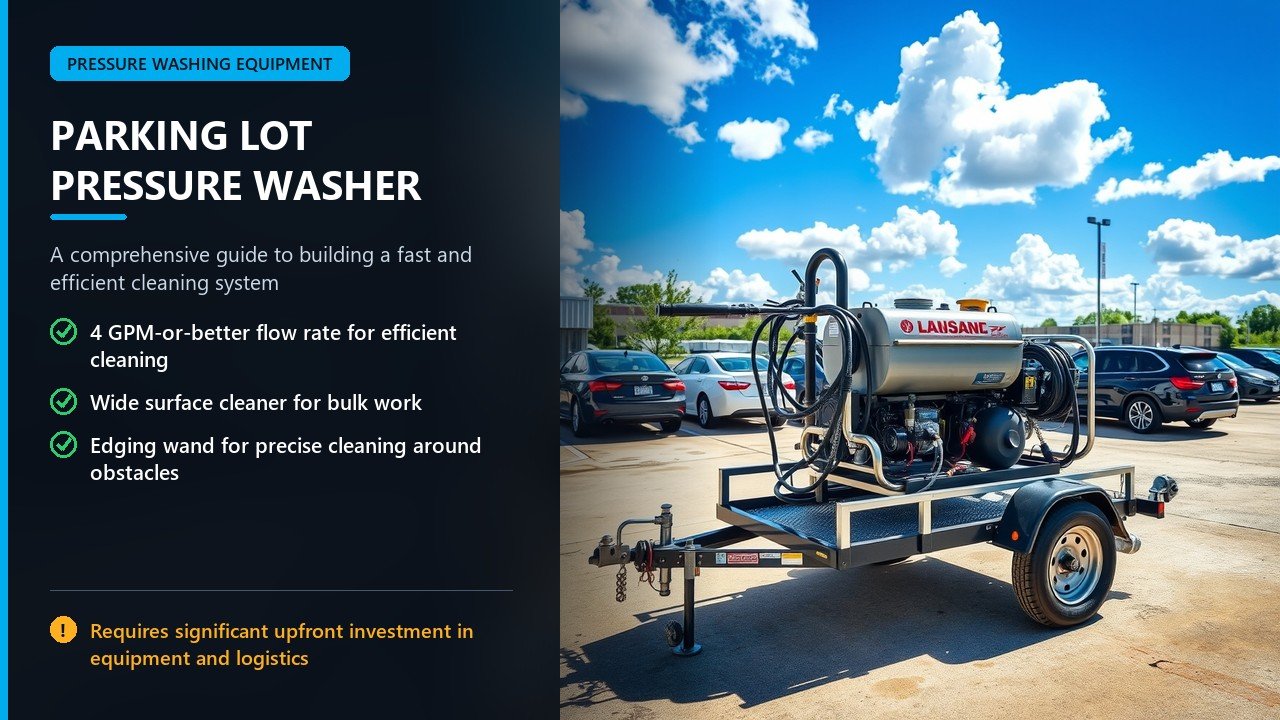
A “parking lot pressure washer” is not one machine. It is a matched system: a 4 GPM-or-better pressure washer, a wide surface cleaner that does the bulk work, a wand for the edges and landscaping, and — for the businesses and municipalities that do this for a living — tanks, chemicals, and water recovery. The machine alone, pointed at the pavement, leaves you kneeling at the curb line all afternoon. The system cleans a showroom-sized lot in a morning.
That is the honest difference between washing a driveway and cleaning a parking lot. Driveways are a weekend job; lots are a business discipline with traffic, oil staining, and environmental rules that decide how the whole operation works. This guide lays out the machine specs, the attachments, the hot-versus-cold call, and the recovery realities so you can build a parking lot cleaning setup rather than guess at one.
Quick Note: For parking lot work, flow rate beats pressure rating every time. A surface cleaner needs 4+ GPM to sweep fast, and no amount of PSI makes a 2.5 GPM machine cover asphalt quickly.
The Problem Parking Lots Present
Parking lots accumulate three different kinds of grime that defeat a casual setup. The first is a slick film of rubber, oil, and tracked dirt that pressure alone just smears — the lot looks clean while it is wet and dull gray the moment it dries. The second is concentrated staining in the dripline: oil and transmission fluid under every parked spot, engine drips at the head of every stall, and gum stamped flat into the surface. The third is biological growth along curbs, fences, and the dark corners where moisture lingers, which cold water rinses but cannot kill.
All three respond to the same professional answer: treat the surface with chemistry, cut the bulk grime with a high-flow rotary cleaner, hot water where the economics justify it, and finish the edges with a wand. That sequencing is why the equipment package matters more than any single attractive number on a spec sheet — a parking lot pressure washer is only as good as the plan it is attached to.
There is a fourth pressure that rarely gets written down but decides every lot job: the first impression. The parking lot is the first and last surface a customer sees — they drive across it before they ever walk through the door, and it frames the entire visit. Property managers budget lot cleaning not because they love the look of clean asphalt but because shoppers, tenants, and health inspectors all read it instantly. Framing the work that way changes the conversation: this is not a maintenance courtesy, it is the exterior face of the business, and it deserves the same equipment thinking as the storefront window.
That framing also explains why lot cleaning is such a repeatable commercial service. Restaurant chains, apartment communities, and retail centers all need it on a rhythm, not once — the stains and film return with the traffic, so the contract renews. An operator who can deliver a clean, dry, striped-free lot on schedule becomes a fixture of the building’s operations rather than a one-time vendor, which is the entire economic case for building a real parking lot cleaning setup instead of improvising with whatever sits in the garage.
Flow Rate Comes First: Why GPM Is the Lot’s Currency
Parking lot cleaning is a surface-covering speed game, and speed is set by gallons per minute. A surface cleaner carries several spinning nozzles inside a shroud; each pass cleans a 20- to 30-inch swath, and the machine’s GPM is what keeps that swath sweeping at a fast walking pace instead of a crawl. Professionals working lots on trucks run 9 to 10 GPM per station with 48- to 72-inch decks for a reason — flow is coverage, and coverage is the day rate.
Pressure, by contrast, is secondary on a cleanable lot. You need enough PSI to cut the film and root out stains — 3,000 to 4,000 PSI is the working range — but adding pressure above that does not make the lot go faster; it just wears tips and raises the risk of scouring the surface. The correct mental model: match PSI to the surface you are cleaning, and buy every extra dollar of budget as GPM. The practical machine chain runs from a 3200 + 4 GPM home-adjacent unit up to the 4 GPM commercial benchmark and beyond, laid out in our 3200 PSI machine guide and the 4000 PSI / 4 GPM benchmark guide.
| Lot Scope | Flow Needed | Surface Cleaner | Who This Fits |
|---|---|---|---|
| Small lot / apartment | 4 GPM | 20 to 24 inch | Property crews, side-work operators |
| Retail / restaurant lot | 5 to 8 GPM | 28 to 36 inch | Small pressure washing businesses |
| Big box / industrial | 8 to 10+ GPM | 48 to 72 inch | Truck-mounted fleet operators |
Hot or Cold for a Parking Lot
Hot water is the difference maker on parking lots, and it shows up in the dripline. Burners that push 200 to 250 degrees melt the petroleum film, lift chewing gum, and make detergent chemists work far harder in the same dwell time. Cold water rinses a lot; hot water degreases it. That is why the commercial machines marketed specifically for parking lot work — like the hot-water rigs from manufacturers such as Daimer — lead with their burner output and steam temperatures rather than merely their PSI.
The honest trade-off is cost and logistics. Hot water machines and their burners are street-priced far above cold units, they drink fuel, and they add a maintenance axis (burner tuning, fuel nozzles, heating coil care) that a cold fleet never touches. For the owner of one retail lot, a good cold 4 GPM system with strong chemicals may be the smarter spend; for a cleaning business bidding dozens of lots, hot water is the competitive edge that justifies the extra money. The full cost-and-application analysis of the hot-versus-cold decision lives in our hot machine guide.
The Surface Cleaner Is the Workhorse
The single most important attachment in a parking lot system is the surface cleaner, the shrouded rotary deck that spins two or more high-pressure nozzles under a brush ring. It marks out stripes for you, holds splash away from your boots, and cleans at a set width on every pass — which is what turns an all-day wanding job into a mid-morning one. The sizing rule follows the machine: a 4 GPM unit drives a 20- to 24-inch deck, 6 GPM feeds 28 inches, and truck-mounted flow pushes the 48-inch-plus commercial decks that clean whole parking stalls in a pass.
Commercial decks worth their price add two details. Casters keep the head rolling smoothly over joint lines instead of dragging, and a solid swivel lets the operator sweep the lot in arcs without fighting torque. Stainless housings shrug off the alkalines used on lot chemistry. The full selection logic, from casters to swivel quality, is covered in our surface cleaner selection guide and the attachment deep-dive.
Read the flow-to-deck matchup carefully, because oversizing is the classic new operator error. A 28-inch deck fed by a 4 GPM machine starves: the nozzles cannot throw a full fan, the head sputters, and the pass slows to a limp instead of sweeping. Undersizing wastes the machine’s flow in a deck too small to matter. The working match is roughly 4 GPM to a 20- to 24-inch head and 5 to 8 GPM to a 28- to 36-inch head, with the truck-mounted rigs running the 48-inch-plus decks at 8 to 10 GPM and up. When the deck is right, the operator moves at a brisk walk and the lot visibly changes in front of them — that is the feeling that separates lot work from scrubbing.
Edging, Curbs, and the Wand Work
A surface cleaner cannot reach everything, and the edges decide whether the job reads as professional. Wheel stops, landscaped curbs, drain grates, light poles, and the strip along the building all need a wand with a compact nozzle. Most operators carry a 15- to 25-degree tip on a trigger gun and work edges, curbs, and stair landings in a second pass while the deck covers open pavement. The flat-surface technique that keeps transitions clean — angle, overlap, and the no-streak finish — is the subject of our flat surface cleaning guide, and the gun-and-wand pairing that makes the edge work comfortable is in our trigger gun guide.
Curbs deserve their own note. Curb faces collect the blackest residue on the property, and they run long enough that a dedicated approach pays: spray a curb cleaner or allow chemistry to dwell, wand the face at moderate pressure, then let the surface cleaner’s rinse pass knock the loose residue to the gutter. Lots cleaned on a weekly or monthly rhythm develop far less curb staining than yearly deep-clean lots, which is why the most profitable contracts include frequency.
Concrete Versus Asphalt
Parking lots come in two very different minerals, and the cleaning plan changes between them. Concrete is hard, porous, alkaline-tolerant, and scours through the upper paste layer when you lean on it too hard — the damage shows as a rough, lighter honeycomb patch. Use moderate pressure, a wider tip, and mild degreasers; heavy acid and tight nozzles are the fast way to permanently erode a concrete surface. Asphalt is darker, softer, and oil-drenched; it reads clean rather easily, but it also erodes under high pressure and heat, so technique matters more than aggression.
The early season is the best time for either surface — cold-weather oil sits harder and is easier to remove before summer heat bakes it into the matrix. For new operators the honest guidance is: walk the lot, test a discreet corner at your intended setting, and scale back on any surface where you see fines, etching, or asphalt tracking under your pass.
Chemicals and the Pre-Treat
Professionals do not show up and start blasting. The standard sequence is pre-treat, dwell, agitate, rinse. A degreaser formulated for driveways or fleet use is applied to the dripline and wheel stops, given time to lift the oil, then rinsed and scrubbed by the machine. Lot-work chemicals fall into the alkaline soap-and-detergent family that pressure washers are built to deliver through a soap system or injector, and the full breakdown of what to use and how to feed it is in our detergent guide and the soap tank explainer.
Zero-in on the dripline: oil concentrate lives where engines drip at stall heads, and a targeted pre-treat there is worth far more than full coverage of a well-washed lot. After rinsing, many commercial operators finish with a light algaecide or biocide along curbs and dark corners to slow the regrowth that cold water alone cannot prevent — the same sequence that turns a monthly cleaning into a routine rather than a restoration.
Chemistry concentration and dwell are the variables most beginners get backwards. Too much chemical stains the concrete and wastes money; too little, and the degreaser never finishes its job before the rinse pass arrives. The professional line is: apply enough pre-treat to keep the dripline visibly wet for the label’s dwell time, agitate with the deck’s water or a soft brush if the lot is badly soiled, then rinse. On hot-water machines the chemistry works faster, so the same product goes twice as far — one more hidden reason the burner pays for itself in chemical consumption as well as time.
Water Recovery and the Rules of the Drain
Everything a parking lot pressure washer lifts off the asphalt ends up in the wash water, and where that water goes is regulated almost everywhere commercial lots are cleaned. Oil-laden runoff must not simply sheet into the storm drain, and many districts require capture or at least best-management practices on contract work. Water recovery is the heavy end of the business: vacuums or recovery decks pick up the rinse water so it can be filtered or disposed of properly rather than routed to the sewer.
For the single-lot owner, the practical form of the rule is simple: do not wash oil into the storm system, absorb runoff spills, and keep the flow away from drains wherever practical. For businesses selling the service, recovery is not optional — it is the differentiator that permits the work at all. The ride-on recovery decks built for decks, garages, and lots (like the tractor-mounted Swirly systems) pair a leading cleaning swath with an onboard dirty-water vacuum so the site genuinely ends clean, with the wash water contained in a tank instead of pooled at the property line.
Even where full recovery is optional, simple containment habits keep lots legal and neighbors friendly. Absorbent booms or a woven sock at the low edge of the work zone catch the oil-laden first runoff before it reaches the grate; sweeping the lot before any washing keeps sediment out of the water entirely; and scheduling the wash away from the afternoon rain lets the residue dry in place to be swept rather than floated into the system. None of these require a truck-scale investment, and all of them are the difference between a neat service and a notice of violation.
Tanks, Trailers, and Site Logistics
Parking lots rarely offer a spigot and a floor drain at the place you need them. Truck-mounted and skid operators solve the water question with onboard tanks: a clean-water tank feeds the washer, and a second tank or recovery system takes the dirty side. Where a garden hose cannot reach, the tank setup is the machine’s lifeblood — the water tank guide and the portable tank explainer cover the flow, filtering, and supply logic that keep a lot operation running through a full day without a faucet.
Tank capacity math is deceptively simple and punitive when wrong. A 4 GPM machine burns 240 gallons an hour at continuous trigger, so a 100-gallon clean-water tank represents well under a working hour between refills — and that is before accounting for rinse passes and the deck at full flow. Work the numbers before you buy: estimate the lot’s gallon demand from the surface area, add the chemistry dwell time and the recovery side, and size tanks for the job with margin. The site without a hose connection is exactly where a promising lot contract quietly dies on its first trip.
Site logistics beyond water are the quiet killers of lot jobs. Traffic control, cone placement, and working with the business’s hours decide whether a lot operation is a Saturday-night job or a Tuesday-midday one. Sunrise and early-evening slots keep the lot usable and the operator safe, and a low-flow day avoids soaking freshly striped paint — details that separate repeatable contracts from one-off calls.
Sequence the site the way professionals do. Arrive while the lot is near-empty, stage the machine and tank at the far edge, close a work zone with cones along the active row, and sweep the parking stalls outward toward the curb and drain. Working chair-row by chair-row rather than hopscotching leaves a visible finished block behind you, protects the crew from driving traffic, and keeps the hose paths short. Every piece of mud on the driveway of your own life is just a smaller version of this same plan, and the lot-grade version simply adds the scale, the chemistry, and the recovery.
Building a Parking Lot Setup: What to Actually Buy
Putting it together from the outside in: start with a machine in the 4 GPM-and-up class, add a surface cleaner matched to its flow, confirm a wand and tips for edging, and add chemicals suited to the surface. For the dedicated buyer, the commercial hardware is on the shelf — brands that build specifically for lot work. Daimer’s parking lot cleaning lineup anchors on hot-water 3500 PSI / 4 GPM machines with steam capability; Mosmatic’s 30-inch commercial surface cleaner is a reference deck for cold and warm water lot work; and Karcher’s self-contained Jarvis surface cleaner bundles engine, pump, and deck for one-step lot and sidewalk service.
Scale matters as much as hardware. One operator with a 4 GPM cart, a 24-inch deck, and a tank cleans retail lots on a schedule; a fleet of trucks with 48-inch decks and recovery wins big-box contracts. The business-case reasoning for the machine sizing, the buyer’s questioning, and the market logic are exactly what our best pressure washer for business guide works through — read it before you spend on a lot system.
The same honesty applies to the water-side setup at home. A lot owner who is simply maintaining their own small lot on the right rhythm usually starts with a solid 4 GPM gas machine and a 20-inch deck — the same platform the apartment and condo crews use — and adds a tank trailer only when the property grows beyond the garden hose’s reach. There is a broader truth: the equipment that cleans a parking lot is the equipment that cleans any large flat surface, so a good lot setup is also the best driveway, patio, and sidewalk setup on the property. Building it around flow rather than peak PSI keeps it useful for every flat surface you will ever stand on.
Common Mistakes With Parking Lot Cleaning
- Buying PSI you do not need. More pressure does not clean a lot faster; more GPM does.
- Wanding the whole lot. Without a surface cleaner, the job triples in time and reads striped and inconsistent.
- Skipping the pre-treat. Chemistry lift before pressure is what actually removes oil and gum; blasting dry film just re-spreads it.
- Ignoring the drain rules. Oil runoff into storm drains is both an environmental and a contract risk.
- Over-pressuring concrete edges. A tight tip on a hard nozzle scours the surface paste permanently.
- Working through business hours. Congested lots are slow, unsafe, and unprofessional to occupy.
- Forgetting the wand pass. The curb line is the first thing the eye checks and the easiest to skip.
Frequently Asked Questions
Is a pressure washer enough to clean a parking lot? A machine alone leaves the edges and the stains; it needs a surface cleaner for bulk coverage, a wand for edges, and chemicals for the oil film to do the job professionally.
What size pressure washer do I need for a parking lot? Start at 4 GPM whether it is electric or gas — that is what drives a 20- to 24-inch surface cleaner at a working pace, and it scales up from there for bigger decks.
Can I pressure wash a parking lot with cold water? Yes, with the right chemicals and technique. Hot water is faster on grease and gum but adds cost and maintenance; many single-lot owners clean effectively cold.
How long does it take to clean a parking lot? Roughly, a 20- to 24-inch deck covers a retail-sized lot in a morning with one operator; larger decks with more flow cut that to hours rather than days.
Do I need a commercial license to clean parking lots? For contract work, you generally need a business setup and compliance with local wash-water rules; the equipment ambitions and the regulatory reality are two different checklists.
Is hot water bad for asphalt? Used carelessly, yes — high temperature on aged asphalt accelerates surface erosion. Keep the stream moving and moderate the heat on the softest surfaces.
Final Thoughts
The parking lot pressure washer that works is the one built around flow. A 4+ GPM machine, a matched surface cleaner, a wand for the edges, the right alkaline chemistry, and a conscious answer to the water-recovery question — that is the complete system, and every piece has a job. Buy the parts you actually need in that order, treat the dripline as the target, and schedule the work when the lot is empty.
And when you are tempted to buy simply “more PSI,” re-read the flow logic: the lot does not care how hard the water hits it; it cares how many square feet you can cover before the sun moves the shadows. Build the system around coverage and the lot will show it.
One final habit separates the operators who make lot work look easy from the ones who fight it: the pass grid. Lap the lot in straight, slightly-overlapping rows and cross the joint lines on the same angle every pass. A grid reads as clean from the storefront windows; hopscotching reads as patchy no matter how hard the machine pushed. That one habit, more than any machine difference, is what makes the same 4 GPM rig read as a commercial cleaning instead of a weekend scrubbing — and it is free.
Quick Reference: Machine 4 GPM+ → deck matched to flow → pre-treat the dripline → deck passes in a grid → wand the edges and curbs → algaecide the dark corners → recover or absorb around drains → schedule in an empty-lot window.