A homeowner named Gail was tired of dragging her pressure washer around the house for every job. Cleaning the far side of the driveway meant moving the machine, reconnecting, and starting over, and by the time she reached the back fence she had earned a break. She bought a 100-foot pressure washer hose so the machine could stay put, and the work got easier immediately. The catch she discovered was that the extra length softened the spray if she did not also think about diameter. The hose solved her reach problem, but it taught her that length and flow trade off against each other.
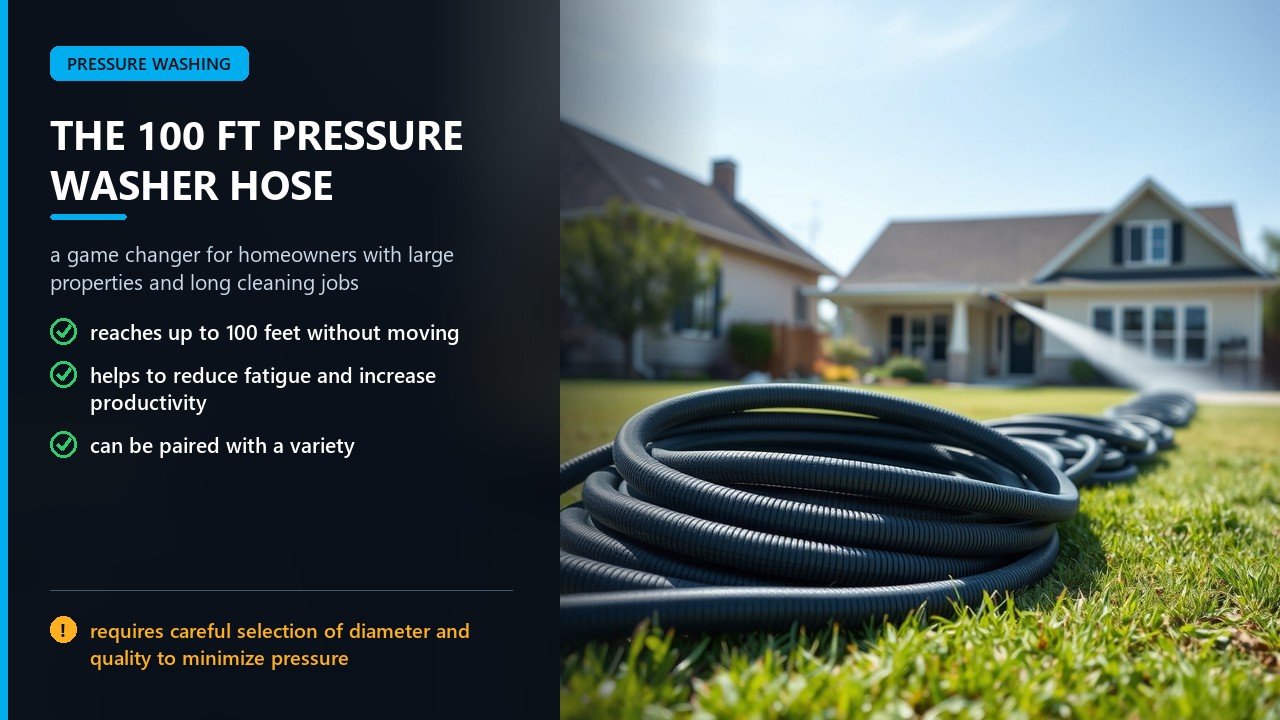
A 100-foot pressure washer hose is the length that frees most owners from moving the machine. It reaches around a house, across a driveway, or down a long fence line while the washer stays near the tap. But long hoses lose pressure to friction, so choosing the right diameter and quality matters more at 100 feet than at 25. This guide explains when a 100-foot hose makes sense, how length affects pressure, how to pick the diameter to offset it, how to manage and store a long hose, and how to avoid the mistakes that turn a helpful tool into a disappointing one.
Why Hose Length Matters So Much
Length is not just about reach. It changes how the machine performs, and understanding why helps you choose well.
Friction loss grows with length. Every foot of hose the water travels adds friction against the inner walls, and that friction costs pressure. The effect is small on a short hose and noticeable on a long one. A machine that feels strong at 25 feet can feel weak at 100, even though nothing changed but the distance. Our guide to length, diameter, and lost pressure explains the relationship.
Diameter controls the loss. A wider inside diameter reduces friction, so a 3/8-inch hose withstands 100 feet better than a 1/4-inch hose. Matching diameter to length is the core skill in choosing a long hose. Our guide to the 3/8-inch high-flow hose explains the standard choice.
Convenience has a price. The reason to go long is to keep the machine in one place and move only the hose. That is a real benefit that saves setup time and effort on every job. The price is some pressure loss, which you manage with diameter and quality rather than avoiding entirely.
Flow matters more than pressure on long runs. On large surfaces, flow is what cleans fast, and long hoses reduce both. A high-flow machine paired with an appropriately wide hose loses less of its advantage over distance, which is why flow and length are considered together. Our guide to why flow rate decides how fast you clean covers the principle.
50 Feet vs 100 Feet vs 150 Feet
Choosing a length means weighing reach against handling and pressure loss. Each length has a role.
25 to 50 feet. The sweet spot for many residential machines. There is little friction loss, handling is easy, and the hose reaches a typical car, small driveway, or patio without moving the machine. Our guide to the 50-foot residential sweet spot covers this range.
100 feet. The practical long-reach choice for homes and small commercial work. It reaches around a house, across a large driveway, or down a fence line, while remaining manageable. With the right diameter, the pressure loss is acceptable on most machines.
150 feet and beyond. Very long hoses suit large properties and fixed cleaning stations, but the friction loss becomes significant and the hose becomes heavy and awkward. Reach of this scale often pairs better with a reel and a high-flow machine. Our guide to how far a 150-foot hose really reaches covers the trade-offs.
| Length | Best For | Pressure Loss | Handling |
|---|---|---|---|
| 25 to 50 ft | Cars, small driveways | Low | Easy |
| 100 ft | Around a house, large lots | Moderate | Manageable |
| 150 ft and up | Large properties, fixed stations | Higher | Heavy, needs a reel |
When a 100-Foot Hose Is the Right Choice
A 100-foot hose earns its place in plenty of setups, but it is not automatic.
Reaching around a building. If the machine sits at one tap and the work is on several sides of a house or building, a 100-foot hose lets one position serve many jobs. That is the classic use.
Long driveways and fence lines. Cleaning a long stretch of concrete or a fence without repositioning the machine saves time and effort. The hose moves; the machine stays.
Fixed or semi-fixed setups. When a machine lives in one spot or on a cart, a 100-foot hose extends its working radius considerably. This is especially useful for wall-mounted or stationary machines. Our guide to how a reel keeps the setup tidy pairs well with a long hose.
When you value setup speed. If you clean often and hate repositioning the machine, the extra length pays for itself in convenience every time. The cost is a modest pressure loss, which good diameter selection minimizes.
When a 100-foot hose is overkill. For a single car or a small patio, a shorter hose is lighter, cheaper, and loses less pressure. Buy length for reach you actually need, not as an all-purpose default.
Picking the Diameter to Offset the Length
At 100 feet, diameter is not a detail. It is the factor that decides whether the hose performs or disappoints.
Step up the diameter for length. The general rule is that longer hoses call for a larger inside diameter to keep friction loss acceptable. Where a 1/4-inch hose is fine at 25 feet, a 100-foot run usually wants 3/8 inch, and a high-flow machine may want 1/2 inch. The goal is to keep the hose from becoming the bottleneck. Our guide to a high-flow hose covers the widest option.
Match diameter to the machine’s flow. A high-GPM machine benefits from a wider hose over 100 feet, while a light electric machine does not need it. Size the hose to the pump’s flow and the run length together, not to one or the other.
Use the hose’s pressure rating with margin. A longer hose still must be rated above the machine’s maximum pressure. Length does not change the pressure the pump produces, only what reaches the nozzle.
Consider a two-stage setup. Some operators use a wide 100-foot hose for reach and a short, wider whip at the end for flexibility near the gun. This keeps the heavy hose where it belongs and the working end light. Our guide to the short connector hose covers the whip.
| Machine Flow | 25 to 50 ft | 100 ft | 150 ft |
|---|---|---|---|
| Under 2 GPM | 1/4 inch | 1/4 to 3/8 inch | 3/8 inch |
| 2 to 3 GPM | 3/8 inch | 3/8 inch | 3/8 to 1/2 inch |
| 3 GPM and up | 3/8 inch | 3/8 to 1/2 inch | 1/2 inch |
Connecting and Extending Hoses
Some owners reach 100 feet by joining two shorter hoses. This works, but the connections matter.
Use quality couplers. A coupler joins two hoses end to end. Cheap couplers leak, restrict flow, and pop apart under pressure, so choose a rated coupler built for the flow. Our guide to joining hoses and killing the twist covers the options.
Mind the flow restriction. Each connection adds a small restriction. Two joined hoses perform slightly worse than one continuous hose of the same total length, because of the extra fittings. When performance matters, a single continuous 100-foot hose is preferable to a chain of shorter ones.
Match the connectors first. Before buying, confirm the ends of both hoses match. Mismatched connectors force adapters, and adapters can narrow the path. Our guide to matching hose connectors helps you avoid the mismatch.
Consider a hose-to-hose quick connect. Quick-connect couplers make assembly fast and let you store the hose in manageable lengths. If you use quick connects, choose ones rated for your flow and pressure so convenience does not cost performance.
Handling a 100-Foot Hose
A long hose is heavier and more prone to tangling than a short one, so handling becomes part of the experience.
Use a reel. The single best way to manage a long hose is a reel. It keeps the hose tidy, speeds deployment, and prevents the tangling that wastes time. Our guide to adding a hose reel covers the options.
Learn proper coiling. When winding by hand, use the over-under method to keep the hose from twisting and kinking. A hose with built-in memory fights you; coiling it consistently trains it to lie flat.
Keep it from kinking. Long hoses are more likely to kink, and a kink blocks flow and stresses the hose. Avoid sharp bends, and straighten kinks immediately. A swivel at the gun helps prevent the twists that lead to kinks.
Watch the weight. A 100-foot high-pressure hose is heavy, especially when full of water. Plan the route so you are not constantly lifting it, and use a reel or cart to move it. Our guide to commercial-grade hose construction covers why some long hoses are lighter than others.
Buying a Quality 100-Foot Hose
At this length, quality differences show up clearly. A cheap hose will reveal its weaknesses over 100 feet.
Pressure rating with margin. The hose must exceed the machine’s maximum pressure. Never use a hose rated below the pump’s output, regardless of length or price.
Reinforcement and jacket. Braided reinforcement under a tough outer jacket resists bursting, kinking, and abrasion, all of which matter more over a long hose that gets dragged around. Our guide to choosing a hose that lasts covers construction.
Flexibility. A more flexible hose is far easier to manage at 100 feet. A stiff hose becomes a wrestling match, especially in cool weather. Look for hoses described as flexible or non-marking.
Temperature rating. For hot water machines, choose a heat-rated hose. Cold-water hoses fail quickly under heat, regardless of length.
Reputable source and standards. Quality makers build to recognized specifications, and industry bodies such as SAE International publish standards relevant to hose and fluid systems. A well-made long hose costs more once and far less over time. Our guide to hose ratings and construction explains what to check.
| Spec | What to Look For | Why It Matters at 100 ft |
|---|---|---|
| Pressure rating | Above machine max, with margin | Safety and durability |
| Reinforcement | Braided steel or fiber | Resists burst and kinking |
| Flexibility | Best available | Easier handling over distance |
| Temperature | Heat-rated for hot water | Cold hoses fail under heat |
| Fittings | Match machine and flow | Avoids bottlenecks |
Caring for a Long Hose
A 100-foot hose is an investment, and care keeps it performing and prevents the pressure loss that comes from damage.
Drain it fully. After use, drain the water so the hose stays light and does not freeze in cold weather. A frozen long hose can crack, and trapped water is the cause.
Store it out of the sun. UV exposure degrades rubber and plastic over time. Store the hose indoors or under cover, coiled on a reel or in large loops. Our guide to choosing and caring for hoses covers storage.
Inspect along its length. A long hose has more surface to check. Look for cuts, bulges, and worn spots, particularly near the fittings where stress concentrates. Replace a suspect hose before it bursts. A failed high-pressure hose is dangerous, and high-pressure water can cause serious injection injuries, which is why the Occupational Safety and Health Administration treats pressure washing as a genuine hazard. Never repair a high-pressure hose with tape or a patch; replace it.
Protect the ends. The fittings take the most abuse. Keep them clean, replace worn o-rings, and avoid dragging the ends across concrete. A little care at the connectors prevents the leaks that waste pressure.
Common Mistakes With a 100-Foot Hose
Buying length without thinking about diameter. The most common error. A long hose needs a wider diameter to keep pressure loss acceptable. Length alone is not enough.
Using a 1/4-inch hose at 100 feet. On most machines, a 1/4-inch hose starves performance over that distance. Step up the diameter for the run.
Joining too many short hoses. Each connection restricts flow and adds a leak point. When possible, use one continuous hose for the length you need.
Ignoring handling. A 100-foot hose without a reel tangles and frustrates. Plan how you will wind and store it before you buy.
Forgetting the supply. A long discharge hose is only useful if the inlet supply keeps up. If the machine starves on the inlet side, the long hose cannot help. Our guide to keeping the pump fed covers the inlet.
Matching the Hose to the Job
A 100-foot hose solves a specific problem: reach without moving the machine. Matching it to the job keeps it a help rather than a hassle.
Home exteriors. Washing siding, gutters, and fences across several sides of a house is the classic case for 100 feet. One machine position can reach far more of the property, and the wide reach reduces ladder time. Our guide to seasonal care keeps the hose ready for these jobs.
Large driveways and hardscape. A long drive or a big patio rewards a hose that reaches without repositioning. Pair the hose with a surface cleaner for fast, even results, and let the length cover ground. Our guide to flat surface cleaning covers driveways, patios, and paths.
RVs, boats, and vehicles. Washing a long vehicle without walking the machine around it is much easier with a 100-foot hose. Use gentle tips and moderate pressure to protect finishes, and let the flow do the rinsing. Our guide to the 40-degree nozzle covers safe washing.
Commercial and fleet work. In a commercial setting, a long hose keeps the machine at a fixed station while the operator works the length of a lot or building. Combined with a high-flow machine, the reach is a productivity tool. Our guide to commercial-grade hoses covers durability for this use.
When to choose a shorter hose instead. For a single car, a small deck, or a quick rinse, a 50-foot hose is lighter, cheaper, and loses less pressure. Reach you do not need is just extra weight to carry.
Understanding Pressure Loss in Practice
The theory of friction loss becomes useful when you apply it to real numbers. Here is how it plays out over a long hose.
Shorter is always stronger, all else equal. For a given diameter and flow, less hose means less loss and a firmer spray. That is why the same machine feels more powerful on a 25-foot hose than on a 100-foot one. The machine did not change; the path grew longer.
Wider narrows the gap. Increasing the diameter restores much of the lost performance. Going from a narrow hose to a wide one at 100 feet can feel like upgrading the machine, even though only the hose changed. Our guide to the high-flow hose explains the gain.
Flow compounds the effect. Higher flow moves more water through the same hose, so friction loss grows with flow as well as length. That is why a high-GPM machine needs a wider hose to keep its advantage over distance. Our guide to why GPM matters connects flow to cleaning speed.
Measure at the nozzle. The only performance that counts is what reaches the surface. If a long hose weakens the spray, the fix is a wider or shorter hose, a cleaner nozzle, or a better-matched system, not a bigger pressure number on the box. Our guide to PSI versus GPM explains how pressure and flow share the load.
Frequently Asked Questions
Will a 100-foot pressure washer hose reduce my pressure? It will, because of friction loss, but the amount depends on the hose diameter and your machine’s flow. Choose a wider diameter to reduce the loss. A well-chosen 100-foot hose performs far better than a narrow one.
What diameter should a 100-foot hose be? For most machines, 3/8 inch is a good match at 100 feet, and high-flow machines benefit from 1/2 inch. Light machines may use 1/4 inch, accepting more pressure loss.
Can I join two 50-foot hoses to make 100 feet? Yes, with a quality rated coupler. Performance is slightly lower than a single continuous 100-foot hose because of the extra connection, but it works well when the coupler is up to the task.
Is a 100-foot hose good for a residential machine? It can be, if the machine has enough flow and you choose the right diameter. For a light machine, 50 feet is often the better balance of reach and performance.
How do I keep a long hose from kinking? Store and wind it with the over-under method, use a reel, add a swivel at the gun, and avoid sharp bends. A flexible, quality hose resists kinking better than a stiff, cheap one.
Do I need a reel for a 100-foot hose? You do not strictly need one, but a reel makes a long hose dramatically easier to manage, store, and deploy. For frequent use, a reel is worth the investment.
Can I use a 100-foot hose with a surface cleaner? Yes. A longer hose pairs well with a surface cleaner for large flatwork, letting the machine stay put while you cover the area evenly. Keep the diameter wide enough to preserve flow to the cleaner.
Why does my 100-foot hose feel heavier than expected? A long high-pressure hose is heavier by nature, and it gets heavier still when full of water. Using a reel, draining the hose after use, and choosing a flexible model all make it easier to manage.
Final Thoughts on the 100 Ft Pressure Washer Hose
A 100-foot pressure washer hose is the length that lets the machine stay put while you work. It saves setup time and effort on every job, reaching around a house, across a large driveway, or down a long fence line without moving the washer. The trade-off is friction loss, and the way to manage it is diameter: choose a wider hose so the pressure loss over 100 feet stays acceptable.
Match the diameter to your machine’s flow and the length of the run, use a hose rated above your machine’s pressure with good reinforcement and flexibility, and handle the length with a reel and proper coiling. Join hoses only when necessary, and use quality couplers when you do. Care for the hose by draining it, storing it out of the sun, and inspecting it along its length.
Do that and a long hose becomes one of the best conveniences you can add to a pressure washer. Gail’s machine became easier to use the day the hose reached far enough, and once she matched the diameter to the length, it cleaned as strongly at the far end as it did up close. That is the balance a 100-foot hose asks for, and it is easy to strike once you know where the pressure goes.