Rotating Brush Pressure Washer Attachment: The Guide to Scrub Power Without the Gravel Blast
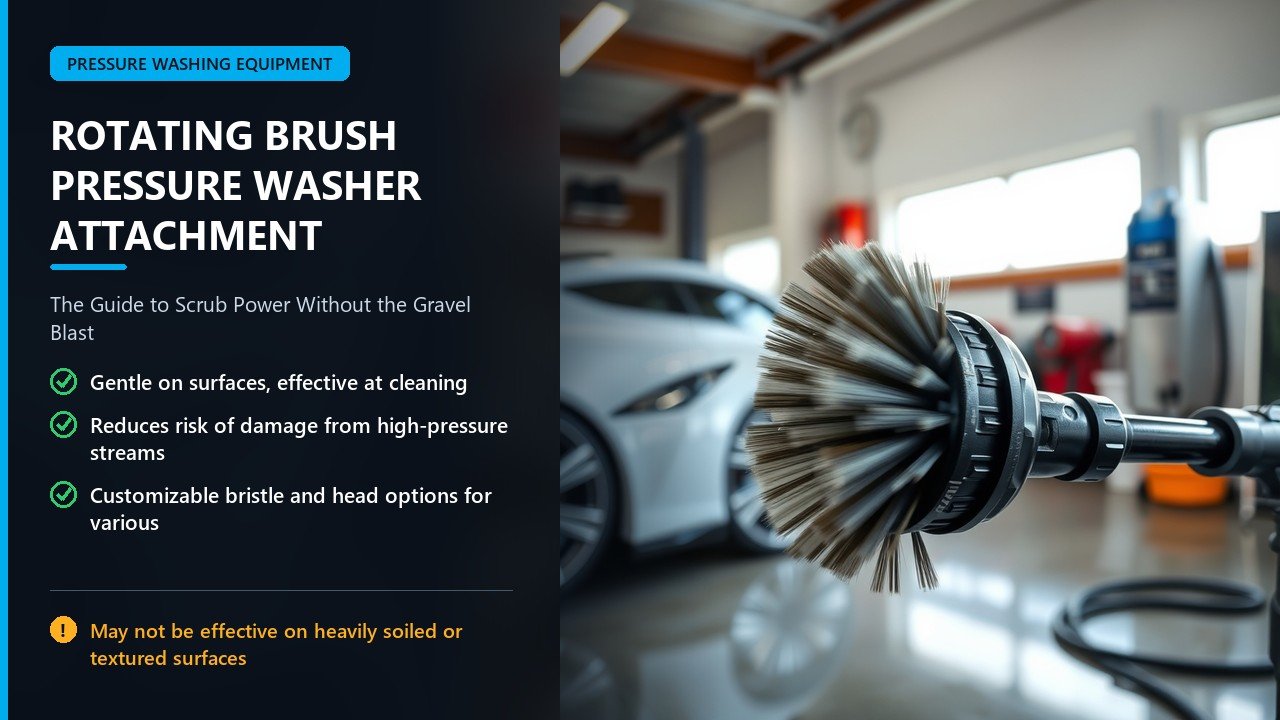
A “rotating brush pressure washer” attachment adds a spinning scrub head to the end of your wand, and it is the closest thing the category has to a shortcut. Instead of standing the stream off at a distance and hoping the pressure does the scrubbing, the brush head puts bristles against the work while pressurized water rinses it away, so the dirt comes off from contact and flow rather than brute impact. For a car’s paint, a boat’s gelcoat, a sheet of vinyl siding, or a slab of patio furniture, that turns a risky stream into a controlled wash.
This guide covers the full rotating brush decision: the two families the name actually means, the ratings and connectors to match before you buy, the bristle and head choices per surface, how the brush delivers detergent, the technique that keeps a brush safe, the maintenance that keeps a brush alive, and the honest cases where you should skip the brush entirely and use something else.
This is not the tool that strips a grease patch off concrete — that is what the impact tips are for. It is the tool for the surfaces you are afraid to hit with a stream: the new car, the gelcoat hull, the plastic trim, the painted siding. Hold that distinction and the rest of the choice falls into place.
Quick Note: “Rotating brush pressure washer” usually means a spinning scrub-bristle head for cars and panels, but the same words are sometimes used for a rotary surface cleaner, which is a flat disc with a spinning nozzle bar for flat ground. This guide covers both, and tells you which one your job needs.
Two Rotating Tools That Share a Name
Inside the naming confusion there are two real tools. The rotating scrub brush is a round bristle head, powered by the water or a small motor, that agitates paint, gelcoat, siding, glass, and furniture while water flows at low pressure through or around it. The rotary surface cleaner is a flat disc with a spinning nozzle bar and a shroud, pushed across driveways, patios, and decks, where the spinning nozzles lift dirt and the skirt catches the overspray. They get conflated because both spin and both attach to a gun or wand, but they clean different geometry entirely.
The scrub brush wins where the surface is curved, vertical, delicate, or painted — vehicles, hulls, furniture, siding, fences, windows. The surface cleaner wins where the surface is flat and infinitely large — concrete, asphalt, pavers, decks. Choosing correctly up front saves you from watching a bristle brush flounder on a driveway or a surface cleaner bounce up a car’s fender, and the full logic of the flat-disc tool is detailed in our surface cleaner guide and its buying companion.
How a Rotating Scrub Brush Works
The modern rotating scrub brush looks like an upsized electric toothbrush for your wash kit: a round head of dense bristles that spins at a few hundred revolutions per minute while water flows through the center. Two power schemes exist. Water-driven brushes use the stream itself to spin an impeller inside the head — simple, no battery, and free in perpetuity, but the head only spins when water is flowing. Motor-driven brushes like Karcher’s WB 130 rotating wash brush spin their bristles on an internal (now brushless, battery-powered) motor, so the scrubbing continues and, critically, the flow can stay low and gentle while the brush does the work — the pair that protects paint.
The bristle head is the part that touches the surface, and its softness decides whether the tool scrubs or scratches. Car and bike heads run soft polymer or microfiber tufts for painted panels; home and garden heads run stiffer nylon for patio furniture and siding; and the swappable-head designs — a release lever or quick-twist collar swaps them without touching the dirty face — are why a single brush covers a whole property instead of just one job. The wash motion, in every case, is the same: the brush supplies the agitation, the water supplies the rinse, and pressure does almost none of the work.
The stream geometry matters more than people expect. Most rotating brushes need water at reduced throttle — the flow loosens and rinses, the bristles scrub, and the low-pressure field is exactly what keeps the tool from chewing into a soft surface. That is why the honest plumbing on a fresh install is worth checking: brush to gun via the transfer adapter or quick connect, no high-pressure tip in the path, detergent plumbed if the tool supports it. The full gun-and-wand layout that these attachments drop into is explained in our gun system guide.
Two details separate the good heads from the mediocre ones. The first is the center water channel: a well-made head directs flow outward through the bristle field so the rinse happens exactly where the scrub happens, while a cheap head dumps straight out the middle and leaves a clean wet circle and a dirty ring. The second is the bristle base, a molded hub that holds the tufts rigidly without splaying; heads whose tufts loop loose hold grit and that is where scratches come from. Neither spec appears on the sticker, but both decide whether you are scrubbing clean or dragging dirt across the panel. A quick word on the shaft seal: the rotating head rides a sealed hub, and a head that starts to wobble or weep is a seal letting water into the drive — the part to catch at inspection before it takes the whole brush.
Ratings and Connectors to Match
The brush’s printed rating is the contract with your machine. A typical consumer rotating brush is rated to about 3000 PSI and 1.4 to 1.9 GPM, which covers the vast majority of gas and electric units people actually own; beyond that headroom, the bristle head and the body work gently for longer. The connector side is simpler: most brushes hang on a 1/4-inch quick-connect outlet or a manufacturer-specific lock like the transfer-adapter twist, so the brush must match the outlet your gun already has.
| Spec | Typical Consumer Brush | Check Before Buying |
|---|---|---|
| Max pressure | 3000 PSI | Covers your machine’s rated PSI |
| Max flow | 1.4–1.9 GPM | Meets your machine’s GPM |
| Connector | 1/4-inch quick connect or twist lock | Matches your gun’s outlet standard |
| Drive | Water-driven or motor-driven | Motor adds control at low flow |
| Head | Swap-able car and home attachments | Soft for paint, stiffer for siding |
If the numbers line up, the brush is compatible with your machine — the PSI headroom buys durability, and the flow rating must simply not be undersold. If your machine is a compact electric unit already near its limit with the brush attached, run it with the gun two-thirds open and let the brush carry the job; starving a brush of flow is how it feels weak, and the stream balance that fixes it is the same one our nozzle color guide teaches for the rest of the range.
Bristles and Surface Pairing
The head’s bristle stiffness is the entire safety equation. For automotive paint and clearcoat, only the softest polymer or microfiber head belongs; for gelcoat, a medium tuft with steady motion; for vinyl siding, a firm nylon head to work seams; for glass, the soft head with detergent. The rule that protects every one of those surfaces is never to add pressure with the brush — if the flashing or the clearcoat needs more power, you pick a different tool, not a harder push.
The realistic uses beyond the car are what make the brush a versatile rig rather than a specialty wheel: boat hulls and pontoons, patio furniture and BBQ grills, railings and fencing, vinyl siding, windows and glass, gutters at ground level, and the occasional pet gear that just refuses a hose. The pattern is the same everywhere — detergent applied, brush let do the scrubbing, low-pressure rinse gathered off the surface so it drains to the ground rather than behind the trim of your house. The one caution belongs on siding and paint, where the answer to a stubborn patch is refoam and dwell, not brush force; the two-stage detergent rhythm of our detergent tank guide is exactly the beat that foams, dwells, scrubs, and rinses clean.
Rotary Surface Cleaners Remind You of the Flat Stuff
The sibling tool earns its mention because it is the rotating brush’s flat-ground double. A rotary surface cleaner like the Greenworks 12-inch spins a nozzle bar carrying two small tips inside a round shroud; the spinning impact scrubs the slab while the skirt catches the overspray, and the operator walks it across like a floor buffer. The result is flat concrete cleaned in a fraction of the time a hand nozzle takes, with no dark fan strokes and no gravel blast back at your shins. Matters of width, feed, and wobble management are where that tool pays its keeping, and the honest sizing rule is to push the widest disc your machine’s GPM can feed without dragging.
The boundary is geometry, not speed: if it is flat and ground-bound — driveways, patios, sidewalks, pool decks, wood decks — the surface cleaner is the right rotating tool; if it is curved, vertical, or painted — cars, boats, siding, furniture — the scrub brush is. The mistake to avoid is thinking one replaces the other, and the details of widths, nozzle tips, and wobble management for the flat tool are in our surface cleaner guide, with the spray-tip thinking that runs both tools in our rotating nozzle guide.
Detergent Through the Brush
Detergent is the brush’s unfair advantage, because the two-handed wash does what pressure alone cannot: the suds loosen the bond between dirt and paint, the bristles lift it, and a light rinse carries it off without the stream ever blasting the panel. Most brush designs offer detergent feeding through the tool — a soap inlet or the machine’s own low-pressure detergent path — and the correct program on a car is pre-rinse, foam, dwell, then a slow one-pass scrub and a top-down rinse. Run the foam thick enough to cling, let the dwell sit while the suds work, and the brush’s job becomes carrying the film off rather than digging at it.
Two habits keep the suds honest. First, use the machine’s soap path rather than the high-pressure tip, so the brush runs soft and the foam clings instead of immediately sheeting off. Second, keep the detergent matched to the surface — a vehicle-safe shampoo for paint, a siding cleaner for the house — and flush the brush with clean water at the end of a chemical job so residue never dries inside the head. The ratio discipline matters too: too thin and the foam runs, too thick and it gums the bristles and rinses poorly, and the bottle and tank mechanics that feed the brush are covered in our bottle guide and tank guide.
Technique That Keeps a Brush Safe
The technique that separates a good wash from a swirl-marked one is restraint. Hold the gun with both hands, admit the brush gently to the surface, and let the rotation pull it along — never press hard, because the bristles plus your body weight is where the marring begins. Keep it moving in overlapping passes so no spot gets worked repeatedly, and drop the throttle so the flow rinses rather than jets. On vertical panels, work top to bottom so the rinse stays ahead of the suds.
The pass system is simple once you feel it. Work in straight, overlapping lanes the way you would a floor buffer, letting each pass overlap the previous by a third, and resist the temptation to circle or to scrub-and-pause — repetition over the same spot is exactly how a light pressure becomes a surface mark. Let the rotating head do the moving; your job is to walk the tool, not to grind it. When the panel finally seems dry, the suds vanish and the rinse streaks show you the lanes that still hold dirt, which is the brush telling you where to go back.
The install drill matters too, and it follows the manufacturer’s pattern: off goes the wand, on goes the transfer adapter to the trigger gun, and the brush locks with a twist or a click. The Sun Joe rotary brush guidance is a clean walkthrough of the tab-and-lock setup for the SPX machines, and the principle is the same across brands: verify the lock before you pull the trigger, then take the first squeeze at low throttle aimed at the ground. Guns and wands connect the same way the brush does, so the connector logic in our coupling guide and fittings guide covers the rest of the setup.
Reach: Getting the Brush to the Second Story
The brush only helps where it can reach, and on one-story to two-story work reach becomes the actual problem. The standard answer is a telescoping wand behind the brush — the extension rides the quick connect between gun and brush, extends from roughly a foot to about three feet, and turns second-story gutters, upper siding, and window sills from ladder work into standing work. The telescoping wands do this duty across the range of attachments, and the full reasoning on lengths, locks, and weight balance is in our telescoping wand guide.
Two cautions before you reach. Extension adds leverage, so the gentle touch the brush needs gets harder to hold the higher you climb the wand — lock the sections firmly, take the weight with the free hand, and drop the throttle another notch as the work goes vertical. And the brush’s soft-head duty does not change two stories up: siding still gets the foam-and-dwell rhythm, and a firm head still has no business near a painted surface, altitude or not. The wand and brush habits that compose into a full exterior cleanup are collected in our wand attachments guide and the spray wand guide.
Care and Maintenance
The brush is low-maintenance and dies mainly from two habits: stored wet and stored dirty. After a wash, pop the head loose and rinse the bristles free of detergent and grit, shake the water out, and let it dry fully before storage — a damp brush left inside a shed grows mildew in the tufts and smells before the season is out. On water-driven heads, run a clean-water rinse through the drive path so no soap film builds inside; on motor-driven heads, keep water out of the electronics and keep the charge topped according to the manual. A battery-backed head that sits dead over a month is the brush that quietly needs a cell replaced, and the recharge schedule matters more than the scrubbing schedule.
Inspect the bristles twice a year: a head that has splayed, shed, or compacted is scrubbing unevenly, and uneven bristles are how subtle marks get into paint that was otherwise spotless. Soft heads are consumables — replace them rather than run them tired — and a spare head of the opposite stiffness (one soft, one firm) is the cheap way to make a single brush serve both the car and the siding. That two-head habit is the nearest thing the brush has to a maintenance kit, and the shortest version of the whole care list fits on a field card: rinse, dry, store loose, replace tired heads.
Buying: What to Look For, When to Skip
When you buy, let three things decide: the swap-ability of the head, the drive type, and the connector match. A head you can change in a release-lever click wallows in value, because it turns one brush into a car, boat, and furniture arsenal. A motor-driven head is the paint-safe choice for low-flow machines and two-stage car washes, while a water-driven head is the zero-hassle budget buy. And the connector — manufacturer twist-lock versus standard 1/4-inch quick connect — decides whether your existing gun and wands play along; the Craftsman 3000 PSI rotating brush and the Ultimate Washer brush lineup are good places to see the connector and gpm specs spelled out before you order.
Two spend rules keep the purchase sensible. Buy the head-capable version even if you only own a car today — the release-lever head is the difference between a one-trick accessory and a three-surface tool, and the spare firm head arrives for less than a dinner out. And buy by the rating, not the logo: a 3000 PSI, 1.5-plus GPM brush from a brand you recognize is interchangeable with a store-brand equal, so the decider is swap-ability and connector, exactly the two numbers the sticker often hides.
The honest skip list is just as useful. Skip the brush for heavy flat concrete that wants a surface cleaner, for stripping paint or grease that wants a turbo or rotary nozzle, and for algae-laden roofs that want a soft-wash chemical path rather than any brush at all. The brush is a finishing tool, not a heavy-duty one; budget accordingly and it will never work a job it was not built for. The spray-tip options that cover the heavy end of the same range are in our turbo nozzle guide and the nozzle guide.
Safety Notes
Rotating brushes cut both injury and property risks compared to open lances, but the rules are worth stating. Keep the brush locked to the gun before the trigger is pulled, keep the trigger locked when the brush is down or in hand, and take the first low-pressure squeeze aimed at open ground so the tool announces itself safely. On cars, never run a firm head on paint, never scrub a single spot, and give clearcoat the respect a $500 panel deserves. And keep the work off the body — the brush’s guard and skirt exist to stop back-splash, but they are not an invitation to lean into the tool. The wider set of pressure-washer safety habits lives in our trigger gun guide.
Frequently Asked Questions
Is a rotating brush safe on car paint? With a soft car-rated head, low pressure, and steady motion, yes — the bristles and water do the work. The damage stories almost always involve the wrong head, heavy pressing, or a dirty brush picking up grit.
Water-driven or motor-driven rotating brush? Motor-driven heads keep spinning at low flow and protect delicate panels, at higher price and with batteries to manage. Water-driven heads are simpler and nearly free to run, but only turn when water flows, which tempts you into pressure you do not want.
Can I use a rotating brush on siding? Yes, with the firmer home-and-garden head and detergent; vinyl siding is one of the brush’s best surfaces because it cleans without the stream lifting the edges.
Are rotating brush and surface cleaner the same? No. The brush is a spinning bristle head for curved, vertical, and painted surfaces; the surface cleaner is a spinning nozzle-bar disc for flat ground. Pick by the shape of the work.
Does the brush need high pressure? No — it needs flow and rotation, shockingly little impact. Most brushes spec a ceiling near 3000 PSI, and you will actually run them at reduced throttle for almost every job.
Why won’t my brush get stuff clean? Check connector matching and flow first: a brush starved on a weak electric machine underperforms. Then check the head — tired, compacted bristles scrub unevenly and a soft head on the wrong surface just slides.
Can a rotating brush rust or corrode? The body and guard are plastic or coated metal on every reputable brush, so the internals that matter are the flow path and the motor, not the shell. The corrosion risk is inside: dried soap and hard-water film on a water-driven impeller, and a battery cell left dead on a motor-driven head.
Do I still need high-pressure tips if I own a brush? Yes. The brush handles the delicate finish work, but flat concrete, grease, stripping, and deep algae still want the impact of a high-pressure tip, a turbo, or a surface cleaner. The brush complements the range rather than replacing it.
Final Thoughts
The rotating brush pressure washer attachment is the detail tool of the wash kit — the piece that turns “spray it from a distance and hope” into “scrub it gently and rinse it clean.” Bought with a swappable head, rating-matched to the machine, and run with the restraint that protects the surface, it is the most satisfying upgrade most owners add after the gun and wand, because it is the one that ends the wince every time a stream points at a painted panel.
Start by naming the job: moving cars, boats, furniture, siding, and glass — the brush. Flat driveways and decks — the surface cleaner. Then verify the connector, pick the soft and firm heads, and let detergent and rotation do the work the machine was never supposed to do alone. The tool is quiet, the work is fast, and the paint, in the end, is the one that thanks you.