A handy homeowner named Marcus wanted a gas pressure washer that could handle everything from his concrete driveway to his two decks, but he did not want to pay premium prices. A friend recommended a Powerhorse 3200 PSI machine, a value-priced gas washer he had used for years. Marcus was skeptical about buying a lesser-known brand, until he saw how the numbers stacked up: a mid-range pressure class, a decent flow rate, and a price well below the big-name machines. He bought it, learned its strengths and its limits, and found that for his level of work it did everything he asked, provided he maintained it and used the right nozzles. His experience shows why this class of machine appeals to so many buyers.
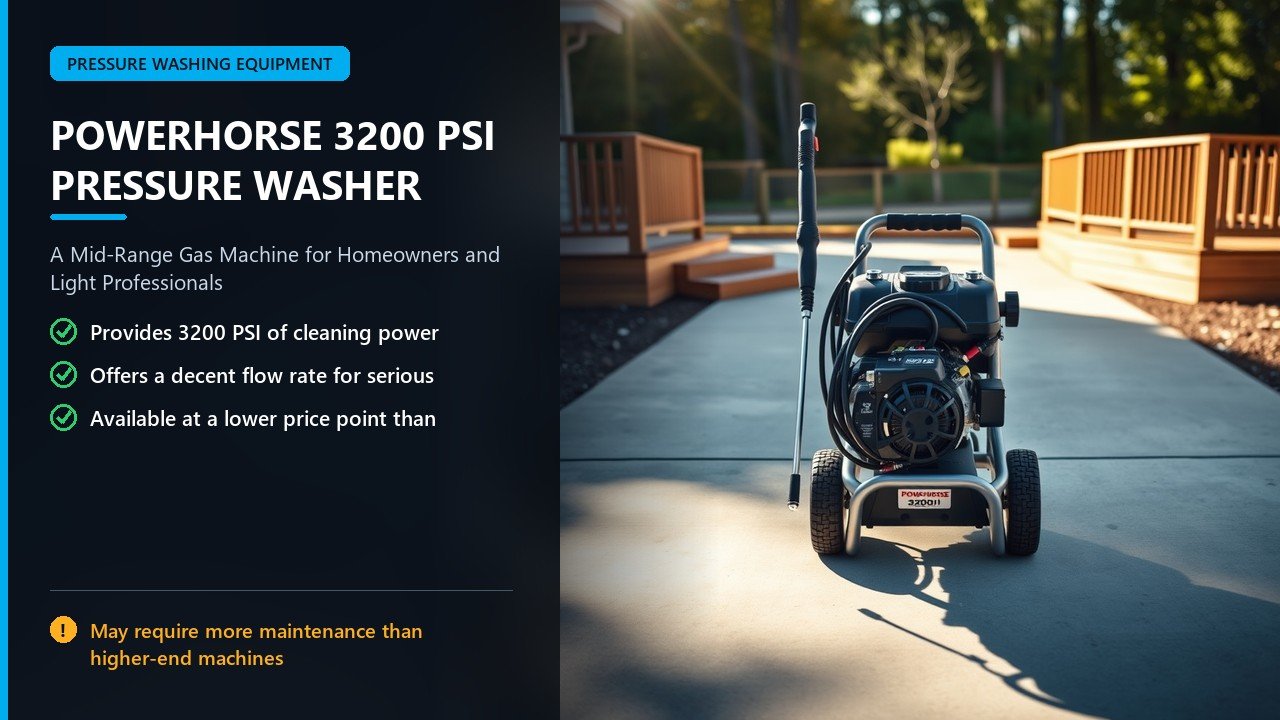
The Powerhorse 3200 PSI pressure washer sits in the popular mid-range gas class, where machines deliver enough power for serious home cleaning without the price of commercial equipment. Powerhorse is a value-focused brand, and a 3200 PSI gas machine in this class is aimed at homeowners and light professional users who want real power for less money. This guide explains what the Powerhorse 3200 PSI pressure washer offers, the class of machine it belongs to, what 3200 PSI can and cannot do, the engine and pump to look for, the features that matter, its strengths and limitations, how it compares to alternatives, how to maintain it, and what to weigh before buying. If you are considering this machine or one like it, this is the honest picture.
What the Powerhorse 3200 PSI Machine Is
Understanding the brand and the class clears up what you are actually buying.
A value-focused gas machine. Powerhorse is a house brand known for budget-friendly outdoor power equipment, including gas pressure washers. A 3200 PSI machine from this brand targets buyers who want mid-range power at a lower price than premium names.
A mid-range pressure class. Around 3,200 PSI sits in the sweet spot for serious home cleaning, above the light homeowner machines and below the commercial class. Our guide to the 3,200 PSI mid-range sweet spot explains the class.
Gas power for mobility. A gas machine runs without an outlet, delivering the power and freedom that outdoor cleaning demands. Our guide to gas pressure washer power covers gas machines broadly.
Sold as a complete package. Machines in this class usually include a gun, wand, high-pressure hose, and a set of color-coded nozzles, so you can start working right away. Our guide to nozzle colors explains the tips you get.
The Class It Belongs To
Placing the machine in context helps you judge whether it fits your needs.
Above entry-level. At around 3,200 PSI, this machine does more than a light 2,000 PSI electric washer, cleaning concrete, siding, and decks with real authority. Our guide to a 3,200 PSI machine for tough home cleaning shows the capability.
Below commercial. It is not built for all-day professional duty the way a 4,000 PSI commercial machine is. Occasional heavy use is fine; daily commercial work will wear it out. Our guide to the 3200 PSI class guide explains the trade-offs.
Ideal for homeowners. For someone cleaning a driveway, patio, deck, siding, and vehicles a few times a year, this class is close to ideal, offering enough power to do the job well without overspending. Our guide to whether 3,200 PSI is right for you helps you decide.
Fine for light professional use. A small cleaning business doing occasional jobs can use a machine in this class, provided expectations are realistic about duty and lifespan. Our guide to the sweet-spot power class covers the use case.
| Attribute | Typical 3200 PSI Class |
|---|---|
| Pressure | ~3,200 PSI |
| Flow | ~2.5 GPM |
| Power | Gas engine |
| Pump | Axial or triplex (verify) |
| Best for | Home cleaning, light pro use |
What 3200 PSI Can Do
This pressure level handles the large majority of home cleaning tasks with authority.
Concrete and driveways. A 3200 PSI machine cleans concrete well, especially with a surface cleaner and a rotating nozzle for stubborn stains. Our guide to turbo nozzles covers the attachment.
Siding and exteriors. House siding, fences, and outbuildings clean quickly at this pressure, though softer materials need a wider nozzle and care to avoid damage. Our guide to the 40-degree nozzle explains safe washing.
Decks and patios. Wood and composite decks clean well at a distance with a fan tip, and pavers and stone respond to the right nozzle and technique. Matching pressure to the surface protects the finish.
Vehicles and equipment. Washing cars, trucks, and outdoor equipment works well, using a wide tip and keeping the nozzle back to avoid damaging paint or seals.
Where it stops. Removing thick coatings, tough industrial grime, or heavy paint may exceed what this class can do efficiently, and it is not a machine for continuous commercial duty. Our guide to PSI versus GPM explains why power alone is not the whole story.
Engine and Pump: What to Look For
On a value machine, the engine and pump decide reliability, so these are the parts to scrutinize.
The engine. Value machines may use a house-brand engine, and that is not automatically bad if parts are available. Check that the engine has serviceable filters, easily replaced spark plugs, and ready parts support. A known engine adds confidence. Our guide to fuel and engine care helps you maintain whatever engine you get.
The pump type. This is the most important detail. An axial cam pump is common at this price and works for home use, but a triplex pump is far more durable. If the machine offers a triplex pump, it is the better long-term buy. Our guide to triplex versus axial cam explains the difference.
Pump serviceability. A pump that can be rebuilt with a seal kit and parts extends the machine’s life dramatically. A sealed, disposable pump ends the machine when it fails. Favor serviceable pumps.
Build and fittings. Metal fittings, a stable frame, and decent wheels matter on a gas machine that gets moved around. Plastic fittings are the weak points that fail first.
| Part | What to Prefer | Why |
|---|---|---|
| Engine | Known brand, parts available | Reliability and service |
| Pump | Triplex if available | Longer life |
| Pump service | Rebuildable with kits | Extends machine life |
| Fittings | Metal, not plastic | Resists leaks and wear |
| Frame and wheels | Stable, sturdy | Usability and safety |
Strengths and Limitations
An honest look at both sides helps you decide if this machine fits your work.
Strengths. Real mid-range power at a value price, gas mobility, a complete accessory package, and enough capability for the large majority of home cleaning jobs. For the money, a well-chosen machine in this class is a strong value.
Limitations. Value machines often use axial pumps with shorter life, house-brand engines with less parts ubiquity, and lighter components than premium machines. The machine is not built for continuous commercial duty.
Where value machines cut corners. Cosmetic and minor components are usually the first to be cheapened, along with the pump and hose quality. The engine and pump decide the machine’s fate, so inspect those closely.
Value depends on use. For occasional home cleaning, a value machine in this class is a smart buy. For heavy or frequent professional work, the savings up front are often erased by earlier replacement. Match the machine to the workload. Our guide to choosing a value gas machine covers the decision.
How It Compares to Alternatives
Looking at the competition clarifies where this class sits.
Premium 3,200 PSI machines. Brand-name machines in the same pressure class often use better pumps, named engines, and stronger components, at a higher price. They tend to last longer and hold value better. Our guide to the 3,200 PSI class covers the range.
Higher-pressure machines. A 4,000 PSI machine offers more power for tougher jobs and professional use, at higher cost and weight. It is worth it only if your jobs demand it. Our guide to a 4,000 PSI gas machine explains the step up.
Electric machines. A comparable electric machine runs quieter and needs no fuel, but offers less power and mobility. For heavy outdoor cleaning, gas wins; for light, quiet work, electric can be better. Our guide to electric machine internals explains the difference.
Used premium machines. A used brand-name machine at a similar price can outperform a new value machine if inspected carefully, since a good pump and engine last. Consider the used route for better components. Our guide to caring for a gas machine helps you judge condition.
Maintaining a Value Gas Machine
A value machine rewards careful maintenance even more than a premium one, because its parts work closer to their limits.
Change the engine oil. Follow the manual, changing oil after the first few hours and then on schedule. Clean oil protects the engine and is the cheapest reliability you can buy. Our guide to gas engine maintenance covers the routine.
Never run the pump dry. An axial pump is especially sensitive to running without water. Always connect and purge before starting, and never let the inlet run out. This habit prevents most pump failures.
Protect the pump from freezing. Trapped water freezes, expands, and cracks the pump. Winterize properly or store where it cannot freeze. Our guide to winter storage covers the steps.
Use fresh fuel. Stale gasoline causes hard starting and rough running. Use fresh fuel with stabilizer and treat it before storage. The Environmental Protection Agency regulates small-engine emissions and fuel handling, and fresh, properly stored fuel protects both the engine and the environment. Our guide to the best gas for pressure washers explains the details.
Keep the air filter clean. Dusty job sites clog filters fast, robbing power. Check and replace the filter cheaply to protect the engine.
Inspect hoses and fittings. Replace the cheap included hose with a better one if it fails, and keep spare o-rings. A good hose improves flow and reduces leaks. High-pressure water can injure skin, which is why the Occupational Safety and Health Administration treats pressure washing as a task with real hazards. Our guide to choosing a durable hose helps.
What to Weigh Before Buying
A few questions help you decide whether this machine is right for you.
How often will you use it? Occasional home use fits this class well. Frequent or professional use points to a higher-duty machine.
What is your toughest job? If your hardest task is a concrete driveway or a deck, 3200 PSI is plenty. If you strip coatings or clean industrial grime, look higher. Our guide to whether 3,200 PSI is enough helps.
What pump does it have? Confirm the pump type and whether it is serviceable. This single detail most affects how long the machine lasts.
Are parts available? Check that the engine and pump have parts support. A machine with no parts is a paperweight when it breaks.
Is the flow adequate? Flow decides cleaning speed. Verify the GPM and how it pairs with the pressure. Our guide to why GPM matters explains the balance.
Is there a better value? Compare against premium and used options. Sometimes a little more money buys a machine that lasts twice as long, which is the better deal. Our guide to choosing a value gas machine covers the comparison.
Common Problems and Fixes
Value gas machines develop predictable issues, and knowing the causes helps you fix them fast.
Won’t start after storage. Almost always stale fuel or a clogged carburetor. Use fresh fuel with stabilizer, run the engine dry or with treated fuel before storage, and clean the carburetor if it gummed up. Our guide to fuel and starting care covers the fix.
Lost pressure. Usually a worn nozzle, a clogged inlet filter, or air in the supply. Check the nozzle, clean or replace the inlet filter, and make sure the supply hose is not kinked or leaking. A gradual loss over time points to pump wear.
Pump leaking or knocking. Often worn seals or cavitation from a restricted or airy inlet. Fix the supply first, then rebuild or replace the pump seals. Our guide to what fails inside a pump covers the parts.
Pulsating spray. Usually air entering the inlet or a partly clogged supply. Tighten the suction connection, purge air, and check for a kinked or too-small supply hose. Using a proper supply hose rated for the flow fixes most pulsation.
Engine surging or dying under load. Frequently a dirty air filter, old fuel, or a fouled spark plug. Service the air filter, use fresh fuel, and replace the spark plug, which solves many running problems cheaply.
Leaks at the gun or wand. Worn o-rings are the usual cause. Replace them, avoid over-tightening, and keep spares on hand. Our guide to fixing gun and wand leaks covers the fix.
| Symptom | Likely Cause | Fix |
|---|---|---|
| Won’t start | Stale fuel, clogged carb | Fresh fuel, clean carb |
| Lost pressure | Worn nozzle, clogged filter | Replace nozzle, clean filter |
| Pump leaking/knocking | Worn seals, cavitation | Fix supply, rebuild seals |
| Pulsating spray | Air in inlet | Seal suction, purge air |
| Dying under load | Dirty filter, old fuel, plug | Service filter, fuel, plug |
| Leaks at gun | Worn o-rings | Replace o-rings |
Accessories That Improve the Machine
A few inexpensive additions get more from a value machine and reduce its weak points.
A better high-pressure hose. The included hose is often the first failure point. A quality hose rated for the pressure improves flow, resists kinks, and lasts far longer than the cheap original. Our guide to choosing a durable hose covers the upgrade.
A surface cleaner. For driveways and patios, a surface cleaner attachment cleans faster and more evenly than a wand, and it protects the surface from streaks. It is one of the best additions for flatwork. Our guide to a productive setup shows how it fits.
A turbo or rotating nozzle. A rotating nozzle concentrates power for tough stains on concrete, useful for the worst spots on hard surfaces. Our guide to turbo nozzles explains their use.
A proper nozzle set. A complete set of color-coded tips lets you match the spray to each surface, protecting delicate materials while cleaning tough ones. Our guide to nozzle color codes explains which tip to use where.
A spare pump seal kit. For an axial pump, a spare seal kit lets you address the most common failure quickly and cheaply, extending the machine’s life rather than replacing it.
A short extension wand. For reaching gutters or tight spots without a ladder, an extension wand is an inexpensive upgrade. Our guide to a power washer wand extension covers the reach tool.
Frequently Asked Questions
Is a Powerhorse 3200 PSI pressure washer good? For home cleaning and light use, a machine in this class offers real mid-range power at a value price. Its quality and lifespan depend heavily on the pump type and engine, so check those before buying.
What is 3200 PSI good for? Driveways, patios, decks, siding, fences, and vehicles. It handles the large majority of home cleaning and light professional jobs, but not continuous commercial duty or heavy coating removal.
What pump does it use? It varies by model. Some use axial cam pumps and some use triplex pumps. Always ask, because a triplex pump lasts much longer and is worth preferring.
Can I use it for a business? Occasional light jobs are fine, but daily commercial work will wear a value machine out quickly. For regular professional use, choose a higher-duty commercial machine.
How do I make it last? Change the engine oil, use fresh fuel, keep the air filter clean, never run the pump dry, and protect it from freezing. Those habits turn a value machine into a long-term tool.
Gas or electric for the same price? Gas offers more power and mobility for outdoor work; electric is quieter and better for light indoor or near-outlet use. For heavy outdoor cleaning, gas is usually the better fit.
Final Thoughts on the Powerhorse 3200 PSI Pressure Washer
The Powerhorse 3200 PSI pressure washer sits in the popular mid-range gas class, where real cleaning power meets a value price. Around 3,200 PSI with solid flow is enough for driveways, patios, decks, siding, fences, and vehicles, which covers the large majority of home cleaning and light professional work. Powerhorse as a value brand targets buyers who want that capability without paying premium prices, and for the right buyer, that proposition is sound.
The catch with any value machine is the pump and engine, so scrutinize those above all. A serviceable triplex pump and a known engine transform the ownership experience, while a disposable axial pump and an obscure engine limit it. Understand that this is not a commercial tool and that its lifespan depends on maintenance. Change the oil, use fresh fuel, never run the pump dry, and protect it from freezing, and even a value machine can serve for years.
That is what Marcus found. He did not get a premium machine, but he got one that did everything his property demanded, at a price that made sense, and he kept it running with steady care. If you need serious home cleaning power on a budget, a well-chosen machine in this class, with the best pump you can get, is a sensible purchase. Buy it for the right job, keep the pump protected, and it will repay the price many times over in clean concrete and clean siding.