A homeowner named Marla hated two things about cleaning her two-story house: dragging out a ladder and watching her back flare up every time she reached for the gutters. She tried a longer hose, which reached the wall but not the height, and she tried balancing on a step stool, which felt unsafe. Then she added a wand extension to her pressure washer and cleaned the whole upper story while standing on solid ground. The work went faster, nothing felt precarious, and her back stopped complaining. The tool cost a fraction of what she expected and changed how she worked.
An extension for a power washer wand is a simple upgrade that adds reach, and it solves one of the most common problems in pressure washing: getting high or hard-to-reach surfaces clean without a ladder. This guide explains what wand extensions are, the types available, how adding length affects pressure and flow, how to choose the right length and fittings, the difference between an extension wand and a gun or hose extension, and how to use one safely. Whether you are washing a two-story wall, a gutter line, an RV roof, or a soffit, the right extension turns a dangerous ladder job into a safe, standing task.
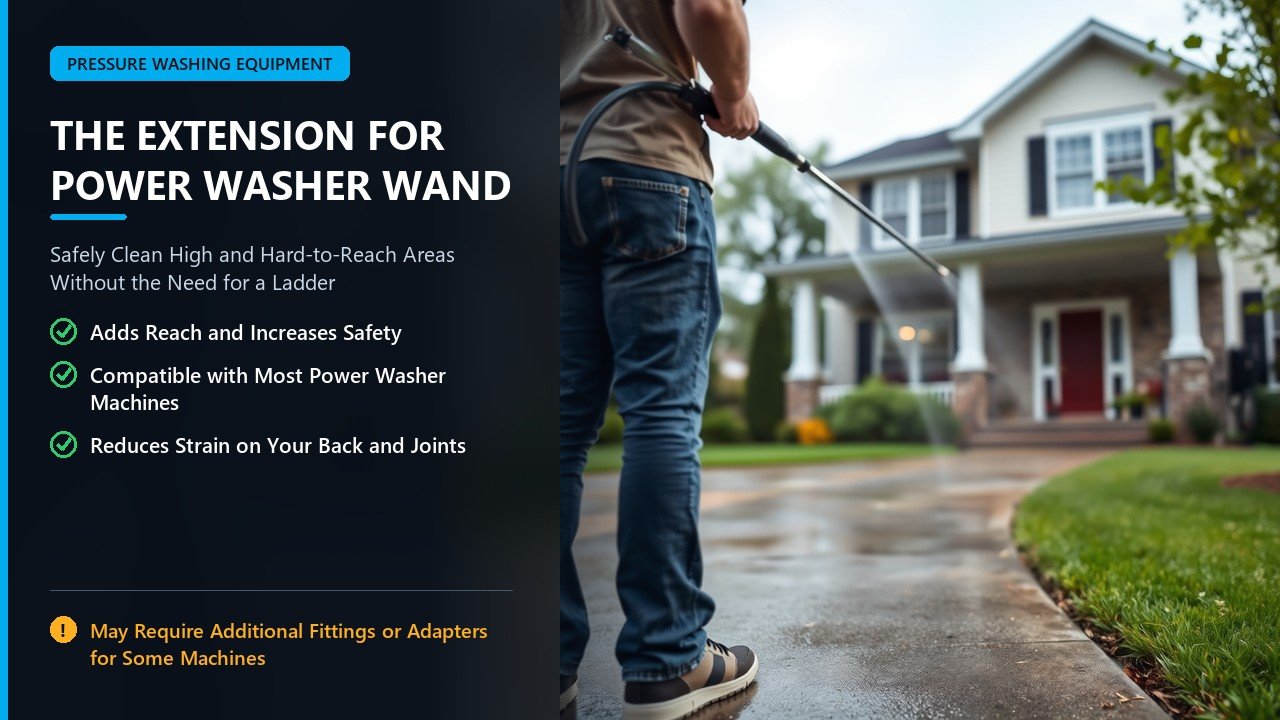
What a Wand Extension Actually Does
A wand extension is a rigid or adjustable tube that fits between your gun and the nozzle tip. It moves the spray point farther from your body, so you can reach high surfaces, clean over obstacles, and work under low structures without bending or climbing.
It adds reach, not power. The extension does not make the machine stronger. Its job is to place the nozzle where you need it while keeping your feet on the ground. That distinction matters when choosing length and understanding performance.
It accepts your existing tips. Most extensions end in a standard quick-connect fitting, so your current nozzles and accessories attach right to the end. Our guide to adjustable nozzles shows how tips change the job.
It pairs with your existing gun. An extension connects between the gun and the wand or tip. You keep your trigger gun and simply add a reach section. Our guide to matching a gun and wand covers the connection side.
The Types of Wand Extensions
Wand extensions come in a few styles, each suited to different jobs.
Fixed straight extensions. A rigid tube of a set length, often with a comfortable grip and a quick-connect end. They are simple, sturdy, and ideal for adding a fixed amount of reach, such as cleaning a gutter line or a high wall in a straight line.
Telescoping extensions. A tube that slides to adjust its length, letting you extend for height and collapse for storage or closer work. These are the most versatile option for high cleaning. Our guide to how a telescoping extension wand works explains the mechanism.
Bendable or angled extensions. Some wands bend or angle so you can spray up under eaves, gutters, or vehicle undercarriages. Our guide to the bendable wand covers these awkward angles.
Gun-mounted extensions. Some reach tools attach directly to the gun or use a long trigger handle, changing the balance rather than adding a separate section. These suit users who prefer a single connected tool.
| Type | Best For | Trade-off |
|---|---|---|
| Fixed straight extension | Walls, gutters, straight reach | One length, less flexible |
| Telescoping extension | Height and varied jobs | More joints, more weight |
| Bendable / angled | Soffits, under structures | Less rigidity at full bend |
| Gun-mounted reach tool | One-piece feel | Heavier, brand-specific fits |
How Length Affects Pressure and Flow
Adding an extension changes performance slightly, and understanding why helps you set expectations.
Friction costs a little pressure. Any added length creates some friction loss, so a very long extension reduces the pressure at the tip marginally. In practice, a normal extension loses little, and the loss is rarely noticeable compared to the benefit of safe reach.
Diameter matters. A narrow extension restricts flow more than a wide one. Choose an extension sized to match your machine’s flow so the nozzle still sees a strong stream. Our guide to high-flow hose sizing explains the same principle for hoses.
Joints are the weak points. Every connection can leak or seal imperfectly. A telescoping extension with several joints has more places to fail than a single fixed tube. Quality seals and a solid lock matter more as the sections increase.
Weight and balance shift. A long extension moves weight away from your hands, so the tool feels heavier at the tip. This matters for fatigue when you hold it high for long periods, and it is a reason to favor a lighter material for tall work.
Choosing the Right Length
Length is the main decision, and more is not always better.
Match the length to the job. A modest extension reaches a typical one-story roofline, a fence top, or a first-floor gutter. A longer reach handles two-story walls and tall soffits. Buying far more length than you need adds weight and cost without benefit.
Check the working height. Consider how high you can comfortably hold the tool and add the extension to cover the rest. Reaching a second story usually means standing height plus the extension plus a reasonable arm angle.
Weight at the tip. A very long extension held overhead gets tiring quickly and can be tough to control. If tall work is frequent, favor a lighter, well-balanced extension over the longest one available. Our guide to how telescoping extensions reach high explains the balance.
Storage and transport. A telescoping or multi-section extension stores smaller than one long fixed tube, which is easier to keep tidy. Our guide to storing your pressure washer covers keeping gear organized.
| Length | Typical Reach | Good For |
|---|---|---|
| Short extension | Adds a little height | Tight spots, first-floor trim |
| Medium | One-story roofline | Walls, fences, low gutters |
| Long / telescoping | Two-story walls | Gutters, soffits, upper siding |
| Extra long | Very tall or wide reach | Specialty high work |
Fittings and Compatibility
An extension only works if it connects properly to your machine. Fittings are where most disappointment happens.
Match the quick-connect. Most extensions use a standard quick-connect that fits most consumer guns. Verify the size, because brands occasionally differ. Our guide to gun kits that fit your machine covers matching.
Thread standards. Some extensions thread onto the wand or gun rather than using a quick-connect. Metric and imperial threads differ, so check before buying to avoid a return. Our guide to matching threads and ratings explains the standards.
Pressure rating. An extension must be rated for at least your machine’s pressure. A cheap extension rated below your machine’s output can burst at the joint. Match or exceed your working pressure. Our guide to why wand material matters covers durability.
Seals and o-rings. Good seals stop drips at the joint. Keep spare o-rings, and replace worn ones rather than over-tightening, which can damage the fitting. Our guide to fixing wand leaks covers the fix.
Telescoping Versus Fixed Extensions
Both styles have a place, and the choice depends on how varied your work is.
Choose telescoping for flexibility. A telescoping extension adjusts to different heights and collapses for storage, so one tool covers many jobs. It is the better choice if you clean a mix of surfaces and want reach on demand.
Choose fixed for simplicity and rigidity. A single-length fixed extension has fewer joints, so it is lighter, stiffer, and less prone to leaks. If you mostly clean one height, a fixed extension is the simpler, sturdier tool.
Consider a bendable tip for the odd job. For soffits, gutters, and under-vehicle cleaning, an angled or bendable extension reaches where a straight shaft cannot. It complements either style. Our guide to bendable wands covers these jobs.
Ladder-free reach as a system. The best results come from treating reach as a system: the right extension for height, the right hose for distance, and the right nozzle for the surface. Our guide to reaching high areas safely ties the pieces together.
Using a Wand Extension Safely
Reach tools trade a ladder for a long, powerful nozzle, which changes the safety picture.
Control the reaction force. The farther the nozzle is from your body, the more leverage it has. Use a two-handed grip, keep your stance balanced, and start the spray pointing away from anything fragile.
Watch for overhead hazards. When spraying high, be aware of power lines, branches, and loose materials that can fall. The Occupational Safety and Health Administration treats overhead and electrical hazards during high work as serious risks, and the same caution applies at home.
Avoid spraying upward into fixtures. Water forced up behind siding, soffits, or vents can cause damage and moisture problems. Direct the spray where it can drain.
Match the tip to the height. A wide, gentle tip is usually better for high work than a narrow, aggressive one, because it covers more area safely and reduces the chance of surface damage. Our guide to the spray wand guide helps you choose.
Mind your footing. Reach tools tempt you to stretch and lean. Keep your feet planted, avoid overreaching, and use a stable surface. Slips and strains are among the most common pressure washing injuries, and the National Institute for Occupational Safety and Health documents many of them as preventable. Our guide to reaching high surfaces safely covers technique.
Common Mistakes to Avoid
Buying for maximum length. The longest extension is not the best if it is heavy and unwieldy. Match the length to your actual reach needs.
Ignoring the pressure rating. An underrated extension is a safety hazard. Always match or exceed your machine’s pressure.
Assuming all fittings are universal. Quick-connects and threads vary. Verify compatibility before buying to avoid returns and frustration.
Overlooking seal quality. Cheap seals leak and waste pressure. Keep spares and replace worn o-rings instead of cranking fittings tight.
Using a long extension on delicate surfaces. The added leverage can make it easier to damage siding or trim. Slow down, use a gentle tip, and keep the nozzle moving. Our guide to picking the right wand for each job helps you match tool to task.
How Wand Extensions Compare to Other Reach Tools
A wand extension is one of several tools that add reach. Knowing how they differ helps you pick the right one, or the right combination.
Wand extension. Adds reach at the nozzle while you keep both the gun and the machine where they are. It is the most direct way to clean high surfaces from the ground, and it accepts your existing tips.
Hose extension. Adds distance, not height. It lets the machine stay in one place while you walk the spray farther away. It does nothing for a second-story wall unless you already have a way to point the wand upward. Our guide to the extension hose that reaches your whole property covers distance.
Telescoping pole. A very long reach tool that extends far beyond a normal wand, often used for gutters and tall walls. It delivers maximum height but can feel unwieldy when fully extended. Our guide to the telescoping extension wand covers this option.
A ladder. The traditional answer to height, but also the most dangerous. Falls from ladders cause serious injuries, and pressure washing adds slippery surfaces and a reaction-force hose to the equation. For most homeowners, a reach tool is the safer choice.
| Tool | Adds | Best For |
|---|---|---|
| Wand extension | Reach at the nozzle | High walls, gutters, soffits |
| Hose extension | Distance from the machine | Large areas, one machine position |
| Telescoping pole | Maximum height | Tall gutters, second-story work |
| Ladder | Physical height | Detail work close up, not spraying |
Matching the Extension to Your Machine
The right extension depends on whether you run an electric or gas machine and on how much pressure it produces.
Electric machines. Most electric pressure washers use a standard consumer quick-connect, which makes finding an extension easy. Because their pressure is lower, almost any rated extension works, but check the connection type, since some compact electric units use proprietary fittings. Our guide to choosing an electric power washer wand covers the details.
Gas machines. Gas machines run higher pressure and flow, so the extension must be rated for both. A gas machine benefits from a wider, stiffer extension that keeps flow strong and holds up to the extra force. Our guide to why wand material matters explains durability.
High-pressure machines. For machines above roughly 3,000 PSI, choose an extension rated at or above that pressure, ideally in stainless steel with quality fittings. An underrated extension is not worth the risk. Our guide to matching pressure and threads covers the specification.
Hot-water machines. If your machine heats water, the extension must tolerate high temperatures, and the parts near the nozzle should be heat-rated. Standard cold-water extensions can fail under heat. Our guide to hot water wand selection covers the specialty parts.
Accessory ecosystem. If you already own a set of quick-connect tips and accessories, choose an extension that uses the same fitting so everything works together. Keeping one connection standard across the tool set prevents mismatches. Our guide to wand attachments helps you build a matched set.
Getting the Most From Your Extension
A few habits get better results and longer life from a wand extension.
Use the right nozzle for the height. A wider fan at a distance covers more surface and reduces reaction force. A narrow, aggressive tip on a long extension is harder to control and more likely to damage a surface. Our guide to extension wands and nozzles explains the pairing.
Work in overlapping passes. At distance it is easy to miss spots. Overlap each pass and keep a steady pace so the surface cleans evenly without streaks. Our guide to reaching awkward areas covers technique for tricky angles.
Keep the angle sensible. Spray at a slight downward angle where possible, so water and dirt run off rather than up under siding or trim. For gutters, angle into the channel to flush debris away from the building.
Clean and store it dry. Flush the extension, dry it, and store it where it will not freeze or corrode. A few seconds of care prevents seized fittings and worn seals. Our guide to fixing wand leaks covers maintenance.
Plan the sequence. Start at the top and work down, so dirty water does not re-soil surfaces you already cleaned. A reach tool makes this natural, because you can clean the highest point first without climbing. Our guide to extension wands that save your ladder and your back covers the workflow.
Frequently Asked Questions
What is the difference between a wand extension and a hose extension? A wand extension adds reach at the nozzle so you can point high or far without moving. A hose extension lets the machine stay in one place while you carry the gun farther away. Use both together when you need height and distance.
Does a wand extension reduce pressure? It reduces pressure at the tip slightly through friction and length, but a properly sized extension loses little in practice. Choose an extension that matches your machine’s flow to keep the stream strong.
Will an extension fit my pressure washer? Most extensions use a standard quick-connect that fits common consumer guns, but sizes and threads can vary by brand. Check the connection type and pressure rating before buying.
How long should a wand extension be? Match the length to the job. A medium extension covers a one-story roofline, while a long or telescoping extension reaches two-story walls. Avoid buying far more length than you need, since weight and control suffer.
Can a wand extension replace a ladder? For many jobs, yes. A telescoping or long extension lets you clean high walls, gutters, and soffits from the ground, eliminating most ladder work and its fall risk. For the highest or most awkward spots, use caution and never overreach.
Is a telescoping or fixed extension better? Telescoping extensions are more flexible and store smaller, while fixed extensions are lighter and stiffer with fewer joints to leak. Choose based on how varied your work is.
Final Thoughts on the Extension for Power Washer Wand
An extension for a power washer wand is one of the cheapest ways to make pressure washing safer and easier. It adds reach at the nozzle, so you can clean high walls, gutters, soffits, and hard-to-reach surfaces while standing on solid ground, and it accepts the tips and accessories you already own. The key is to match the extension to the job: the right length for the height, the right rating for the pressure, and the right fittings for your machine.
Choose a telescoping extension for flexibility or a fixed one for stiffness and simplicity, and add a bendable or angled tip for odd jobs. Keep the pressure rating at or above your machine’s output, keep spare seals handy, and use a wide, gentle tip for tall work so you cover more surface safely. Treat reach as a system by pairing the extension with the right hose and nozzle. Then slow down, keep your footing, and let the tool do the stretching.
Do that and you retire the ladder for most jobs, protect your back, and work faster with less risk. Marla’s upper story got clean without a single climb, and the safest way up turned out to be the way that never left the ground. For a small addition, a wand extension delivers one of the biggest improvements in how pressure washing feels.