A small-business owner named Tariq bought a pressure washer with a soap tank and expected his cleaning to improve instantly. Instead, he got a weak trickle of suds that barely touched the grime, and half the detergent seemed to vanish before it hit the surface. He assumed the machine was defective until a more experienced operator explained the three things he was doing wrong: he was using too much soap, too thick a detergent, and soap mode when he should have been rinsing. Once he understood how a soap tank actually works, his cleaning transformed. The soap tank is a simple component, but using it well requires understanding what it does and what it cannot do.
A soap tank for a pressure washer is the reservoir that holds detergent and feeds it into the water stream so your machine can apply soap before you rinse. It is one of the most misunderstood parts of a pressure washer, because it is often confused with a water supply tank and because the way detergent travels from the tank to the nozzle matters a great deal. This guide explains what a soap tank is and how it differs from a water tank, how detergent actually reaches the nozzle, the types of soap tanks and injection systems, how to size and mount one, how soap and rinse modes work, how to choose and mix detergents, dilution ratios, the mistakes that ruin results, maintenance, troubleshooting, and whether you even need a soap tank. If your soap never seems to work, this is why.
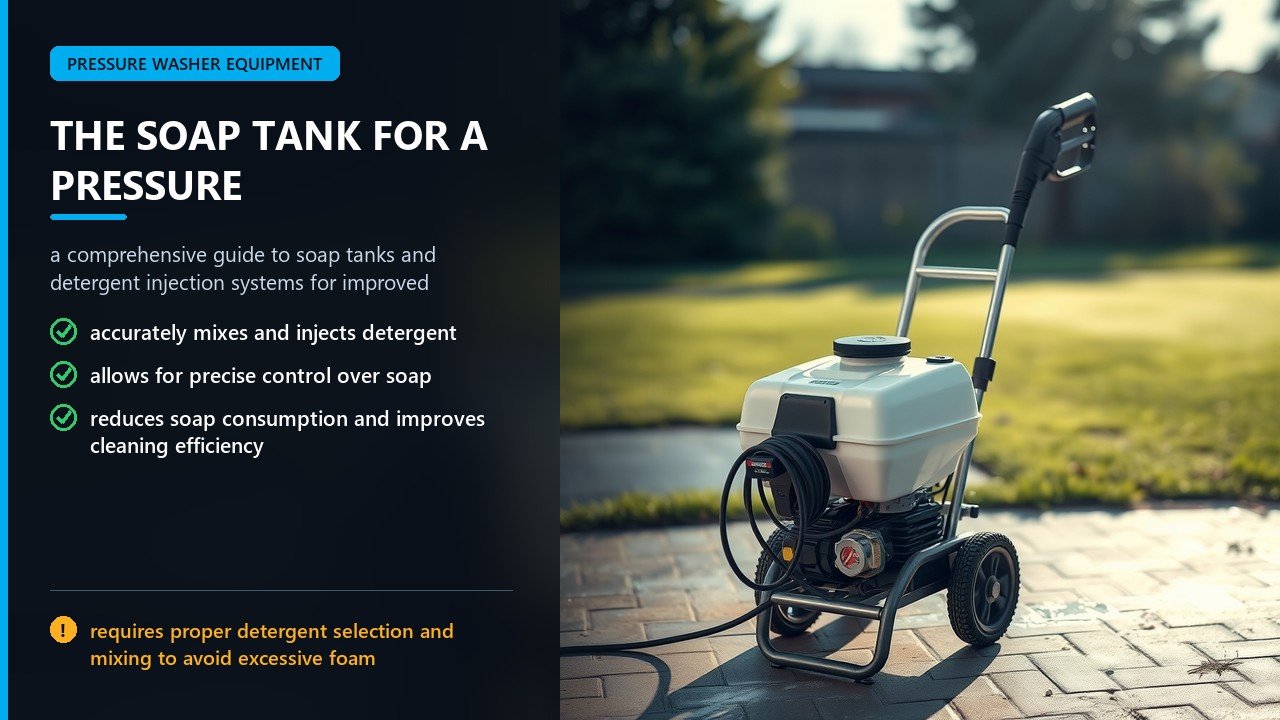
What a Soap Tank Actually Is
Define the component clearly before using it.
A detergent reservoir. A soap tank holds cleaning detergent and connects to the machine’s injection system, which draws the detergent into the water stream so the spray carries soap to the surface. It is a separate reservoir from the water supply.
Not a water tank. A soap tank holds concentrated detergent in small volume, while a water tank holds the water supply your machine draws from. Confusing the two leads to wrong expectations and wrong setups. Our guide to pairing washers and tanks explains the water side.
Part of an injection system. The tank alone does nothing; it works with an injector that draws detergent into the stream. Understanding the system explains why soap sometimes fails to appear, and why the nozzle you fit changes everything. Our guide to how detergent tanks work covers the basics.
A convenience, not magic. A soap tank applies detergent conveniently, but cleaning still depends on the detergent, the dwell time, and the rinse. It does not replace good technique, and it cannot rescue the wrong product or the wrong nozzle. Our guide to adding soap for a deeper clean explains the method.
Soap Tank Versus Water Tank
This distinction trips up many owners, so it is worth making plainly.
Purpose. A soap tank stores detergent to be injected into the stream; a water tank stores the water supply the machine draws from. One is for chemistry, the other for supply. Our guide to water tank sizing explains supply tanks.
Volume. Soap tanks are small, often holding under a gallon of concentrate. Water tanks are large, holding many gallons for extended cleaning. Our guide to a washer with a water tank covers the big tanks.
Connection. A soap tank feeds the injector; a water tank feeds the pump inlet. Mixing them up can starve the pump or send detergent where it should not go. Our guide to suction hoses from tanks explains supply connections.
Some machines have both. A machine can draw water from a tank and inject soap from a smaller reservoir at the same time, which is common on mobile setups. Our guide to mobile tank setups covers the combination.
| Feature | Soap Tank | Water Tank |
|---|---|---|
| Holds | Detergent concentrate | Water supply |
| Volume | Small, under ~1 gal | Large, many gallons |
| Feeds | The injector | The pump inlet |
| Purpose | Apply chemistry | Supply water |
How Detergent Actually Reaches the Nozzle
Understanding the path of detergent explains most soap problems.
Downstream injection. The most common method. Detergent is drawn into the water stream after the pump, through a venturi or injector, then travels down the hose to the nozzle. Downstream injection avoids sending detergent through the pump. Our guide to the soap hose covers the tubing.
The venturi effect. A narrowing in the injector creates a low-pressure zone that draws detergent from the tank into the stream. The strength of this draw depends on flow and the injector’s design. Our guide to a soap dispenser attachment explains the mechanism.
Soap versus rinse nozzles. Many machines apply soap only with a low-pressure (black) nozzle, because the venturi needs low pressure to draw detergent. Switch to a high-pressure tip and soap stops flowing. This is intentional. Our guide to nozzle colors explains the tips.
Why soap sometimes disappears. Wrong nozzle, clogged injector, too-thick detergent, or air in the line all stop the draw. Each has a fix. Our guide to why dish soap backfires covers a common cause.
Types of Soap Tanks and Injection Systems
Systems vary, and each suits different machines and users.
Onboard soap tank. Built into the machine, convenient and compact, but usually small and sometimes awkward to fill or clean. Common on consumer machines. Our guide to detergent tanks covers onboard designs.
Removable bottle or tank. A bottle that snaps onto the machine or injector and can be removed for filling and rinsing. Our guide to the pressure washer bottle covers the bottle type.
Inline injector with a siphon hose. A separate injector with a hose that siphons detergent from any container, letting you use large jugs and swap detergents easily. Flexible and popular for serious users. Our guide to the soap hose covers this setup.
Upstream injection. Detergent is drawn before the pump and pushed through it. Less common because detergents can damage some pumps, but used on specific machines. Check your machine’s design before using any detergent.
Foam cannons and attachments. Separate devices that mix detergent and air to create foam, often used for vehicle washing. These are an alternative to a built-in soap tank. Our guide to soap dispenser attachments covers add-ons.
| System | How It Feeds | Best For |
|---|---|---|
| Onboard tank | Built-in injector | Casual home use |
| Removable bottle | Snap-on injector | Easy cleanup |
| Inline siphon injector | Siphons from any jug | Serious/frequent use |
| Upstream injection | Draws before pump | Specific machines |
| Foam cannon | Mixes soap and air | Vehicle washing |
Choosing and Mixing Detergent
The detergent you put in the tank matters as much as the tank itself.
Use pressure washer detergent. Detergents made for pressure washing are formulated to work under pressure and rinse cleanly. Our guide to cleaning products and detergents covers the options.
Match the detergent to the job. Degreasers for grease, general-purpose cleaners for dirt, and specialty cleaners for specific surfaces. Using the wrong type wastes effort. Our guide to choosing a degreaser helps.
Respect the dilution ratio. Most detergents are concentrates that must be diluted as the label directs. Too strong wastes product and can harm surfaces; too weak does nothing. Our guide to adding soap correctly covers ratios.
Avoid dish soap. Dish soap foams far too much, cleans poorly under pressure, and can damage plants and surfaces. It is the single most common soap-tank mistake. Our guide to why dish soap backfires explains.
Consider plant and surface safety. Some detergents harm vegetation or finishes. Choose products labeled safe for your surfaces and rinse plants thoroughly. Our guide to detergent care covers compatibility.
Using Soap and Rinse Modes Correctly
Getting the sequence right is what makes soap actually help.
Pre-rinse first. Rinse the surface with plain water to remove loose dirt before applying soap, so the detergent works on the grime that remains. Our guide to degreaser use covers technique.
Apply soap at low pressure. Fit the soap nozzle, draw detergent, and coat the surface evenly. Low pressure lets the venturi draw soap and prevents driving detergent into the surface unevenly. Our guide to nozzle colors explains the soap tip.
Let it dwell. Give the detergent time to loosen grime before rinsing. The dwell time does as much work as the spray. Our guide to adding soap covers dwell.
Rinse with high pressure. Switch back to a high-pressure nozzle and rinse the loosened grime away with plain water. This is where soap mode ends and cleaning completes. Our guide to detergent tank operation explains switching modes.
Flush the system. After using detergent, run clean water through the injector and hose to clear soap residue, which can clog or corrode the system if left. Our guide to the soap hose covers flushing.
Common Mistakes and Troubleshooting
Most soap-tank problems trace to a few familiar causes.
No soap appears. Usually the wrong nozzle, a clogged injector, a kinked siphon hose, or air in the line. Fix the nozzle, clean the injector, check the hose, and purge. Our guide to how tanks work helps diagnose.
Weak or watery soap. A detergent that is too thick or too diluted, or an injector with too little draw. Thin the detergent if allowed, or use the correct dilution and check the injector. Our guide to adding soap covers ratios.
Excessive foam. Dish soap or too strong a concentration. Switch to a proper detergent and dilute correctly. Our guide to dish soap problems explains.
Detergent won’t stop flowing. The injector is stuck open, often from dried detergent. Flush and clean the injector after every use to prevent this. Our guide to soap hose care covers cleaning.
Detergent leaks from the tank. A cracked tank, a loose cap, or a failed fitting. Replace the damaged part, since detergent leaks waste product and can harm surfaces. Our guide to the bottle assembly covers parts.
Detergent damage to the machine. Using a detergent that is too aggressive or leaving it in the system can corrode parts. Flush after every use and follow the machine’s detergent guidance. Our guide to avoiding the wrong soap explains.
Do You Even Need a Soap Tank?
For some jobs soap is essential; for others it is unnecessary.
Where soap helps. Grease, oil, vehicle films, mold, mildew, and biological grime respond to detergent before rinsing. A soap tank applies it conveniently over large surfaces. Our guide to degreasing covers the uses.
Where soap is optional. For plain dirt and dust on driveways and siding, water alone often suffices, and soap adds time and cost. Use soap where it changes the result. Our guide to adding soap helps you decide.
Alternatives to a built-in tank. A downstream injector with a siphon hose, a foam cannon, or a manual sprayer can apply detergent without an onboard tank. Our guide to soap dispenser attachments covers alternatives.
The practical answer. If you clean greasy, moldy, or vehicle surfaces regularly, a soap tank or an equivalent injector is worth having. If your work is mostly plain dirt, water alone may be enough. Our guide to soap and detergent systems covers the choices.
Store detergent properly. Keep concentrate sealed, labeled, and out of freezing temperatures, since freezing can separate or degrade some detergents. Store it away from children and pets, and never transfer it into an unlabeled container. Proper storage keeps the detergent effective and safe between jobs, and it prevents the accidental mixing that causes so many cleaning mishaps.
Sizing, Mounting, and Setup
Getting the tank and its plumbing right makes soap application reliable.
Match tank size to the job. A small onboard tank is fine for a car or a small patio, but a large surface like a house exterior may empty it before you finish. If you clean large areas often, choose a bigger tank or an inline siphon system that draws from a large jug. Our guide to how detergent tanks work covers sizing.
Mount it where you can fill and see it. A tank that is hard to reach or that hides the fluid level leads to running dry mid-job or spilling detergent. Choose a mounting that keeps filling and checking easy. Our guide to the bottle system covers mounting options.
Keep the siphon hose short and clear. A long or kinked siphon hose reduces the injector’s draw, weakening soap flow. Route it for a short, smooth path, and check it for kinks or clogs. Our guide to the soap hose explains routing.
Fit the right injector. The injector must match your machine’s flow and pressure to draw detergent correctly. An undersized or mismatched injector produces weak soap. Our guide to a soap dispenser attachment covers matching.
Confirm the machine supports injection. Not every pressure washer is designed for downstream soap injection, and some pumps must never see detergent. Check the manual before adding a system. Our guide to avoiding the wrong soap explains the risk.
Maintaining the Soap System
Detergent residue is the enemy of an injection system, so maintenance is mostly about flushing and cleaning.
Flush after every use. Run clean water through the injector, siphon hose, and working hose to clear detergent before it dries. Residue clogs injectors and corrodes parts, and it is far easier to prevent than to remove. Our guide to soap hose care covers flushing.
Clean the injector on schedule. Even with flushing, injectors accumulate residue. Remove and clean the injector periodically, following the manufacturer’s guidance, to keep the draw strong. Our guide to how tanks work covers the part.
Rinse the tank. Empty, rinse, and dry the soap tank when you will not use it for a while, so residue does not harden and clog the outlet. Our guide to the bottle assembly covers cleaning.
Inspect seals and connections. Detergent leaks damage surfaces and waste product, so replace worn o-rings and cracked bottle seals promptly. Our guide to soap hose parts covers replacements.
Protect from freezing. Water and diluted detergent left in the tank and lines freeze and crack them. Drain and protect the soap system in cold weather along with the rest of the machine. Our guide to winter storage covers the routine.
| Maintenance Task | When | Why |
|---|---|---|
| Flush soap lines | After every use | Prevent residue clogs |
| Clean the injector | Periodically | Keep the draw strong |
| Rinse the tank | Before storage | Stop hardened residue |
| Inspect seals | Regularly | Prevent leaks and damage |
| Drain before freezing | Cold weather | Prevent cracks |
Frequently Asked Questions
What is a soap tank for a pressure washer? It is the reservoir that holds detergent and feeds it into the water stream through an injector, so the spray applies soap before you rinse. It is separate from the water supply tank.
Why is no soap coming out? Most often because you are using a high-pressure nozzle instead of the low-pressure soap tip, or the injector is clogged or air is in the line. Fit the soap nozzle, clean the injector, and purge.
Can I use dish soap in the tank? No. Dish soap foams excessively, cleans poorly under pressure, and can harm plants and surfaces. Use a detergent made for pressure washers at the recommended dilution.
How much detergent should I mix? Follow the detergent label. Most concentrates are diluted as directed, and the tank holds the diluted mix. Too strong wastes product and harms surfaces; too weak does nothing.
Is a soap tank the same as a water tank? No. A soap tank holds a small amount of detergent for injection, while a water tank holds the large water supply the machine draws from.
Do I need to flush the soap system? Yes. Run clean water through the injector and hose after each use to clear detergent residue, which can clog or corrode the system if left.
Final Thoughts on the Soap Tank for a Pressure Washer
A soap tank for a pressure washer is a simple component with a simple job: hold detergent and feed it into the water stream so your machine can apply soap before rinsing. Where owners go wrong is in the details. They confuse the soap tank with a water tank, use the wrong nozzle so no soap is drawn, pour in dish soap that foams and rinses badly, or skip the flush that keeps the injector clear. Fix those details and the soap tank does exactly what it should.
Use a proper pressure washer detergent at the label’s dilution, apply it at low pressure with the soap tip, let it dwell, then rinse at high pressure with plain water and flush the system afterward. Choose the injection system that fits your habits, whether it is an onboard tank, a removable bottle, or an inline siphon injector you can feed from any jug. Handle the chemistry safely and keep it out of storm drains and waterways.
That is what Tariq discovered. Once he used the right nozzle, the right detergent, and the right sequence, his soap tank worked exactly as designed, and his cleaning improved. A soap tank is not magic, but used correctly it is a genuine advantage. Understand the component, respect the chemistry, and your soap will finally do the work you bought it for.