A young man named Devon wanted to start a cleaning business but had no idea what to buy. He first bought a cheap pressure washer and a garden hose, then realized he could not drive to a customer’s site, clean for hours, and find a spigot whenever he needed one. He lost a job because a client’s outdoor tap was broken, and another because he had nowhere to hold water. That is when he learned that mobile pressure washing is not just a machine; it is a system of equipment that lets you work anywhere. Once he assembled the right pieces, a water tank, a trailer, proper hoses, and a way to carry and recover water, his business finally ran the way he imagined.
Mobile pressure washing equipment is the collection of tools and components that let you take pressure washing on the road and work without relying on a customer’s water or power. It goes far beyond the pressure washer itself. This guide explains what counts as mobile pressure washing equipment, the core pieces you need, the mounting options from skids to trailers to trucks, how to handle water supply and wastewater, how to choose the machine and accessories, whether to build or buy, the cost and return on investment, maintenance, and the compliance rules that mobile cleaners must follow. If you are building or upgrading a mobile setup, this is the equipment map that keeps you from the mistakes beginners make.
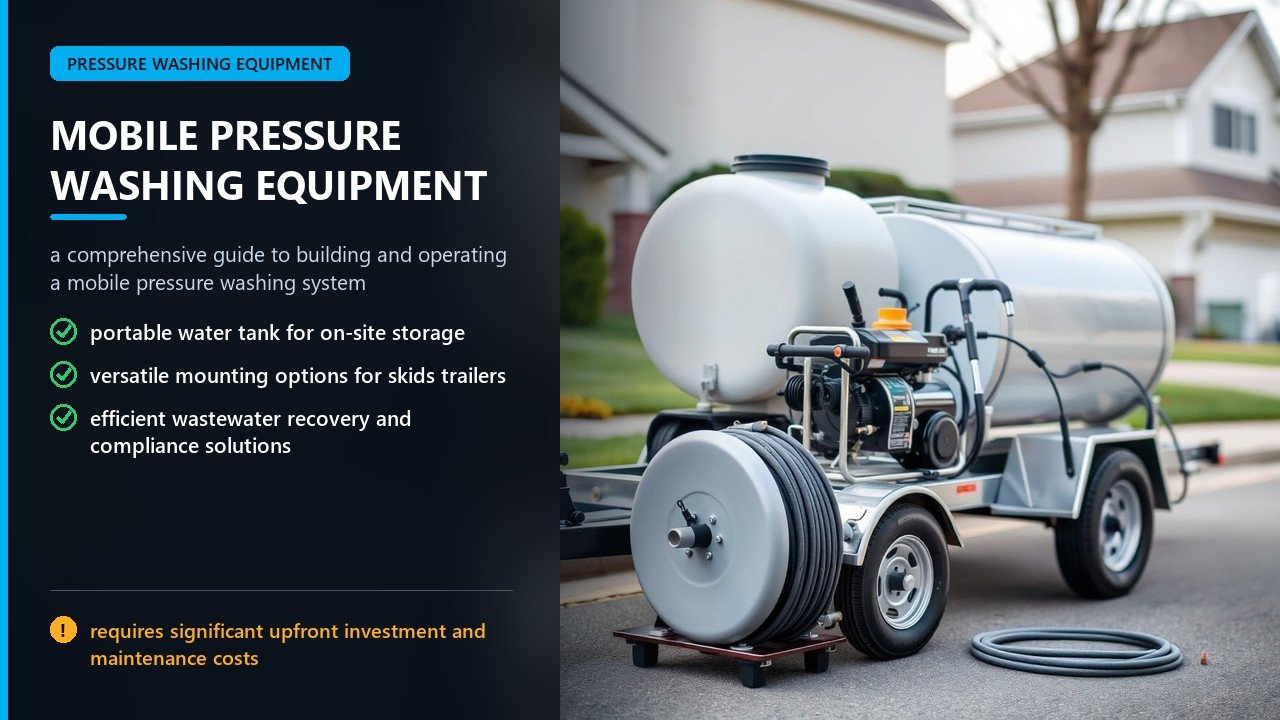
What Counts as Mobile Pressure Washing Equipment
Mobile equipment is everything that lets you clean on location independently, and it is more than the washer.
The pressure washer itself. The core machine, usually gas-powered for mobility and power, with enough pressure and flow for the work. Our guide to matching a machine to the job helps you choose.
A water supply. A tank or tanks let you work without a spigot, and many mobile setups use a buffer tank even when a supply is available, to feed the pump steadily. Our guide to water tank sizes and buffer tanks covers the options.
A mounting platform. A skid, cart, trailer, truck bed, or van determines how much equipment you can carry and how quickly you can set up. Our guide to trailer basics explains the platform side.
Hose and reel systems. Reels, jumpers, and hoses keep the high-pressure line organized and let you reach the work from the vehicle. Our guide to the jumper hose that connects pump to reel covers a commonly overlooked part.
Guns, wands, and nozzles. The tools that deliver the spray, plus a range of tips for different surfaces. Our guide to nozzle colors explains the tips.
Detergent and application gear. A soap tank and downstream injector or low-pressure applicator for applying cleaning solutions. Our guide to how detergent tanks work covers the chemistry side.
| Core Equipment | Purpose |
|---|---|
| Pressure washer | Provides pressure and flow |
| Water tank / buffer tank | Works without a spigot |
| Mounting platform | Skid, cart, trailer, truck, or van |
| Hose and reel system | Reach and organization |
| Gun, wand, nozzles | Delivers the spray |
| Detergent setup | Applies cleaning solutions |
| Wastewater recovery | Compliance and clean sites |
Mounting Options for Mobile Work
How you mount the equipment shapes your business, from a simple cart to a full trailer rig.
Skid-mounted. The machine and components are built onto a compact skid that drops into a truck bed or trailer. Skids are flexible and easy to move between vehicles, and they suit cleaners who already have a truck. Our guide to wall, skid, or trailer mounting compares the choices.
Cart-mounted. A cart makes a machine portable and self-contained, best for lighter work and smaller jobs where a full trailer is overkill. Our guide to making a washer mobile covers carts.
Trailer-mounted. A dedicated trailer holds the machine, water tanks, reels, and recovery gear, and can be backed right up to the work. Trailers are the backbone of many cleaning businesses. Our guide to how a trailer builds a business explains the appeal.
Truck or van-mounted. Mounting inside a truck bed or van protects equipment and keeps it ready, ideal for cleaners who work from a single vehicle. Our guide to how mounted cleaners transform a business covers the workflow.
| Platform | Best For | Trade-off |
|---|---|---|
| Skid | Cleaners with a truck | Needs a host vehicle |
| Cart | Light and small jobs | Limited capacity |
| Trailer | Full-scale business | Tow vehicle and space needed |
| Truck / van | Urban and fast setup | Limited room for tanks |
Water Supply for Mobile Cleaning
Water independence is what makes a setup truly mobile, and it deserves careful planning.
Tank capacity. Choose tank size based on how long you work without refilling and how much water the machine uses. A high-flow machine empties a small tank quickly, so capacity and flow must match. Our guide to mobile tank setups explains the math.
Buffer tanks. Even with a water supply on site, a buffer tank feeds the pump steadily and prevents starvation at high flow. Many commercial setups use one alongside a source. Our guide to pairing a washer and tank covers the reasoning.
Refill strategy. Plan where you will refill between jobs, whether from a customer’s tap, a bulk water supplier, or a hydrant with permission. Refilling is a logistical part of the business, not an afterthought.
Pump feeding. How water reaches the pump matters. A gravity feed, a transfer pump, or a direct connection all affect reliability, and the pump must never run dry. Our guide to a portable tank washer covers independence from a spigot.
Wastewater Recovery and Compliance
Mobile cleaning creates runoff, and handling it properly is both a legal duty and a business advantage.
Why recovery matters. Dirty water from washing vehicles, equipment, or buildings can contain oil, grease, and chemicals. Dumping it into storm drains is often illegal because those drains lead to waterways. The Environmental Protection Agency regulates stormwater and wastewater discharge, and local rules add their own requirements.
Recovery equipment. Vacuum recovery systems, containment berms, and surface cleaners with recovery collect runoff so it can be disposed of correctly. Some machines include water recovery as part of the setup.
Disposal planning. Recovered water must go to an approved disposal point, such as a sanitary sewer with permission or a treatment facility. Know your local rules before you start, because fines and reputation damage cost more than the equipment.
A selling point. Cleaners who recover water and leave a site spotless win repeat business and stand out from competitors who leave a mess. Compliance is not just a cost; it is a differentiator.
Choosing the Machine for Mobile Work
The pressure washer at the center of a mobile setup must match the work and the platform.
Gas power for mobility. Gas machines provide the power and independence that mobile work demands, without relying on an outlet. Our guide to gas engine power covers the engine side.
Enough pressure and flow. Commercial mobile work needs strong pressure and, especially, strong flow for speed. A machine with good flow cleans faster and finishes more jobs per day. Our guide to commercial power and duty explains the class.
Portable but powerful. A 4,200 PSI class machine delivers commercial muscle while remaining movable, which suits many mobile operators. Our guide to a 4,200 PSI commercial machine covers this balance.
Durability and service. Mobile machines work hard and travel rough. Choose a machine with a robust pump, known engine, and available parts so you can repair it quickly. Our guide to quality pump brands explains the value.
Accessories That Make or Break a Setup
The right accessories turn a machine on a platform into a productive business tool.
Hose reels and the right hose. A reel keeps the high-pressure line organized and ready, and a properly sized hose delivers full flow to the work. Our guide to hose reels and our guide to commercial hoses cover the essentials.
A quality gun and wand. Comfortable, durable gun and wand setups reduce fatigue on long days and stand up to commercial use. Our guide to a heavy-duty gun covers the upgrade.
Surface cleaners. A surface cleaner attachment speeds up flatwork like driveways and parking lots and improves consistency, which raises your output. Our guide to a cart with a hose reel shows a productive setup.
Nozzles and tips. A full set of tips and a turbo nozzle lets you match the tool to each surface, from soft siding to tough concrete. Our guide to nozzle colors explains the set.
Detergent application. An injector or low-pressure application system lets you apply cleaning solutions efficiently. Our guide to soap tanks covers the setup.
Build or Buy a Mobile Setup
You can assemble a setup yourself or buy a complete rig, and each path has trade-offs.
Buying a complete setup. A ready-made trailer or skid package saves time and comes engineered to work together. It costs more but gets you working faster, which matters when time is money. Our guide to choosing trailers for sale covers what to look for.
Building your own. Assembling a setup lets you tailor components and often costs less, and it teaches you how everything works, which helps with repairs. It takes time and planning. Our guide to building a 5×8 trailer and our guide to turning a trailer into a business cover the build path.
Renting or leasing. For occasional or seasonal work, renting a setup can beat buying, since it avoids capital cost and storage. Our guide to when renting beats buying explains the trade-off.
Buying used. A used trailer or machine can save money if inspected carefully for pump wear, frame rust, and engine condition. Our guide to trailer basics helps you judge a used rig.
| Approach | Best For | Trade-off |
|---|---|---|
| Buy complete | Fast start, turnkey | Highest cost |
| Build your own | Custom fit, lower cost | Time and planning |
| Rent or lease | Occasional or seasonal work | No asset, ongoing cost |
| Buy used | Budget-conscious startup | Inspection risk |
Cost, ROI, and Getting Started
Mobile setups range widely in cost, and the return depends on how well the equipment matches the work.
Equipment list and cost. A complete mobile setup includes the machine, tanks, platform, reels, hoses, guns, nozzles, and often recovery gear. Starting costs climb quickly, so prioritize the pieces that directly generate revenue. Our guide to equipment needed for a cleaning business walks through the list.
Match equipment to services. The services you offer, such as fleet washing, driveways, or commercial exteriors, decide the machine, water capacity, and recovery gear you need. Buying for services you do not offer wastes money. Our guide to matching equipment to the job helps.
Productivity drives ROI. A faster, more reliable setup completes more jobs per day, which is what pays back the equipment. Flow, organization, and uptime matter more than a single big spec. Our guide to how trailer systems transform a business covers the productivity angle.
Scale as you grow. Start with a modest setup that handles your early jobs, then add capacity, recovery, or a better machine as revenue grows. Overspending on a large rig before you have customers is a common failure. Our guide to trailer-based business growth explains the path.
Power, Heat, and On-Site Efficiency
Beyond the core pieces, a few choices shape how productive and versatile a mobile setup becomes.
Cold or hot water. Adding hot water capability greatly expands what you can clean, especially grease and oil on vehicles and equipment, but it adds cost, fuel use, and complexity. For many mobile cleaners, hot water is a profitable upgrade once the business justifies it. Our guide to what hot water cleans that cold cannot explains the gain.
Generator power. Some setups carry a generator to power electric accessories, recovery vacuums, or lighting, which extends what you can do on a site without power. Match generator capacity to your actual loads rather than oversizing.
Organization and workflow. Reels, quick-connects, and a logical layout reduce setup time and keep the job moving. Time spent untangling hoses is time not spent earning. Our guide to hose reels and mounting covers organizing the high-pressure line.
Quick-connect everything. Standardizing connections across the setup speeds changes between tools and reduces the spare parts you need to carry. A consistent system is faster and easier to repair in the field.
Spare capacity. Sizing tanks and reels with a little margin means fewer disruptions on long jobs. Running out of water or hose mid-job costs time and looks unprofessional. Our guide to tank sizing helps you plan capacity.
Maintenance and Safety on the Road
Mobile equipment works hard and travels rough, so maintenance and safety habits protect both the gear and the operator.
Service the engine and pump. Oil changes, air filters, and pump oil keep the heart of the setup running. Our guide to gas engine maintenance and safety covers the routine.
Inspect the trailer or vehicle. Tires, lights, and hitches deserve regular checks, since a breakdown on the way to a job loses the day. Safety on the road is as important as safety on the site.
Winterize between seasons. Water left in a pump, coil, or hose freezes and cracks equipment. Protect the whole setup from freezing. Our guide to winter storage covers the steps.
Work safely. High-pressure water and hot water are both hazardous, and mobile work adds traffic and customer sites to the risks. The Occupational Safety and Health Administration treats pressure washing as a task with real injury risks, and good operators respect that on every job.
Secure your load. Equipment, tanks, and reels should be properly mounted and secured so nothing shifts in transit. A shifted water tank or loose machine is a serious hazard on the road.
Common Mistakes to Avoid
Buying the machine and forgetting the system. A washer without water capacity, mounting, and reels is not a mobile business. Buy the whole setup.
Ignoring water logistics. Without a tank and a refill plan, you are at the mercy of a customer’s spigot. Plan water independence from the start.
Neglecting wastewater rules. Discharging runoff into storm drains risks fines and reputation. Build recovery into the setup.
Overspending before revenue. A huge rig with no customers is debt, not a business. Scale with your workload.
Underspending on reliability. A cheap machine that breaks mid-job costs more than it saved. Buy known engines and quality pumps. Our guide to commercial reliability explains the balance.
Frequently Asked Questions
What equipment do I need for mobile pressure washing? At minimum, a pressure washer, a water tank or source, a mounting platform such as a skid or trailer, hose and reel systems, a gun and nozzles, and detergent gear. For many jobs, wastewater recovery is also required.
Can I pressure wash without a water tap? Yes, with a water tank and the right setup. Many mobile operators carry a tank so they are independent of a customer’s water supply, and some use a buffer tank even when a supply is available.
Do I need to recover wastewater? In many areas, yes. Discharging wash water into storm drains is often illegal, and recovery equipment collects runoff for proper disposal. Check local regulations before washing.
Is a trailer or a truck bed better? A trailer holds more equipment and can be backed up to the work, while a truck bed or van is more agile and easier to park. The right choice depends on your services and vehicles.
How much power do I need? Commercial mobile work benefits from strong pressure and, especially, strong flow for speed. A commercial-class gas machine around 4,000 PSI with good flow handles most professional jobs.
Should I build or buy my setup? Buying is faster and turnkey; building is more customized and often cheaper but takes time. For a quick start, buying or buying used can win; for a tailored fit, building pays off.
Final Thoughts on Mobile Pressure Washing Equipment
Mobile pressure washing equipment is a system that frees you from a customer’s water and power and lets you clean anywhere. The pressure washer is the heart, but the water tank or buffer tank, the mounting platform, the hose and reel systems, the gun, wand, and nozzles, the detergent gear, and usually the wastewater recovery equipment are all essential parts of a working setup. Missing any one of them turns a business into a series of obstacles.
Choosing well means matching equipment to the services you sell, favoring reliability with known engines and quality pumps, planning water logistics and compliance from the start, and scaling as revenue grows rather than overspending on a big rig before you have customers. Whether you build, buy, rent, or buy used, the goal is a setup that works every day and pays for itself through productivity. Maintain it with scheduled engine and pump service, protect it from freezing, and keep it safe on the road and on the site.
That was the lesson Devon learned the hard way, one broken spigot and lost job at a time. Mobile pressure washing is not about owning the biggest machine. It is about owning the right system and keeping it ready, so that when a customer says yes, you can pull up, set up, clean, and get paid. Assemble the whole system and maintain it, and the equipment stops being a limitation and becomes the foundation of the business you set out to build.