A mobile cleaning operator named Renee ran a high-flow machine rated at 4 GPM, but she kept her old 3/8-inch hose. The machine had the pump to move serious water, yet the hose acted like a bottleneck, and the pressure at the nozzle sagged whenever she stretched the line. She assumed the machine was the problem until a supplier pointed at the hose. Switching to a 1/2-inch line restored the flow, and the machine finally performed the way its specs promised. The hose had been quietly capping everything the pump could do.
A 1/2-inch pressure washer hose is a high-flow line built to carry large volumes of water without starving the machine. It is the hose of choice for high-GPM pressure washers, long runs, and commercial work where flow is the difference between finishing fast and fighting the equipment. This guide explains what the 1/2-inch measurement means, why this diameter matters for flow, when you actually need it, how to size it for your machine, what fittings to look for, and how to care for it so it delivers full performance for years.
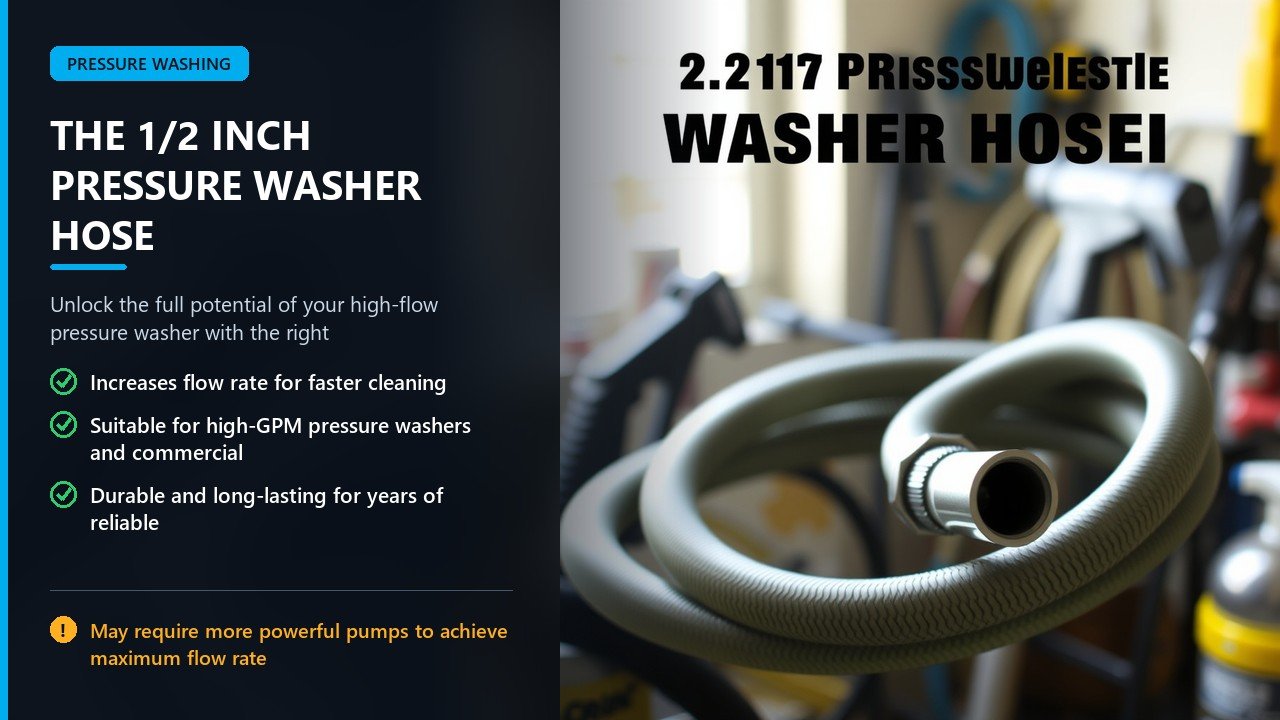
What the 1/2-Inch Measurement Means
Hose size is measured by inside diameter, and that single number controls how much water the hose can carry.
Inside diameter, not outside. The 1/2-inch figure describes the hollow channel the water travels through. The outside of the hose is larger, wrapped in its jacket and reinforcement. Two hoses can look similar on the outside while carrying very different flows inside, so always check the ID, not just the appearance. Our guide to hose length, diameter, and lost pressure explains how each affects performance.
A wider path means more flow. Water moving through a larger opening meets less resistance. A 1/2-inch hose has a far larger cross-section than a 3/8-inch or 1/4-inch hose, so it delivers more flow for the same pressure. That is the entire reason the size exists: to keep a high-flow machine fed without restriction.
It is a high-flow tool. A 1/2-inch hose is not for every machine. On a small electric pressure washer with modest flow, it is unnecessary and awkward. It earns its place on machines that move serious water, where a narrower hose would starve the pump or lose pressure over distance. Our guide to how a 1/2-inch hose delivers the flow your machine needs digs into the physics.
Why Flow Rate Matters So Much
Flow, measured in gallons per minute, is what determines how fast you clean, and the hose is the pipe that carries it.
Friction robs pressure. As water moves through a hose, friction against the walls slows it and drops pressure. A narrower hose has more wall contact relative to its flow, so it loses more pressure over the same length. A wider hose reduces that friction loss, keeping more of the machine’s pressure at the nozzle. Our guide to why flow rate decides how fast you clean covers the principle.
Length multiplies the loss. Friction loss grows with length. A short 3/8-inch hose might be fine, but stretch it to a hundred feet and the pressure loss becomes obvious. A 1/2-inch hose offsets that loss, which is why long runs on big machines call for the wider line. Our guide to choosing a 100-foot hose shows how reach and flow interact.
Starving the pump. On the supply side, a hose that cannot deliver enough flow forces the pump to work against a restriction. On the discharge side, an undersized high-pressure hose chokes the output and weakens the spray. Either way, the machine underperforms and can be stressed. Matching hose diameter to flow protects both performance and the pump. Our guide to how a 1/2-inch hose saves your pump on big jobs makes the case.
1/2-Inch vs 3/8-Inch vs 1/4-Inch Hose
Pressure washer hoses come in three common inside diameters, and each suits a different flow range.
1/4 inch. The lightest and most common on residential electric machines. It is easy to handle and adequate for low flow, but it restricts higher-volume machines. Our guide to the 1/4-inch hose and where it works best covers the light-duty role.
3/8 inch. The standard high-flow choice for gas machines and many commercial setups. It balances flow, weight, and cost, and it handles most mid-to-high flow machines well. Our guide to why 3/8 inch is the standard high-flow choice explains its popularity.
1/2 inch. The high-volume line for the biggest flows and longest runs. It moves the most water and loses the least pressure, but it is heavier, stiffer, and more expensive. It suits machines around 4 GPM and up, or long runs where every single unit of pressure matters. Our guide to high-flow machines and their hoses helps you judge the step up.
| Hose ID | Typical Machines | Flow Range | Handling |
|---|---|---|---|
| 1/4 inch | Light electric | Low | Light and easy |
| 3/8 inch | Gas and mid commercial | Moderate to high | Balanced |
| 1/2 inch | High-flow commercial | High | Heavy and stiff |
When You Need a 1/2-Inch Hose
A 1/2-inch hose is a deliberate choice, and it earns its keep in specific situations.
High-GPM machines. If your machine moves roughly 4 GPM or more, a 1/2-inch hose helps it deliver full flow to the nozzle. On these machines, a narrower hose is the weak link. Our guide to a 4 GPM machine covers that class.
Long runs. When the job requires a long hose, the wider line reduces friction loss and keeps pressure strong at the far end. Cleaning a large building, a big driveway, or a commercial property from a fixed machine benefits from the flow a 1/2-inch hose preserves.
Commercial and mobile work. For professionals, time is money and flow is speed. A high-flow hose keeps productivity up across long days and large surfaces, which is why commercial rigs often standardize on wide hose. Our guide to commercial-grade hoses covers what to look for.
Matching an existing high-flow setup. If your machine, gun, and nozzles are already rated for high flow, a 1/2-inch hose completes the system instead of throttling it. A chain is only as strong as its narrowest link, and the hose is often that link.
When you do not need it. On a light electric machine, a 1/2-inch hose adds weight and cost for no benefit, because the machine cannot move enough water to justify it. Match the hose to the machine, not to a desire for the biggest possible line.
Sizing the Hose to Your Machine
Correct sizing means balancing diameter, length, and flow so the nozzle receives what the machine produces.
Start with the machine’s GPM. The pump’s flow sets the baseline. Choose a hose whose diameter suits that flow with margin, so it never becomes the restriction. For a rough guide, low-flow machines suit 1/4 inch, mid-to-high flow suits 3/8 inch, and high flow suits 1/2 inch, with the boundary decided by how much pressure loss you can tolerate.
Account for length. The longer the run, the more the wider diameter pays off. If you need a long hose on a machine near the boundary between two diameters, step up to the wider one to offset friction loss. Our guide to length, diameter, and lost pressure walks through the trade-off.
Keep the supply ahead of demand. The high-pressure hose is not the only line to size. The inlet supply must also deliver enough water, or the machine starves regardless of the discharge hose. Match both ends of the system. Our guide to the right water supply explains the inlet side.
Test at the nozzle. The true measure of a good match is pressure and flow at the nozzle. If performance sags compared with the machine’s ratings, the hose may be the culprit. A wider or shorter hose often restores the missing performance.
| Machine Flow | Recommended Hose | Notes |
|---|---|---|
| Under 2 GPM | 1/4 inch | Light machines, short runs |
| 2 to 3 GPM | 3/8 inch | Standard gas machines |
| 3 to 4 GPM | 3/8 to 1/2 inch | Step up for long runs |
| 4 GPM and up | 1/2 inch | High-flow commercial |
Fittings and Connections
A high-flow hose is only as good as its connections. The wrong fitting restricts flow or leaks, undoing the benefit of the wide hose.
Match the thread standard. Pressure washer fittings commonly use M22 threaded connections or quick connects, and high-flow hoses may use larger fittings to avoid creating a bottleneck. Confirm the fittings on your machine, gun, and hose so they connect without adapters that narrow the path. Our guide to building a leak-free connection covers the options.
Avoid flow-restricting adapters. Adapters are useful, but a chain of them with narrow internal passages can choke a high-flow line. Where possible, choose a hose with the fitting you need built in, or use adapters rated for the flow. The internal bore of every fitting should match the hose. Our guide to hose adapters that end leaks explains the pitfalls.
Use quick connects that fit the flow. Quick connects are convenient, but choose ones sized for your hose and flow, not the smallest available. A large hose with a small quick connect is a wide pipe squeezed into a narrow nozzle. Our guide to hose with quick connect covers the convenience-fitting trade-off.
Double-check the gun and nozzle. The gun and nozzle must also handle the flow. A high-flow hose feeding a gun with narrow passages or a worn nozzle still results in a weak spray, because the restriction has simply moved downstream. Rate the whole system for the flow you intend to use.
Choosing a Quality 1/2-Inch Hose
The diameter is only the beginning. Construction decides how long the hose lasts and how well it performs.
Check the pressure rating. The hose must be rated above your machine’s maximum pressure, with margin. A hose rated below the pump’s output is a safety risk and will fail early. Never stretch a hose beyond its rating.
Look at the reinforcement. Quality high-pressure hoses use braided reinforcement, often steel or high-tensile fiber, under a tough outer jacket. Better reinforcement resists bursting, kinking, and abrasion. Our guide to commercial-grade hose construction explains the layers.
Consider flexibility and weight. A 1/2-inch hose is inherently heavier and stiffer than a narrow one, so a quality hose uses materials that keep it as flexible as possible. A more flexible wide hose is easier to manage and less tiring over a long day. Our guide to choosing a commercial hose that lasts covers the trade-offs.
Match the temperature rating. For cold water use, a standard rating is fine. For hot water machines, the hose must be heat-rated, or it will fail quickly. Confirm the temperature rating for your application.
Buy from a reputable source. Standards matter for pressure hose, and reputable makers build to recognized specifications. Industry bodies such as SAE International publish standards relevant to hose and fluid systems, and quality makers design to them. A well-made hose costs more once and far less over time. Our guide to hose ratings and construction covers what to look for.
| Spec | What to Look For | Why It Matters |
|---|---|---|
| Pressure rating | Above machine max, with margin | Safety and durability |
| Reinforcement | Braided steel or high-tensile fiber | Resists burst and kinking |
| Flexibility | Best available for the diameter | Easier handling, less fatigue |
| Temperature | Heat-rated for hot water | Cold hoses fail under heat |
| Fittings | Match machine and flow | Avoids bottlenecks and leaks |
Care and Storage
A 1/2-inch hose is an investment, and basic care extends its life considerably.
Coil it properly. Coil the hose in large, even loops rather than tight twists, and avoid sharp bends that kink the reinforcement. A hose reel makes this easy and keeps the line tidy. Our guide to how a reel keeps your setup tidy covers reel options.
Protect it from abrasion. Dragging a hose across concrete and sharp edges wears the jacket. Route it away from hazards and lift it over rough spots when you can. The outer jacket is the first line of defense for the reinforcement inside.
Keep it out of traffic and heat. Do not run a hose where vehicles will drive over it, and keep it away from hot exhaust and sharp metal. Both crush and heat damage the hose from the outside.
Drain and store dry. After use, drain the hose and store it out of direct sun and above freezing. Left full of water in freezing weather, the hose can crack. Our guide to winter storage covers protecting the whole setup.
Inspect regularly. Check for bulges, cuts, and worn spots, especially near the fittings. A damaged hose is a burst waiting to happen, and high-pressure water is dangerous. Replace a suspect hose before it fails. Our guide to hose parts and replacement covers repairs.
Common Mistakes With 1/2-Inch Hoses
Buying wider than the machine can use. Oversizing the hose for a low-flow machine adds weight and cost without benefit. Match the diameter to the flow.
Choking a wide hose with narrow fittings. Upgrading the hose but keeping small quick connects or adapters defeats the purpose. The whole path must support the flow.
Ignoring length. A too-long hose on a machine near the flow boundary reintroduces the friction loss the wider diameter was meant to solve. Choose length deliberately.
Overlooking the pressure rating. Never use a hose rated below the machine’s output, no matter how good the price. This is a safety limit, not a preference.
Storing it wet in the cold. Trapped water freezes and cracks the hose. Drain and store it properly, every season.
Fitting a 1/2-Inch Hose Into a High-Flow System
A wide hose is one part of a chain, and the chain works only when every link supports the flow. Understanding the whole system prevents the common mistake of upgrading one part and being disappointed.
The pump sets the flow. Everything begins with the pump’s rated GPM. If the pump moves 4 GPM, the goal is to deliver close to that at the nozzle. If it moves 2 GPM, a 1/2-inch hose cannot create more. Match the hose to what the pump produces, not to a wish for more flow.
The supply must keep up. On the inlet side, the water source and supply hose must deliver at least as much water as the pump demands. A high-flow machine fed by a thin garden hose starves, surges, and can be damaged, no matter how wide the high-pressure hose is. Both ends of the machine need enough water. Our guide to keeping the pump fed covers the supply.
The gun and nozzle must pass it through. A high-flow hose feeding a gun with narrow internal passages, or a worn nozzle, still results in a weak spray. The restriction has merely moved downstream. Choose a gun and nozzle rated for high flow so the wide hose’s benefit reaches the surface.
Fittings must not narrow the path. Every adapter and quick connect should have an internal bore that matches the hose. A stack of small fittings on a wide hose defeats the upgrade. Where possible, use fittings sized to the flow, and keep the connection path as simple as you can.
The payoff is consistency. When the pump, supply, hose, gun, and nozzle are all matched, the machine delivers steady flow and pressure regardless of run length. That consistency is what professionals pay for, because predictable performance is what makes a job fast and repeatable. Our guide to how high-pressure water turns a hose into a cleaning machine connects the parts.
Frequently Asked Questions
What is a 1/2-inch pressure washer hose used for? It is a high-flow hose for high-GPM machines and long runs. It carries more water with less pressure loss, making it ideal for commercial work, big machines, and situations where the hose would otherwise restrict flow.
Can I use a 1/2-inch hose on any pressure washer? Physically it can connect with the right fittings, but it is only worthwhile on machines with enough flow to benefit. On a low-flow machine, it adds bulk and cost for no gain.
Is a 1/2-inch hose better than 3/8-inch? Not universally. It moves more water and loses less pressure, but it is heavier, stiffer, and costlier. Choose based on your machine’s flow and your run length. For many machines, 3/8 inch is the better balance.
How long can I run a 1/2-inch hose before losing pressure? Friction loss depends on flow, length, and diameter, but a 1/2-inch hose loses far less pressure over distance than a narrower hose, which is why it suits long runs. Consult flow charts for your specific flow and length.
What fittings does a 1/2-inch hose use? It can use M22 or quick-connect fittings, often sized larger to match the flow. Confirm the fittings match your machine and gun, and avoid adapters that narrow the internal bore.
Does a wider hose increase my machine’s pressure? No. Pressure is set by the pump. A wider hose preserves more of that pressure at the nozzle by reducing friction loss, so the cleaning effect can improve even though the pump’s rating is unchanged.
Can I use a 1/2-inch hose on a hot water machine? Only if the hose is rated for heat. Standard cold-water hoses fail quickly under hot water. Choose a heat-rated 1/2-inch hose and confirm its temperature rating before use.
How do I store a 1/2-inch hose? Drain it fully, coil it in large even loops, and store it out of direct sun and above freezing. A hose reel makes coiling easier and keeps the line from kinking. Never leave it full of water in freezing weather.
Final Thoughts on the 1/2-Inch Pressure Washer Hose
A 1/2-inch pressure washer hose exists for one reason: flow. Its wide inside diameter moves more water with less friction loss than a narrower line, which lets a high-GPM machine deliver its full performance to the nozzle instead of choking on a bottleneck. For commercial work, long runs, and big machines, that difference is the whole job.
Choose the diameter to match your machine’s flow, and step up to 1/2 inch when the flow is high or the run is long. Confirm that your fittings, gun, and nozzles support the same flow, because the restriction simply moves downstream if they do not. Buy a hose rated above your machine’s pressure with proper reinforcement and the best flexibility you can get, and care for it by coiling it well, protecting it from abrasion and heat, and storing it drained and out of the cold.
Do that and the hose stops being the weak link. Renee’s machine did not get stronger when she changed the hose; it simply stopped being held back. That is what a 1/2-inch high-flow line is for, and when it matches the machine, it lets the whole system finally work as designed.