A homeowner named Dan hated the end of every pressure washing job. Coiling fifty feet of stiff, kinked hose into a neat loop always turned into a wrestling match, and by the time he finished, the hose was a tangled mess that took twice as long to store as it did to use. He bought a retractable power washer hose setup to solve it, and for a while it worked beautifully: pull the hose out, let it retract, done. But a year later the pressure had noticeably dropped, and a repair shop explained that the coiled retracting hose he chose was too small and restrictive for his machine’s flow. Dan learned that retractable hoses come in forms that help and forms that quietly hurt, and telling them apart is the whole game.
A retractable power washer hose is any hose system designed to extend and retract for convenience, most often through a spring-loaded reel but sometimes through a self-coiling hose. The promise is simple: no more tangles, no more coiling, faster setup and storage. The risk is equally simple: some retractable designs restrict flow or use low-quality parts that leak, costing you pressure and money. This guide explains the types of retractable hose systems, how they work, when retracting helps and when a coil hose hurts, how to choose a retractable hose or reel that does not strangle your machine, the specifications that matter, installation and maintenance, common problems, and the alternatives to consider. If you want to end hose chaos without losing pressure, this is what you need to know.
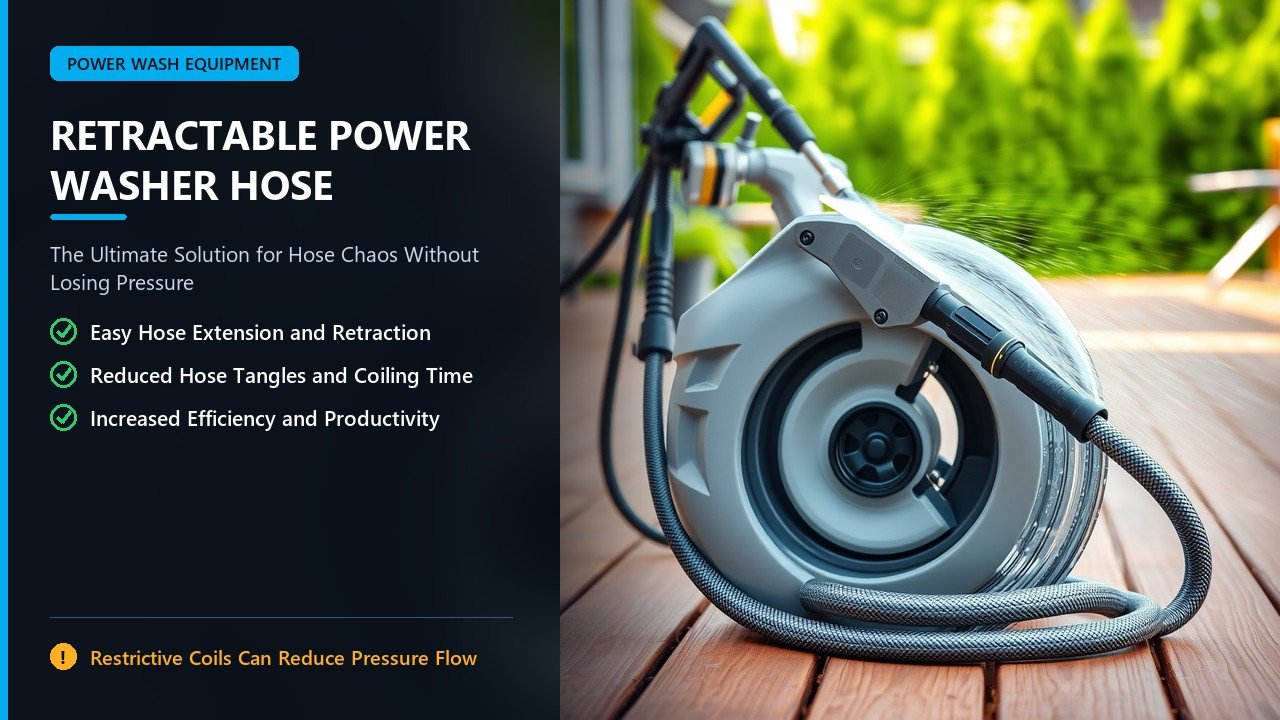
The Two Types of Retractable Hose
Telling these apart is the key to making a good choice.
The retractable reel. A spring-loaded reel holds a standard high-pressure hose and rolls it up at the pull of a handle or a tug. The hose itself is normal size, so flow is preserved, and the reel handles storage. This is the retractable system most owners actually want. Our guide to a retractable hose reel covers the concept.
The self-coiling hose. A coiled or “retractable” hose that shrinks and expands on its own. These are compact and tangle-free, but the smaller diameter and coiled construction often restrict flow, starving the machine and reducing pressure. Our guide to the coil hose trap explains the problem.
A hybrid reality. Some products combine a coiled hose with a reel or a housing, blending the two. Understanding which part does the work, and whether the hose itself is large enough, is what matters.
Why the distinction matters. A retractable reel improves convenience without harming performance, while a restrictive coil hose improves convenience by harming performance. One is a tool upgrade; the other can quietly ruin your cleaning power. Our guide to choosing a hose covers the fundamentals.
| Type | How It Retracts | Effect on Flow |
|---|---|---|
| Spring rewind reel | Spring rolls hose in | None, full hose size |
| Self-coiling hose | Material coils itself | Often restricts flow |
| Hybrid housing | Coil inside a case | Varies by hose size |
How a Retractable Hose System Works
Understanding the mechanism helps you judge quality.
Spring rewind. A coiled spring inside the reel stores energy when you pull the hose out and releases it to roll the hose back in. A latch holds the hose at the length you need. Our guide to how spring rewind reels work explains the mechanism.
Swivel fittings. A quality reel uses a swivel connection that lets the hose and drum rotate without twisting or leaking. The swivel is the weak point on cheap reels, so its quality matters. Our guide to hose couplings covers the connections.
Mounting. Retractable reels mount on a wall, a cart, or a machine, and the mounting must be solid enough to handle the pull of the spring. Our guide to installing a retractable reel covers mounting.
Self-coiling material. A coil hose relies on a molded shape in the hose material, not a spring, to retract. That shape and the small diameter are what limit flow. Our guide to the coil trap explains the trade-off.
The Coil Hose Trap
Self-coiling hoses deserve special attention because they are the most common retractable mistake.
Small diameter restricts flow. To coil tightly, these hoses use a small internal diameter, which chokes the flow a pressure washer needs. The result is a machine that feels weak because its supply is starved. Our guide to 1/4-inch hose explains why size matters.
Coils act as restrictions. Even at the same diameter, the coil shape adds flow resistance compared to a straight hose. The tighter the coil, the more the flow suffers. Our guide to why a reel beats coiling covers the principle.
Pressure drop shows up as weak cleaning. The owner often blames the machine when the real culprit is the hose. A pressure gauge or a simple test with a standard hose reveals the difference. Our guide to pressure loss and sizing explains how length and size interact.
Not always wrong. For very small electric machines with modest flow, a coil hose may be an acceptable convenience. For any machine with real flow, restrict it at your peril. Match the hose to the machine. Our guide to why flow matters explains the stakes.
When Retractable Helps and When It Hurts
Retracting solves real problems but introduces others depending on the design.
Helps: storage and setup. A retractable reel ends the coiling battle and speeds up every job. For anyone who cleans often, the time saved is real. Our guide to why a reel wins makes the case.
Helps: less damage. A hose left tangled on the ground gets stepped on, driven over, and kinked, which shortens its life. Reeling it up protects the hose. Our guide to choosing a durable hose covers hose care.
Hurts: restrictive coil hoses. A self-coiling hose often costs pressure and flow, undermining the machine. This is the most common retractable mistake. Our guide to the coil trap explains why.
Hurts: cheap reels that leak. A low-quality retractable reel with a poor swivel leaks and loses pressure at the connection. Cheap reels create the very problems they were meant to solve. Our guide to reel repair covers the failures.
The verdict. A quality retractable reel paired with a full-size hose is a genuine upgrade. A restrictive coil hose or a flimsy reel is a downgrade disguised as convenience. Choose accordingly. Our guide to picking a reel that lasts helps.
| Design | Convenience | Performance | Verdict |
|---|---|---|---|
| Quality retractable reel + full hose | High | Full | Upgrade |
| Self-coiling hose | High | Reduced | Often a trap |
| Cheap reel | High | Leaks, drops | False economy |
| Standard hose, hand-coiled | Low | Full | Fine, just tedious |
Choosing a Retractable Hose or Reel
If you go retractable, the specifications decide whether it helps or hurts.
Match the hose diameter to the machine. Keep the full-size hose your machine needs. A reel should not shrink the hose diameter, since that starves flow. Our guide to 3/8-inch hose and our guide to 1/4-inch hose explain sizing.
Check the pressure rating. The hose and reel must handle your machine’s pressure with margin. An under-rated hose can burst, which is dangerous. Our guide to picking a safe hose covers ratings.
Demand a quality swivel. The swivel is where cheap reels fail and leak. Look for a brass or well-sealed swivel and a rated pressure that matches the hose. Our guide to hose fittings explains the connections.
Confirm the length you need. Buy enough hose to reach your work, remembering that length adds pressure loss. Balance reach against loss. Our guide to the 50-foot sweet spot and our guide to reaching far without losing power help.
Choose metal over plastic. Metal reels and fittings last far longer than plastic under the stress of high pressure and repeated use. Our guide to commercial-grade hoses explains what durable means.
Plan the mounting. A reel only helps if it is mounted securely where you work. A wall, a cart, or the machine itself all work if the mount is solid. Our guide to a cart with a hose reel shows one approach.
| Specification | What to Choose | Why |
|---|---|---|
| Hose diameter | Matches your machine | Preserve flow |
| Pressure rating | Rated above your PSI | Safety and life |
| Swivel | Brass, well sealed | No leaks or pressure drop |
| Length | Enough reach, not excessive | Balance reach vs loss |
| Materials | Metal over plastic | Durability |
| Mounting | Solid wall/cart/machine | Stable, usable |
Installation and Maintenance
A retractable system rewards correct setup and a little care.
Mount it solidly. The reel endures a constant pull from the spring, so anchor it into solid material with appropriate fasteners. A loose reel tears out of a wall. Our guide to wall-mounted reels covers installation.
Connect with quality fittings. Use tight, properly rated fittings and quick connects between the pump, reel, and hose. Loose or mismatched fittings leak and drop pressure. Our guide to quick-connect fittings covers the upgrade.
Do not over-pull. Yanking the hose to the very end strains the spring and the swivel. Use the latch and retrieve the hose gently. Our guide to reel repair covers the damage over-pulling causes.
Keep the swivel clean and sealed. Dirt and worn o-rings cause the swivel to leak. Clean it and replace o-rings as needed. Our guide to hose parts covers replacements.
Purge before starting. Air trapped in the hose and reel system causes sputtering. Purge the line by running the machine briefly with the trigger open before working. Our guide to the jumper hose explains the connection to the reel.
Protect from freezing. Water left in a reel or coil hose freezes and cracks it. Drain and protect the whole system in cold weather. Our guide to winter storage covers the steps.
Mind the runoff. Wash water carries dirt, detergent, and grease, and where it goes matters. Whether you are reeling up after a driveway wash or a commercial job, keep runoff out of storm drains and waterways, since the Environmental Protection Agency regulates discharge. A tidy reel is no excuse for a messy finish.
Setting Up a Retractable Hose System
A little planning at installation prevents most of the problems that frustrate owners later.
Map your working radius. Before buying, measure how far you actually need to reach from where the machine or reel will live. Buying too much hose adds pressure loss and clutter; buying too little forces repositioning. A reel that reaches your whole work area without excess length is ideal. Our guide to the 50-foot sweet spot helps residential users, while our guide to reaching farther covers longer runs.
Connect the reel to the pump correctly. A short jumper hose carries high-pressure water from the pump outlet to the reel’s inlet swivel, and the reel’s outlet feeds the working hose. Keeping these connections tight and correctly rated prevents leaks and pressure loss. Our guide to the jumper hose explains the link.
Purge the whole system. After connecting everything, run the machine briefly with the trigger open to push air out of the pump, jumper, reel, and hose. Air trapped in the system causes sputtering and uneven spray, and it stresses the pump. Purging takes seconds and prevents frustration.
Set the latch and tension. Most reels have a latch that holds the hose at a chosen length and a spring tension that controls retraction speed. Adjust the tension so the hose retracts fully but not violently, and learn how the latch releases. Our guide to how reels work covers the mechanism.
Choose the right location. Mount the reel where the hose reaches your work without dragging across sharp edges or hot surfaces, and where the retraction path is clear. A reel jammed against a wall or a vehicle cannot retract cleanly, which strains the spring.
Common Problems and How to Fix Them
Retractable systems develop a handful of predictable issues, and most are easy to solve.
The hose will not retract fully. Usually insufficient spring tension or a tangled spool. Increase tension per the manual and guide the hose in evenly the first few times. Our guide to reel repair covers the fix.
The swivel leaks. Worn o-rings or a damaged swivel seat. Replace the o-rings or the swivel itself, and avoid over-tightening, which distorts seals. Our guide to hose parts covers replacements.
Pressure feels low. Often a restrictive coil hose, a kinked working hose, or a partly closed supply. Put a full-size hose on and compare, check for kinks, and confirm the supply is fully open. Our guide to pressure loss explains the causes.
The hose bursts or weeps. An under-rated or aged hose. Replace it with one rated above your machine’s pressure, and inspect hoses for age and damage regularly. Our guide to safe hose ratings explains the margin you need.
The reel pulls off the wall. Insufficient fasteners or mounting into weak material. Remount into solid structure with proper anchors rated for the pull. Our guide to installing a reel covers the method.
The hose kinks at the reel. A hose that is too stiff for the reel radius or routed sharply. Choose a hose suited to reeling and route it with gentle bends. Our guide to kink-resistant hoses helps.
Alternatives to a Retractable Hose
Retracting is not the only way to tame a hose, and sometimes a simpler solution works better.
A manual hose reel. A hand-cranked reel stores the hose and protects it without springs or swivels that can fail. It is slower than retracting but simpler and often more durable. Our guide to a manual hose reel makes the case.
A fixed hose and good technique. A standard high-pressure hose, coiled properly by hand and stored on a hook, costs less and preserves full flow. The only cost is the coiling time. Our guide to caring for a hose covers storage.
A cart with a reel. A pressure washer cart with an integrated reel combines mobility and storage, so the reel travels with the machine. Our guide to a cart with a hose reel covers the setup.
A machine with a factory reel. Some pressure washers come with a built-in reel, which can be convenient if the reel and hose are quality. Our guide to factory reels versus add-ons covers the trade-off.
Choosing between them. If you clean often and value speed, a quality retractable reel is worth it. If you clean occasionally or prefer simplicity, a manual reel or a well-kept standard hose may serve you better and last longer. Match the tool to your habits. Our guide to picking a reel by job helps.
Frequently Asked Questions
What is a retractable power washer hose? It is a hose system that extends and retracts for convenience, either a spring-rewind reel holding a standard hose or a self-coiling hose that shrinks on its own. The two behave very differently.
Are retractable hoses good? A quality retractable reel with a full-size hose is a genuine upgrade. A self-coiling hose often restricts flow and reduces pressure, so it can be a downgrade despite the convenience.
Do coil hoses reduce pressure? Often yes. The small diameter and coiled shape restrict flow, starving the machine and making it feel weak. For machines with real flow, that restriction matters.
What size hose should a retractable reel use? The same full-size diameter your machine needs, such as 1/4-inch or 3/8-inch, not a smaller coil hose. Shrinking the diameter starves flow.
How do I stop a retractable reel from leaking? Choose a reel with a quality brass swivel, keep the swivel clean, and replace worn o-rings. Cheap swivels are the main cause of leaks and pressure loss.
Can I add a retractable reel to my machine? Yes. You can mount a reel on a wall, a cart, or the machine itself and connect it with a jumper hose. Choose a reel rated for your pressure and hose size.
Final Thoughts on the Retractable Power Washer Hose
A retractable power washer hose can end the coiling battle and speed up every job, but only if it is the right kind. The spring-rewind reel, holding a full-size hose, is the retractable system owners usually want: it stores the hose neatly without touching your flow. The self-coiling hose, by contrast, often restricts flow and costs pressure, trading performance for convenience in a way that can make a healthy machine feel weak.
If you go retractable, protect your performance: keep the hose diameter your machine needs, choose a reel rated above your pressure, demand a quality swivel, and mount it solidly. Pair it with good fittings, avoid over-pulling, and protect it from freezing. Do that, and you get the convenience of retracting without the hidden cost. Avoid the coil hose trap and the flimsy reel, and retractable becomes a true upgrade.
That is what Dan learned after his pressure mysteriously dropped. He replaced the restrictive coil hose with a proper retractable reel and a full-size hose, and both his pressure and his patience returned. Retracting should save you time, not power. Choose a reel, keep the hose honest, and you will end the hose chaos without ever wondering where your pressure went.